Photo: Edmund Sumner
A new footbridge which was recently completed in west London has been designed to create a dramatic spectacle when it opens. The opening bridge in Merchant Square in Paddington, was conceived by Knight Architects and structural engineer AKT II in a limited design competition in 2012. It replaces another footbridge at the same location, and is part of a development managed by European Land which is based around a new waterside garden square.
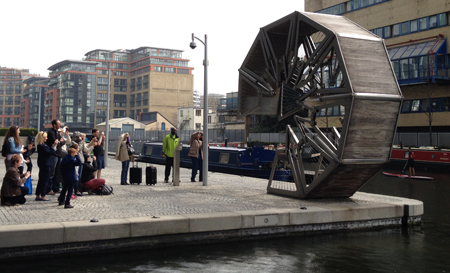
Unusually, the brief called for a piece of architecture that would provide a focal point to an area of waterfront public space and that would be required to be opened at least once a week. The basin is also home to the Rolling Bridge designed by Heatherwick Studio, which is routinely opened every Friday lunchtime and the new bridge creates a pair of structures that are conceived as a distinctive piece of visual theatre (see box below).
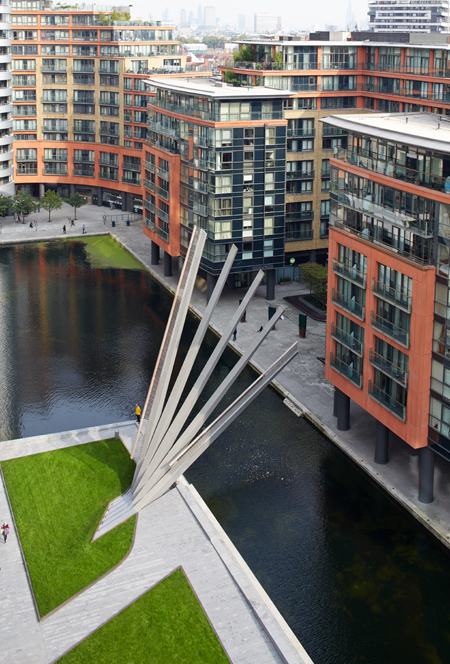
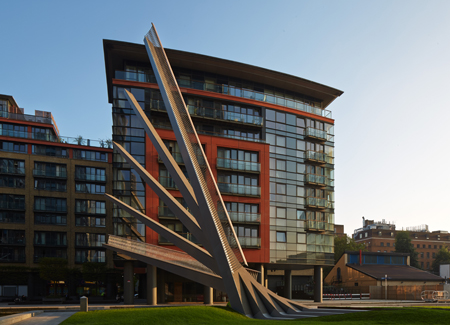
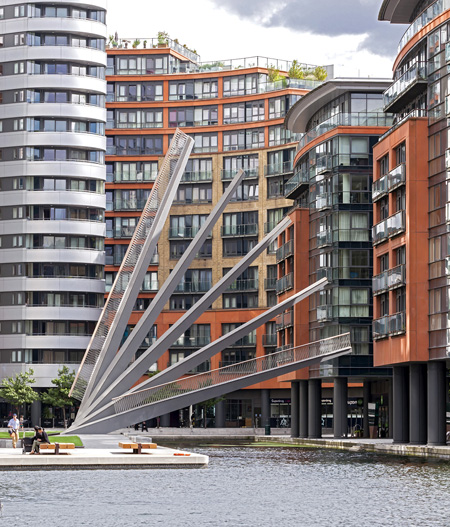
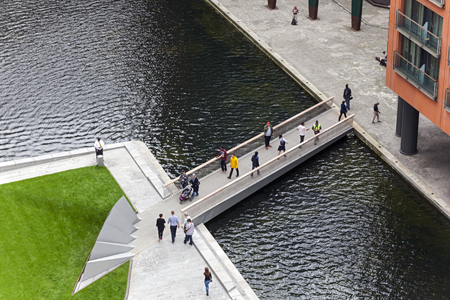
The design concept of the new bridge is both simple and spectacular: a 3m-wide cantilevering deck is hinged at its north end and is raised using hydraulic jacks to create an opening action similar to that of a traditional Japanese hand fan. The aim was to create an elegant, innovative design using proven technologies, resulting in a structure that would have a positive impact on its location and bring connectivity, identity and delight. The design has been considered in respect to the high-quality architecture and landscape of the basin, and from elevated as well as ground level viewpoints.
Photo: Edmund Sumner
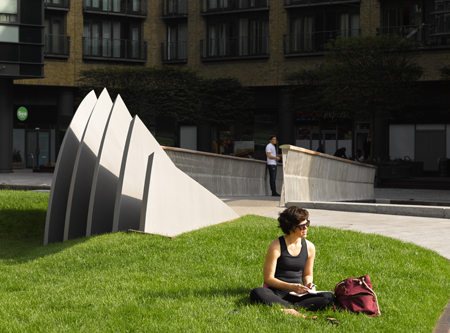
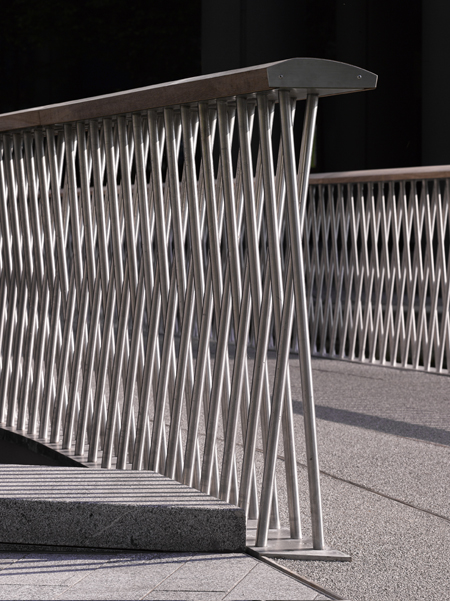
The five steel beams forming the deck open in sequence with the first rising to an angle of 70° and the last achieving the required clearance over the canal of 2.5m tall by 5.5m wide at mid-channel. Shaped counterweights assist the hydraulic mechanism and reduce the energy required to move the structure. The bridge balustrades are formed from twin rows of inclined stainless steel rods, overlapping to form a robust yet filigree and highly-transparent structure. The handrail houses a continuous low energy LED downlight which is designed to provide excellent and uniform functional illumination of the walking surface and the edge, as well as creating an attractive lighting feature.
As well as the axial alignment of the crossing, the other aspect of the brief which inspired the team was the opportunity for the bridge to provide drama in its movement. The relatively modest span suggested that only vertical movement could offer the drama sought in the brief, certainly when compared to a slewing or swing bridge. The team considered that movement in the horizontal plane would not be interesting – no more so than a 20m narrowboat turning in the canal – but in contrast, how much more exciting it would be if a 20m narrowboat were to be raised upright! The team discounted unproven or ‘whacky’ modes of operation such as rolling, twisting, folding and so on for reasons of reliability and maintenance.
This arrangement also suited constraints on land ownership which dictated the bridge structure should be supported primarily from the north end, with only limited support provided on the south bank. Simplifying maintenance was a key driver and, by dividing the beam into five discrete ‘fingers’, the duty on the hydraulics required to raise the beam is significantly reduced bringing the technology down to the scale of components routinely found on tipper vehicles and other site plant, with a corresponding familiarity and availability for maintenance operatives.
While seemingly simple and straightforward, the design of the bridge is the result of a complex form-finding process which optimises multiple interwoven geometric, structural and other technical parameters producing a lean, efficient and cost-effective outcome. These processes adopt genetic algorithms capable of optimising plate thicknesses; positions of the pivots, rams and bearing supports; sizes, weights and shapes of counterweights within the extremely tight geometric constraints defined by the high water tide and the predefined levels of the north and south banks.
Designing a structure which consists of five independently moving elements, similar in appearance while not identical, using the classic linear sketch-to-CAD-to-FEM workflow would be highly inefficient. The number of parameters affecting each other, including counterweight size, lever-arm, vertical pitch, stroke length of hydraulic rams, pivot location and so on, required a highly integrated approach, where structure, function and aesthethics could be developed and quickly tested in iterative steps on a single model.
In order to achieve this, the entire bridge geometry was developed and detailed in 3D, using the popular 3D modelling software Rhinoceros, which is not only accurate at developing complex three-dimensional shapes, but also supports a wide variety of file types, making it easy to export the geometry for further analysis in programs such as Ansys or Sofistik.
The open-source Rhino plug-in Grasshopper, which is a parametric design development tool, also known as a visual programming language, was used to optimise the design. This was implemented by describing a set of rules that would define the bridge’s geometry and then varying a set of parameters to achieve the pursued balance between visual quality and structural efficiency.
As an example, there was a non-linear relationship between the counterweight radius and its tonnage having a direct influence on the location of the centre of gravity, which always had to be on the cantilever side, keeping the hydraulic rams in compression. This dependency could be varied by either changing the counterweight radius, affecting its visible height above ground, or by changing the location of the pivot which would have an impact on the bridge appearance in an open position.
As both AKT II and Knight Architects work with Rhino and Grasshopper on a daily basis, this core step of the design process was actually the most straightforward and enjoyable one, as it allowed fast and hassle-free coordination of the geometry and therefore a quickly-paced transition from concept to final design.
The design of the footbridge structure relied very much on the fabricator’s ability to manufacture the five ‘fingers’ to exacting tolerances. In their lowered position, the five slender steel fingers must effectively create a flat, almost seamless walking surface. This put a lot of responsibility on the fabricator assembling the structure and required a high degree of skill. The fabrication and installation of the footbridge was carried out by specialist fabricator SH Structures.
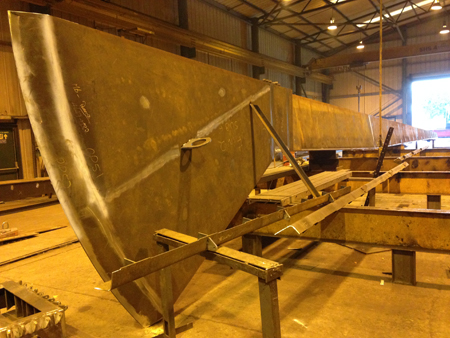
The five fingers were set up in bespoke jigs which were used to control the critical dimensions and limit distortion caused by the welding process. Each finger also has a sculpted blade at one end which not only contains the ballast needed to balance the bridge but also forms a vital component in the overall aesthetics of the bridge. Each blade tip was formed from profiled pressed plate which was carefully puddle-welded onto the internal stiffeners. The finished welds were ground flush to give a sharp seamless finish to the blades.
The fabricated steel beams had a high-quality painted finish applied to provide a highly durable protective coating. The top surface of the beams are finished in a similarly durable epoxy and aggregate non-slip finish which has been proven in aggressive environments and on lifting bridges including the Gateshead Millennium Bridge. The fine, hard-wearing natural stone aggregate was selected to match the high quality palette of finishes used elsewhere in the Merchant Square landscape. The counterweights are formed from fabricated flat steel plates and the finish on the sculpted counterweights is a painted version to match that of the beams. Alternative materials including aluminium and stainless steel were considered for the primary structural members however these could not provide either the necessary structural performance or a cost-effective alternative to conventional steel.
Photo: Edmund Sumner
Each of the five beams forming the bridge is activated by a relatively small double-acting hydraulic cylinder driven from a single power pack in the basement of the adjoining building. At around 6t and slender in shape, each beam is a modest weight and experiences little windage, so the size of mechanism and power requirements are relatively low and the counterweights have been sized to aid the system while ensuring the bridge can always be closed under gravity. This type of basic mechanism is robust, proven and easy to operate and maintain.
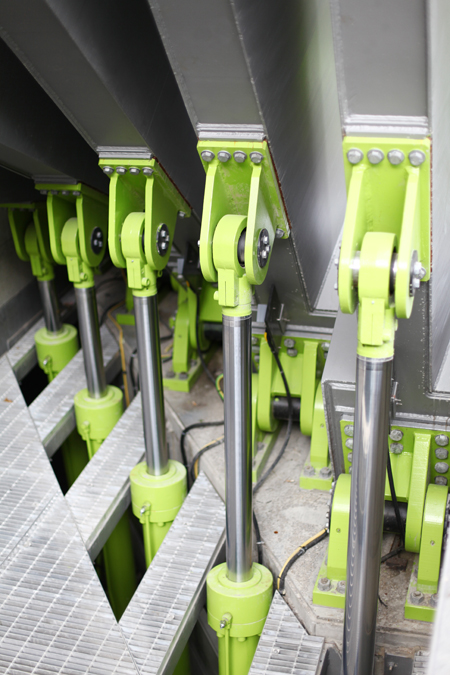
The hydraulic cylinders and rotational bearings are housed in a concrete structure below ground level, protected from the canal water by a drained sump, and connected to the power pack by hydraulic pipework. Although the length of the pipework has been minimised to reduce the cost of hydraulic oil, there is benefit in positioning the power pack in the basement of the neighbouring building where it can be readily accessed for maintenance and is well protected. Access to the hydraulic cylinders can be gained without closing the bridge to pedestrians and the bridge beams can be raised to provide ready access for inspection, cleaning and maintenance.
The power requirements of the electrical and hydraulic systems were determined by the load to be lifted, which is effectively reduced by the counterweights, and by the required opening time, which does not need to be very rapid and therefore allowed a cost-effective solution. There are savings too in terms of the supporting structure, which does not need to be designed for high braking loads in case of an emergency stop condition.
Fabrication of the steel superstructure and mechanical, hydraulic and electrical components began early in 2014 and construction began with site clearance. The head of the canal basin was drained to allow access for other parts of the development and the bridge works took advantage of this for both the basement excavation and the installation of the beams. Both activities benefitted from improved access and safety.
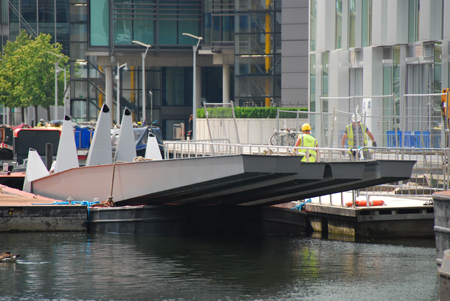
Instead of delivering the structure direct to the site and lifting it into place with a mobile crane, which would be the conventional manner of installation, the bridge fingers had to be delivered to a wharf upstream where they could be loaded onto a barge to be towed to the site using a canal tug. A great deal of care and attention was put into this aspect of the site installation with the team having to load the delivery barge with the fingers in a certain sequence to ensure the barge would pass under the various structures on the way to site. The built-up nature of the surrounding development and the poor ground conditions immediately next to the canal meant that the fingers had to be lifted into place with a barge mounted Hiab-type crane. Ingenuity and efficiency were combined with the modular nature of the design to great effect in the installation.
Bartlomiej Halaczek is an associate at Knight Architects; Daniel Bosia is director of AKT II Consulting Engineers and Michael Thorogood is director of Eadon Consulting
Team:
Client: European Land & Property Limited
Architect: Knight Architects
Structural engineer: AKT II
Mechanical, hydraulic & electrical engineer: Eadon Consulting
Contractor: Mace
Steel fabricator: SH Structures
Landscape design: Townshend Landscape Design
Lighting design: Studio Fractal
Eye witness
It’s just after 11am on a Friday when we emerge from the Underground at Paddington Station in west London and weave our way through the slightly shabby rear of the train station, following the signs to Paddington Basin. We’re here to see something that I’ve been wanting to witness for a decade; however just a few months ago, the need to get organised and make the trip became doubly compelling.
The basin has been home to the famous ‘Rolling Bridge’ designed by Thomas Heatherwick and SKM Anthony Hunt since 2005, but last year it was joined by a new movable bridge, designed by Knight Architects and AKT II, which seems destined to achieve the same giddy heights of fame.
The once-weekly planned opening of the Rolling Bridge that has been taking place on a Friday since the bridge was built is now followed by the opening of the new bridge, and takes place three times a week due to popular demand. We seek out the two bridges, tucked between shiny new office buildings, and give them a cursory inspection to establish the physical relationship between them.
There’s some confusion about which will open first, a question that can’t be resolved by the security guards milling around the private land who seem as clueless as us. We’re worried we might wait by the wrong one and be reduced to sprinting along the basin so as not to miss the action. But there are other people hovering around and we start to realise that we’re not the only folk for whom bridge-watching is considered an acceptable pastime. When we see a young chap kneeling intently on the middle of Rolling Bridge and taking multiple photos of the finish on the deck, we realise that there are degrees of obsession to which we are not party.
Just before midday a man in a high-vis jacket, with a large key hanging from his hand, emerges from one of the buildings and strolls casually towards the Rolling Bridge. A considerable crowd gathers and there is a palpable air of expectation as the bridge begins its slow lifting and curling motion.
The staff are clearly used to the reactions of the public at the weekly event, and when the structure reaches full circle, they pause respectfully to allow everyone time to have their photos taken in front of the curled up bridge. Once the bridge is unfurled, we saunter in a loose grouping along the waterfront to the new Merchants Bridge and take our positions.
Most people choose to view the operation from the landscaped side, where the beautiful sculpted counterweights – each stylishly engraved with its individual weight – emerge from the ground like a row of smooth teeth. I stand on the other side, somewhat fearful I may not be able to stop myself reaching out to touch the smooth edges of the counterweights as they slowly withdraw below ground.
With the bridge at full height, its splayed-out form looking so much taller than its 20m length, the same series of photocalls is played out on the opposite bank. A couple of children pose awkwardly for their mum and two young women take pictures of each other throwing crazy shapes and gurning in front of it. We’re all drawn together by a real sense of fun, occasion and drama that only subsides as the fingers of the bridge touch down again and the rearing spectacle transforms back into a mild-mannered footbridge.
Helena Russell