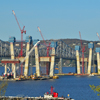
Freyssinet has been working in Kosovo since September 2000, its first job being as general contractor for the rebuilding of the Mitrovica Bridge - a project that was as significant culturally as it was structurally. The bridge connects the two halves of Mitrovica town, which lies on the border between Kosovo and Serbia. The town has a Kosovan population on the south bank of the river and a Serbian population on the north bank, hence when work first started, the purpose of the bridge was to try and reunite the two warring communities as well as creating a new landmark for the area.
Since that first project, Freyssinet has had a continuous presence in Kosovo, and has worked on more than 20 bridge projects of varying sizes and scope, ranging from strengthening of short, single-span road crossings to the construction of the new 150m-long Kacanik Bridge which is currently under way.
Garin explains that the award of the first contract had more to do with Freyssinet's willingness to work in Kosovo than the standard tendering and contract award procedure. The Mitrovica Bridge rebuilding project was funded by the French Development Agency (AFD) and although Freyssinet rarely works as a main contractor, it was the only company that would take on the job. The design was carried out by French consultant BCEOM, part of the Egis Group, and architect Eric Grenier of Arscenes who designed the lighting of the structure.
At the time, the situation in Kosovo was very complex - the country was being run by the United Nations Mission in Kosovo; nine bridges on major routes had been destroyed, the remaining roads and bridges were unable to cope with military convoys, and there were checkpoints throughout the area. No local contractors had the ability to rebuild bridges and roads, and there were limited construction materials and equipment available. Neighbouring regions such as Macedonia were still engaged in combat, limiting even further the options for sourcing materials and labour, and thousands of houses had been destroyed. What's more, there was no ministry responsible for administration of roads and infrastructure.
"We are not really a main contractor," says Garin, "but there were no Kosovan contractors who could do the work - most of the engineering contractors were based in Serbia - so we decided to get involved by offering turnkey solutions."
The Mitrovica Bridge was probably the most difficult of all the projects that Freyssinet has worked on in the region - it effectively involved rebuilding the bridge in a military zone. From the start, the commitment to try and reunite the two communities was central to the project - the aim was to not only develop the rather unassuming structure into a landmark for the city, but also use it as a way of encouraging peaceful interaction between the two sides.
Freyssinet was committed to recruiting labourers from both sides of the town, and employed the same number from each community. To begin with, says Garin, each group worked from its own side of the river, with the French army in between, on the middle of the bridge. But then the contractor began mixing the groups, picking out a handful of men from each side and getting them to work on the opposite end of the bridge.
This seemed to be successful, he recalls, so much so that at the end of contract, despite one or two difficult situations along the way, the two groups were working happily together.
The refurbished bridge was designed with dramatic lighting, and included overlooks where locals could gather to chat and mingle - in the region, this is an important part of a bridge's purpose. Sadly, however, it seems that the ethnic divide has opened up once again in the years since the bridge was reopened - when Bd&e visited the site in April, the engineers were dismayed to find it closed off once again, with army checkpoints at each end, tanks parked across the middle, and notices forbidding pedestrians from lingering on the bridge.
Nonetheless, the completion of this first project led to a succession of other contracts, including six-month contracts to demolish and rebuild a number of small concrete structures, and a larger contract at Rakovina, where two bridges, over a railway line and a river, were rebuilt using precast units.
Two military bridges which were in use at the site had to be removed so that the new bridge could be built on the same alignment, so there was no vehicle access for the duration of the construction. But the children on one side of the river still had to cross it to attend school on the other side, so part of the contract included the construction of a small wooden footbridge for this purpose.
The construction procedure on this bridge was driven by the availability of lifting equipment in the country, Garin says. The biggest crane that could be hired was a 100t capacity crane, so the main span had to be cast in two pieces, erected on a temporary support and glued then prestressed together, rather than being erected as a single span.
Work on this project was also limited by the lack of materials available. "The only thing that we could find was concrete," he says, "and that was from an Italian company which was based nearby." Everything else had to be imported, which meant that Freyssinet had to keep its requirements to the minimum, and do as much as possible using old-fashioned methods.
"This was a very dangerous and difficult contract," Garin continues, "we had to have guards on the site day and night, but we had good cooperation from the police."
Currently under construction at the moment is the Kacanik Bridge, which will provide a new crossing of the river and railway line for the main road that connects Pristina to the Macedonian capital of Skopje. Located in the southern, mountainous region of Kosovo, the previous bridge was originally scheduled for repair. Under further investigation, however, it turned out that one of the piers of the bridge had not been built properly, and the foundations of another were moving, so the decision was taken to demolish the bridge and build a new one on the same alignment.
Garin explains that the demolition of the bridge was part of Freyssinet's contract, but KFOR, the Nato Kosovo Force was pleased to take on the demolition by use of dynamite. In fact, the removal of the bridge became quite an event, with locals, journalists and officials lining the surrounding mountain sides to see the structure blown up.
Two temporary access bridges currently carry the road traffic across the river, while construction of the new prestressed concrete bridge takes place in the remaining space. Freyssinet has a one-year contract to design and build the structure, in a project funded by the European Agency for Reconstruction in collaboration with KFOR and the Kosovo Ministry of Public Works. Reconstruction of five bridges on the same route and the repair of seven others form part of the overall project. Work on the Kacanik Bridge started in February last year and is expected to be completed in the next few months. Consultant BCEOM, which was involved in the Mitrovica Bridge, is also designer for the Kacanik Bridge.
Once the demolition had been carried out and the site cleared, one of the early problems of the construction,