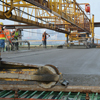

Engineers building a new bridge over the Volga River in Ulyanovsk in Russia came up with some interesting solutions for lifting in the main spans. Vladimir Guryanov, Aleksandr Dankovtsev, Stanislav Pshenichnikov and Valeriy Kotov report
The story of the building of a new bridge over the Volga River in Ulyanovsk is an epic tale; design of the crossing was developed by consultant Giprotransmost from 1985 to 1987. Completion of the first pier of the almost 6km-long bridge took place twenty years ago, and the first superstructure span was erected by contracting subdivisions of construction directorate Ulyanovskmostostroy in 1992. Work on the bridge is still continuing under a new contractor, but significant progress has now been made with 20 of the 23 spans now installed, and completion due next year.
The new bridge over the Volga River forms part of a 13km-long connection between the industrial cities of Kineshma and Zavolzhsk, which is intended to replace the existing ferry and is being built at an estimated cost of US$800 million. It will carry road and rail in a double-deck configuration with the road on the top and the rail on the bottom level of a steel truss deck.
On each side of the river is a series of transition spans, which will enable the rail carriages to be directed to the lower chord of the bridge for the river crossing; these consists of spans of maximum 66m length and more typically 36m or 45m. The main river crossing itself has spans of up to 221m length, the steel double-deck truss supported on pairs of concrete piers. Approach embankments of 7km length are also included in the project.
Although construction work first began in 1988, it was stopped in 1994 because of a lack of money, and the project was dormant for four years. An improvement of economic conditions in Russia allowed construction activity to resume in 1998, since when the pace of construction has increased from year to year.
Superstructure of the main part of the bridge, over the navigable waterway consists of steel double-decked triangular trusses without verticals or hangers, most of which are 220m long and 12m high, weigh 4,400t and are made up of two flat trusses spaced 13m apart. Both the four-lane highway deck on top of the truss and the two-track railway deck on the bottom chord of the truss are steel plate decks, which are integral with the respective chords of the main trusses. As each pair is erected on the piers, they are connected to form a continuous two-span superstructure unit with 2x220m configuration.
On the left-bank portion of the bridge, where the piers are relatively low, these units were assembled on the bank, then rolled out onto the dock, transported to the bridge alignment by two floating towers and raised on to the piers.
The floating towers consist of flat-top barges built of steel box KS pontoons, and each has a 10m-high falsework tower built on top. However, the considerable in-crease in the height of the piers from number three to number nine made this man-ner of segment erection impossible on the higher spans.
From pier three and to pier nine on the right-bank portion of the bridge, the pier height increases up to 60m, accompanied by an increase in the river depth of up to 20m. Under these conditions it was initially assumed that erection of superstructure would be carried out by cantilever assembly, using a temporary support at mid-span.
At the same time, several other options were considered, including the possibility of floating the superstructure to the site at low level and erecting it on to the unfinished piers. Concreting would then continue with the piers being raised incrementally after each consecutive lift of the truss. Another suggestion was to float the segments from the assembly area to the piers using a gigantic floating tower up to 60m high.
Another option was put forward - to raise the segments with a so-called truss-lift. This consists of two large, robust frames in the form of portals which would be positioned at the ends of the truss. Each end of the superstructure element to be erected would rest on a horizontal support beam which was in turn suspended on two heavy-duty steel perforated straps hanging vertically from the upper cross-beam of the portal, with the support beam fixed to the steel straps with interchangeable pins. The load would be moved incrementally by two batteries of hydraulic jacks installed vertically between the support beam and another beam parallel to the former and hanging beneath it on the same perforated steel straps. The operation would require huge cribwork and a lot of other expensive, time-consuming devices which at the time were considered insufficiently reliable.
By 2006, with the bridge still not finished, contractor Volgomost was charged to work with BSK Company and complete the bridge within three years. This was within the framework of a federal programme intended to see completion of some of the country's important bridges whose construction was running late.
The first step was to evaluate the design documentation that had been developed and the condition of the engineering facilities and erection equipment available to the contractors - this process underlined the fact that the task could not be accom-plished by the methods proposed. All of them were regarded as too time-consuming, unreliable or expensive.
Instead, Volgomost engineers found a solution and developed a new technological facility that incorporated some of the original technology systems, with unique erection arrangements and combined with reliable equipment from leading manufacturers.
In the process of developing the technology, three original solutions were developed that became subject to patents. A contract was signed with specialist subcontractor Freyssinet for lease of hydraulic equipment and for technical assistance during superstructure erection. Monitoring systems were also developed to control the stresses in auxiliary structures and the position of the superstructure segments during erection operation.
The process that was developed begins with the assembly of the superstructure segments one by one at the building site, from where they are rolled out to the landing dock, loaded onto floating supports and transported to the bridge alignment while still in the low level position. In order to minimise the shift between axes of the bridge and the segment to be erected, a portion of truss on the end panel element of each unit is omitted. This makes it possible to position the segment be-tween the piers in such a way that one of the pier columns is in the space between the main trusses of the segment; this is referred to as the 'fork' position.
An erection bracket is installed on top of the two columns of both piers - this is a two-legged cantilever frame with its legs located close to the bearing pedestal on each column. Two platforms are placed on the transverse beam of the bracket, along which they can move, propelled by horizontal hydraulic jacks. A battery of strand jacks is mounted on each platform and the lower ends of the high-strength strands are fixed to the segment brought on the floating support; the upper ends are guided through the pistons of the strand-jacks, which have a system of grips and anchors that alternately clamp the strand and release it. Assembly and installation of the erection bracket are performed by a tower crane KB-676 with 25t lifting capacity. All hydraulic equipment together with operating personnel has been supplied according to the terms of the lease agreement with Swiss company Hebetec, which is part of the Freyssinet company.
Each of the four corners of the segment is lifted using a battery of four strand jacks with lifting capacity of 400t eac