The Lille Langebro swing bridge opened to the public in June, making a new connection across Copenhagen’s Inner Harbour from the city centre to the historic Christianshavn, a traditional merchants’ neighbourhood set within 17th-century fortifications. The bridge’s name, translated as ‘Little Long Bridge’, differentiates it from the adjacent Langebro (‘Long Bridge’), which is one of the city’s key traffic arteries. Concern for the safety of the 10,000 cyclists crossing the larger bridge every day led to the commission of a dedicated cycle and pedestrian bridge alongside. It is estimated that up to 3,000 cyclists will use the new bridge every day, in a city where bicycles outstrip cars in number.
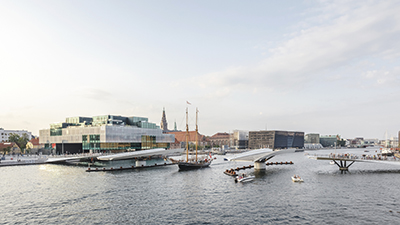
Curving decks swing out to provide a 35m-wide navigation channel (Rasmus Hjortshøj)
The elegant new design enhances the waterfront and confirms Copenhagen’s reputation as the world’s best city for walking and cycling. The commission was won in a competition for Danish client Realdania By & Byg, which will subsequently gift the bridge to the municipality of Copenhagen. It connects Vester Voldgade and the City Hall to the harbour and onward across the water to Christianshavn in an elegant curve. The 160m-long structure was a collaboration between Buro Happold, Wilkinson Eyre and Eadon Consulting. Realdania is a philanthropic association that supports projects large and small with the mission to create quality of life through the built environment.
Three key ideas characterise the design concept: First, the bridge follows an elegant curve in plan that aligns with – and continues – the sweeping ramparts and moat of the historic Christianshavn. Second, the structure is arranged as a triangular wing on either side of the bridge that dips below the deck at the abutments then gradually soars up at mid-span in a sinuous curve, before falling again. These wings give the bridge a clear but subtle line where light meets shade. Lastly, the curved bridge profile affords a surprising visual spectacle when the two swinging sections open for marine traffic.
The structure is higher at mid-span than at the quaysides to allow for the required 5.4m navigation clearance for boats. The curved alignment and raised wings enable a gradual revelation of the surroundings through modulated views. Split into five spans, with two 37m-long approaches either side of the 85m-long main section, Lille Langebro has a minimum clear deck width of 7m, split into a 3m pedestrian path and a 4m cycleway subdivided into two lanes. From an engineering point of view, the bridge design incorporates a number of innovative features that also presented challenges.
The bridge structure consists of main longitudinal edge members formed from triangular box sections. As the plates forming these boxes incorporate double curvature due to the complex geometry, the structural design of the boxes and their internal stiffness were heavily influenced by the practicalities of fabrication. An orthotropic deck spans between the outer members. The longitudinal stiffeners follow the sweeping path of the bridge, adding interest through view of the soffits as well as demonstrating the attention to detail that gives the bridge its finished quality.
In order to maintain a slender profile in elevation, a moment connection was designed to connect the moving parts at mid-span. This connection clamps the sections together but is released to allow longitudinal movements arising from temperature. The clamping action means the bridge is much stiffer and less prone to deflections and vibrations than if it were simply pinned in the middle.
The structural analysis was undertaken parametrically using scripting to generate the model geometry. Highly aware of the problems that can arise with locking swing bridges as a result of thermal movement, the team carried out an extensive investigation of the bridge’s behaviour. This involved a shading study and the application of pattern loading in order to predict the displacements that would occur at different times of the day and of the year. Tolerances in the connections and joints could then be accurately determined. The four bridge piers were formed within cofferdams and founded on limestone. Made of concrete, they are robust enough to resist high ice loads. A secondary vessel-collision protection system at either side of the 35m-wide navigation channel safeguards the bridge from ships.
Architectural considerations meant that it was important to conceal the bridge mechanism as far as possible. The motors and slewing ring are housed within the hollow bridge piers; hydraulic power units are housed in cavities inside the outer deck members. Enlarged chambers adjacent to the moment connection house the hydraulic rams and associated mechanical parts.
The four bridge sections were entirely prefabricated and assembled upside down in the workshop before being turned over. After delivery to site by sea, they were erected using a large capacity shear leg crane. The primary steelwork was painted a uniform off-white, highlighting its curved form and catching the changing light reflected from the water. The piers are dark grey to minimise their visual impact, further enhancing the flowing lines of the bridge. Other materials were selected for their robustness; the parapet is fabricated from brushed stainless steel, with a lightweight stainless-steel mesh infill for transparency. Concealed lighting in the handrails illuminates both deck and wings, creating a twisting ribbon of light between the abutments.
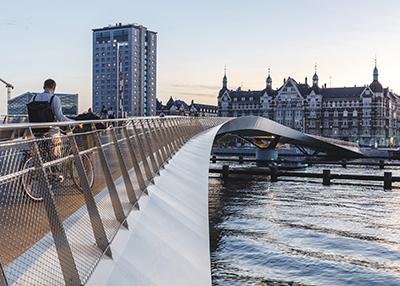
Concealed lighting creates a twisting ribbon of light between abutments (Rasmus Hjortshøj)
Each of the two moving spans are mounted on a large-diameter slewing ring driven by multiple electric motors. The motors are sized so that there is redundancy, hence if a drive unit fails, the bridge can continue to operate on the remaining motors. The bridge is controlled from the existing Langebro road bridge control tower, with an excellent direct line of sight and supplementary visibility provided by CCTV.
Wheels and sockets at the ends of the moving span align the decks as they return to the closed position. Deck flaps cover the joints between the moving and static spans and accommodate thermal expansion and contraction. Shock absorbers at the ends of the deck and the joint between the two moving spans bring the bridge to a gentle stop at the fully closed position. The core area of moving bridge innovation on the project was the development of the moment connection between the two moving spans. This was required to enable the decks to be slender and achieve the intended architectural form. Traditionally, large locking pins are used to carry moment; however, the client had previously experienced these becoming stuck. To overcome the issue of jamming, a new mechanism was developed to enable moment to be carried across the joint whilst also permitting thermal expansion and contraction.
The solution developed for each of the two structural beams uses two core elements, each driven by a hydraulic cylinder. The upper mechanism generates compression, the lower one generates tension. When the structure returns to the closed position at the end of each bridge operation, a compressive preload is applied at the top of the beam, while a tensile preload is applied towards the bottom. The hydraulic cylinders driving the mechanisms are then hydraulically connected so that as the bridge expands and contracts the cylinders ‘breathe’ with the bridge, and the preload remains relatively constant. As live load is applied, the preload increases, via an increase in hydraulic pressure, and hence so does the moment capacity. The hydraulic system is passive in that the hydraulic pumps are turned off once the preload is applied. The pressure within the moment connection is monitored and is automatically topped up if the preload drops below a predetermined value.
The bridge is designed to operate up to 200 times per year, with a maximum frequency of once per hour and in wind speeds up to 20m per second.
Simon Fryer is technical director at Buro Happold, Simon Roberts is associate director at Wilkinson Eyre, and Michael Thorogood is director and senior design engineer at Eadon Consulting