Much of the infrastructure created by engineer Isambard Kingdom Brunel continues to endure and serves an important role in the UK transportation network. But even Brunel, with his visionary qualities, would never have been able to predict the traffic loading his structures would need to support more than a century later.
In the case of world-famous landmarks such as the Clifton Suspension Bridge, traffic is regulated. It would be neither practical nor possible to adapt the bridge to carry modern traffic loading. However, in other cases the need to adapt a structure outweighs the historic context of Brunel’s work, and no doubt he would have approved of this, considering he approached his trade as an engineer, not an artist. He was not precious about his work being preserved.
The Loughor railway viaduct in South Wales is one such example where modern demands have taken precedence over historic context. The viaduct forms part of an 8km-long section of the West Wales Line crossing the Loughor Estuary between Swansea and Llanelli. Since 1986 it has been single track, creating something of a bottleneck.
A US$72 million project funded jointly by Network Rail and the Welsh Government in partnership with South West Wales Integrated Transport Consortium to redouble this section of line included plans for a replacement viaduct. The original timber structure was assessed and was found to be both incapable of carrying the weight of two trains and so close to reaching the end of its useful life that that speed restrictions had had to be put in place.
The original 220m long, eight-span timber viaduct – an example of Brunel’s once numerous timber viaducts – was completed in 1852. Over the years it had received substantial attention and strengthening works, including two rebuilds and refurbishment, the most recent being in the early 1980s.
Network Rail and its contractor Carillion were faced with only one realistic solution; to replace the entire structure on the current track alignment. However, such an undertaking would need to address several limiting factors that would impact on design and installation – mainly the sensitive local ecology, and the tight 250-hour line possession, the most Network Rail could provide for installation to take place.
Engineers also had to consider the challenging location on the fast-flowing river estuary with its extremely high 8m tidal range. The Severn Estuary, into which the Loughor River flows, has the second highest tidal range in the world. Loughor Estuary is a designated conservation area and the viaduct site is situation within and adjacent to several sites which are designated as important for nature conservation at European level.
These include the Carmarthen Bay & Estuaries Special Area of Conservation which was designated in 2004 for the presence of important habitats, various Sites of Special Scientific Interest, and Ramsar wetlands. Consequently, several months of intense consultation were undertaken with the Environment Agency for Wales, the Marine Consents Unit and the environmental departments of local councils during which the sensitivity issues of the area concerned were addressed.
The surrounding area was also designated as a Special Protection Area as it is an important wildfowl overwintering site, regularly supporting more than 20,000 birds. Mitigation measures were taken to minimise disruption by carrying out works such as piling for the foundations of the new structure outside the winter period between November and February. This reduced the potential for any significant impact on bird migration.
To ensure installation could be achieved within the 250-hour line possession, the majority of the construction had to be carried out in advance to enable the switch over to the new viaduct during the shut-down period. In total this process entailed demolition of the existing viaduct, construction of new abutments and piles, installation of the new viaduct, and completion of the permanent way works to connect to the track on the original alignment.
To add a further complication, the east and west abutments of the original viaduct have statutory protection, so Listed Building consent was also required. Bridge specialist Mabey Bridge was invited to a series of planning and design meetings with main contractor Carillion and consulting engineer Tony Gee & Partners to discuss a specification for a steelwork solution that would satisfy the requirements for a robust replacement viaduct capable of pre-assembly and rapid installation.Discussions covered design of the launching nose and tail, splice design, positioning and launch-and-slide installation.
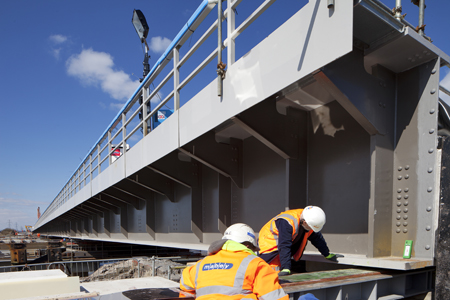
Mabey Bridge had a particular empathy with this project as the firm was initially established in 1849 to assist with the design and construction of Brunel’s Wye Valley Railway bridge. The replacement viaduct was designed as a 236m-long, 1,200t structural steelwork and concrete deck construction with footways, which was supported on twelve permanent piers placed 36m apart. The new piers were designed as 1.2m diameter permanent steel cased piles, and six temporary piles were designed to enable the new bridge to be launched along the north side of the original viaduct while the latter was being demolished.
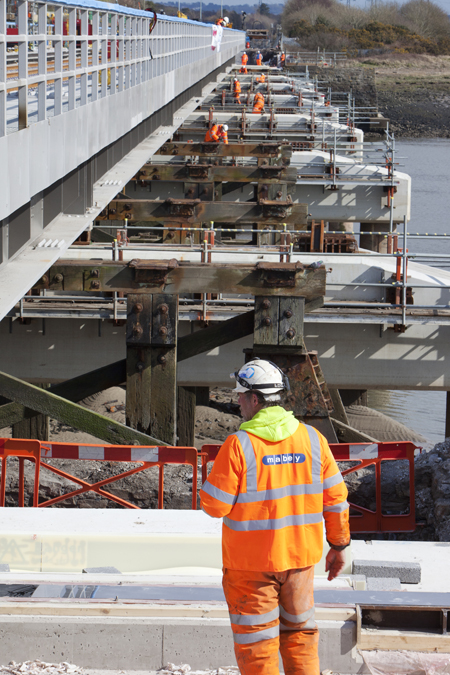
A three-month programme of fabrication of the structural steelwork and footways began. As well as fabrication and protective treatment, Mabey Bridge was contracted to oversee the site assembly of the viaduct, including supply of temporary pier cross-beams, the launch of the new structure in four phases, and the final slide into position. With such a tight time frame to work to, the plan was to construct the new river substructure adjacent to and just below the existing live railway crossing whilst the new viaduct was being launched and constructed alongside. Seventeen timber trestles supported the original deck of the viaduct and these were planned to be replaced by the 12 permanent 1.2m-diameter piles. Meanwhile, the six temporary piers would be installed next to the existing viaduct to allow for launch of the new structure prior to sliding into place.
Both the permanent and temporary piles were constructed from piling rigs and cranes on two jack-up barges in the estuary. The finished steelwork was transported from Mabey Bridge to site by road in 24m-long girder sections. The girders were assembled in a lay-down area on the west side of the estuary into four units, one for each of the launch phases.
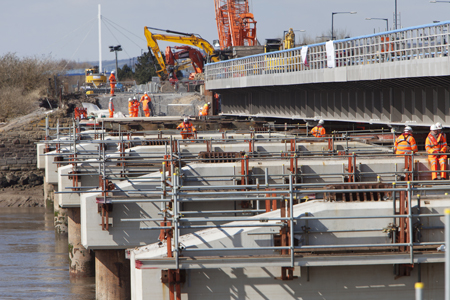
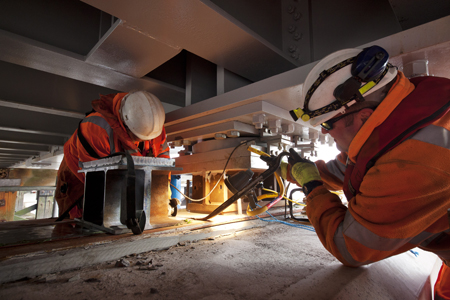
Following the assembly the structure was launched over the river onto the six temporary piers in four stages. After the launch was finished, the steelwork was jacked down onto its permanent bearings. The deck was then concreted, waterproofed, ballasted and the tracks laid in place.
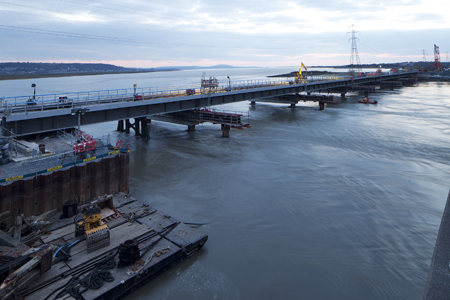
In total it took 250 hours to remove the original viaduct structure and to slide in the new deck with track before handing over to the local team for commissioning. Some 220m of old deck was removed over 67 hours using cranes and barges to cut and lift out redundant materials, and it took 14 hours to slide the new structure into position along the temporary and permanent crossheads.
This impressive task was carried out b