Materials known as shape memory alloys have been around for several decades and are used in many different industries for a whole variety of applications. But a new type has now been developed specifically for use in civil engineering, in particular in the bridge industry.
There are several different types of shape memory alloy; the most common is a nickel titanium alloy which is used in medical applications and has been around for more than fifty years. They also have different types of behaviour – either deforming elastically, or deforming plastically with the capability of returning to their original shape when heat is applied to them.
It is this second characteristic that is of interest to researchers at the Swiss research establishment Empa, as it has the potential to offer an alternative to the traditional technique for prestressing concrete. Although prestressing is widely-used and well-understood technique, it has a number of drawbacks.
Ducts need to be positioned within the structure into which tendons are installed. Large jacks are needed to prestress the tendons and often access to the ends of the tendons can be at height or in an awkward location, making the practicalities onerous.
A shape memory alloy would eliminate the need for these jacks – the simple application of electricity is all that is needed to prompt the material to return to its original form. The procedure starts with the alloy bars being stretched to the appropriate length, and then embedded into the concrete in the same way as reinforcement.
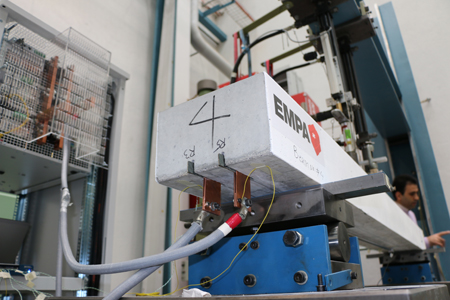
Once the concrete was cured, electricity could be used to heat the material – simply by applying an electrical supply through a wire at each end – and the alloy would attempt to return to its original shape, inducing prestressing in the concrete around it.
Until recently, however, the theoretical solution has been held back in practice because there was no shape memory alloy that was suitable for use in this way. Alloys such as nickel titanium are not suitable for use in the large quantities required in the construction industry.
But the iron-based alloys that were considered much more suitable had a major drawback – they had to be heated up to around 400°C to prompt the change in shape, and this would be detrimental to the concrete or mortar into which they were embedded.
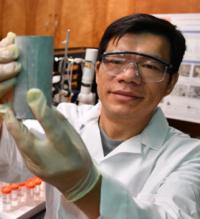
Empa researchers led by Christian Leinenbach of the Joining Technology & Corrosion Laboratory have developed a novel iron-manganese-silicon alloy which is activated at just 160°C, a temperature much more suitable for use with concrete. The material science researchers ‘designed’ a range of virtual alloys using thermodynamic simulations, and then selected the most promising combinations. These were manufactured in the laboratory and their shape memory characteristics tested.
Several of the new materials met the requirements set by the construction engineers, an important milestone on the path to providing economic shape memory steel alloys for industrial applications – in other words, manufacturing them by the ton.
Christoph Czaderski, of Empa's Engineering Structures Laboratory, believes that iron-based SMA materials have a promising future in the building industry since the process of prestressing is simpler and cheaper than conventional techniques. In addition they may allow engineers to create prestressed structures which are impossible or very difficult to achieve using conventional techniques. These include the use of short fibre concrete, near-surface mounted laminates, column wrapping and ribbed armouring steel.
A feasibility study funded by the Commission for Technology & Innovation recently showed that it is possible to produce the new alloys on an industrial scale, not just a few kilogrammes for laboratory use. The manufacturing process has been developed in collaboration with Leoben University in Austria, the Technical University Bergakademie Freiberg in Germany, and the German company G Rau.
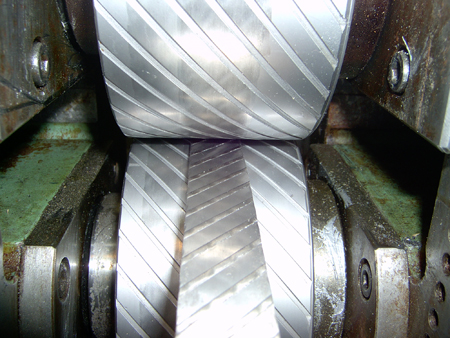
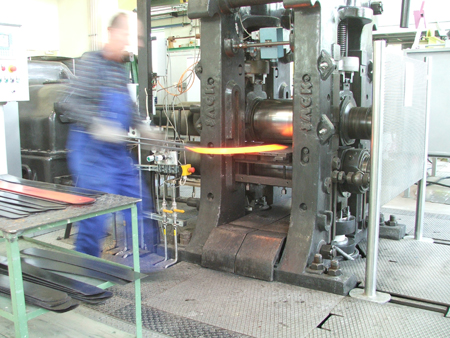
The working of cast ingots, each about 100kg in weight, into thin strips just 2mm thick or ribbed armouring steel rods at temperatures of more than 1,000°C calls for a high degree of technical knowledge, and the appropriate equipment. To carry forward the developments made at Empa, a start-up company, Re-Fer AG, has been set up. The company intends to produce and distribute iron-based SMA for the construction industry and the cost of the new products is expected to be about the same as for stainless steel-based materials, and lower than that of CFRP or other advanced composites.
Until last month, the idea had not been tested on a large scale – mainly because it is only recently that the new material has been manufactured in bulk, around 8t according to the head of Empa’s structural engineering research laboratory, Masoud Motavalli.
Beams of between 2m and 3m had previously been tested with the alloy, but in October the tests were ramped up with use of much larger beams. “We are carrying out tests on roughly 7m-long concrete beams reinforced with shotcrete that has been fortified with smart alloys,” says Motavalli. “We’re interested in how much energy is needed for the smart reinforcement to make the bridge ‘sound’ again.Ultimately, we also want to know how we can best implement this practice.”
He says that there is still quite a long way to go before shape memory alloys become widely used on bridge projects – it could take six to ten years to fully develop the material. The potential for corrosion of the material is one obvious aspect that needs to be investigated, and researchers also need to learn more about the extent of the bond that forms between the alloy reinforcement and the concrete. Clearly this bond is crucial to achieving an effective and long-lasting prestressing force in the structure.
The corrosion performance of the SMA is better than that of mild steel, says Motavalli, but not as good as that of stainless steel. However they do not yet know why this is the case. However he believes that the research team could be applying it to a full-size bridge within the next year to 18 months – the start-up company is pushing hard for this. Although there is a long way to go, having commercial backing will make all the difference.
The idea was floated more than ten years ago, but for a long time there were insufficient funds to enable the researchers to establish whether the theoretical idea could be brought to a practical reality. Work finally kicked off in earnest two years ago when the team got funding from a Swiss institution, and the start-up company then provided the funding to continue.
The will is definitely there to get the technique out on site, Motavalli says – the potential of the technology is recognised. Some experiments had already been carried out into using the material for strengthening or adding capacity to beams, in the same way as steel strips or carbon fibre-reinforced polymers are used by glueing or clamping them to the structure.
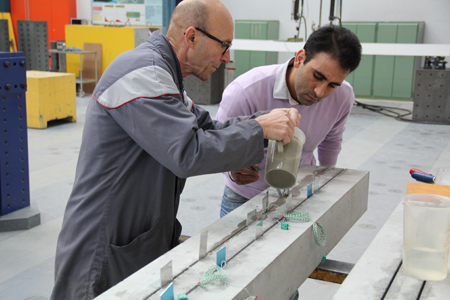
An alternative technique is ‘near-surface mounted’ reinforcement, in which the material is fixed with epoxy into a groove made in the surface of the beam. Although CFRP is usually employed for the latter, it can also be done using the shape memory alloy but with mortar as the fixative. Epoxy cannot be used because it cannot withstand the heat that has to be generated to activate the alloy.
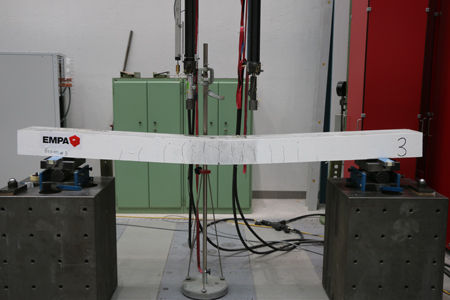
As soon as the cementitious mortar is cured, the material is heated and the prestressing is applied by the material attempting to return to its former shape. The benefits of such strengthening and prestressing techniques are well-known, but with the SMA, much less space and equipment is needed to carry out the ‘prestressing’ process.