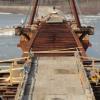
The new connection over Idefjord will form part of the E6 highway that will link Gothenburg with Oslo. Concept for the structure is by Lund & Slaatto Arkitektur, who won a design competition for the project, and it is being designed and built by contractor Bilfinger Berger, after the contract was awarded in 2002.
Despite the tight project schedule of less than 36 months, some details were changed to improve the slenderness of the structure, right up to the last stages of the structural design.
The 704m-long bridge consists of a steel superstructure divided into two separate box girders, one for each carriageway. Cross-girders connect the boxes only at the bridge supports, so that the total width of the superstructure is 28m, including the gap of 6.2m between them. On both sides of the fjord the superstructure rests on 6.2m wide, single concrete piers with a rectangular hollow section. The diaphragm sections have to be anchored by vertical tendons inside the piers after launching of the superstructure, in order to cope with the large uplift forces resulting from these geometric conditions.
Across the fjord, the superstructure is suspended from a slender concrete arch and at either end, where the box girders and arch meet, the box girders are stressed together by external tendons traversing the arch. This ensures that no additional cross-girder is necessary and the arch will rise between the carriageways with no visual intrusion on its shape. The arch is 247m long between the abutments and rises from 30m to more than 90m above mean sea level.
After the arch abutments were completed in June last year, work started on the arch and its auxiliary pylons which are used to support the cantilevering halves of the arch.
For construction purposes, the arch has been divided into 53 segments which are cast using a pair of specially-designed self-climbing formwork travellers. Every segment, including the starting and the closure segments, can be cast with the same formwork.
Work on a new segment starts every four to five working days on each side of the arch, requiring installation of 12 new cables and the stressing, restressing or release several installed cables per week. The two temporary pylons are of hollow box construction, and accommodate the ducts for the temporary stay cables at three different levels. Once erected, a total of 46 temporary stay cables were installed as back-stays as well as 70 from the front to support the arch section and form traveller.
Every rear cable is coupled with two temporary rock anchors type BBV L15 and grouted 15m to 24m deep into the rock; the load bearing capacity of the anchors is up to 2300 kN. Additional lateral stays had to be installed at a later stage in order to withstand transverse impacts such as wind loads. Due to the extreme slenderness of the structure these stays will be needed even when the arch is closed, right up to the time of the rigid connection with the superstructure. The stay cables are strand bundles composed of seven-wire steel stressing strands coated with a white HDPE sheathing. This specific type without any grease or wax filling is required due to environmental reasons and the colour was chosen to reduce the massive temperature effects from solar impact.
Stays were prefabricated by Bilfinger Berger subsidiary BBV Vorspanntechnik in Germany and wound on steel drums to be shipped to the construction site in Strömstad, Sweden for installation. At the live ends of the stay cables a specially-developed pulling device is installed on the bundles of 9, 12, 15, 19 or 22 strands that make up the cable and the entire tendon is drawn up to the pylon top by means of a winch. The winch is positioned on the base slab of the pylon and its wire rope must first be deviated at the rear side of the pylon falsework, then pulled through the inclined duct, and deviated a second time at the front face of the falsework in order to pick up the pulling device from the ground. Once the active anchor has been lifted to the pylon and pulled through the duct from the front face to the rear face the threaded disc is locked by a ring nut and then finally lowered onto the anchor plate.
Weight restrictions on the pylon falsework and the availability and capacity of cranes and hoists led the post-tensioning supplier to recommend the use of monojacks for all stressing operations.
An important task for designers and contractors was the calculation and control of the arch and pylon movements during free cantilever construction. The consultant must consider all the loads that will occur in three-dimensional evaluations while the contractor must monitor deviations, stresses or forces on site using equipment that is reliable even under severe site conditions. Rapid implementation of corrective actions must be carried out if necessary to ensure construction progress and quality assurance.
For the design of the stay cables and the determination of the required stay cable forces and stressing sequence, a range of forces had to be considered; the dead load of the arch segments and stay cables; the post-tensioning of stay cables; the construction loads from the form traveller and construction equipment on the arch; the temperature effects and the wind loads for a design wind with a return period of 10 years.
In construction, the arch stabilised by the stay cables forms a highly statically indeterminate system and for this reason the construction sequence does not govern the design of the arch. Instead, the major requirement is to avoid cracking in the arch, which would make the prediction of deformations during the construction process much more difficult and reduce the overall buckling stability of the arch in the final stage.
Crack control is carried out by limiting concrete tensile stresses during the entire construction process. For each step, only the stay cables supporting the leading segment are stressed, right up to their final force. Those at the temporary pylons are installed in steps and forces are increased depending on the forces of the stay cables at the arch. Beginning at segment ten, single strands or entire stay cables in the lower region are dismantled.
As well as computer-aided concrete creep measuring and conventional surveying equipment for deviation control, innovative monitoring equipment is being used for checking the actual cable forces. By measuring ambient vibrations such as wind-induced sway of cables and recording the appropriate Eigen-frequencies, the tension force in the installed cable can be easily determined. This eliminates the need for installing load cells with the stays or carrying out secondary stressing operations with subsequent pressure readings. This technology was developed as part of a research project funded by the European Union, involving a number of specialist companies such as Vienna Consulting Engineers and BBV. The equipment being supplied to the contractor is known as the 'Brimos' (Bridge Monitoring System) Recorder.
Throughout the free cantilever launching, arch deformations and stay cable forces are measured and compared to the nominal data from the structural analysis. Once stay cable forces have been controlled by the Brimos-Recorder and cross-checked by pressure readings at the stressing jacks, the need for corrective measures is determined. The governing criteria for the design of corrective measures are the deformations of the arch.
After an arch segment has been cast the deformations are checked; if the deviation exceeds the given tolerance, stay cable forces are a