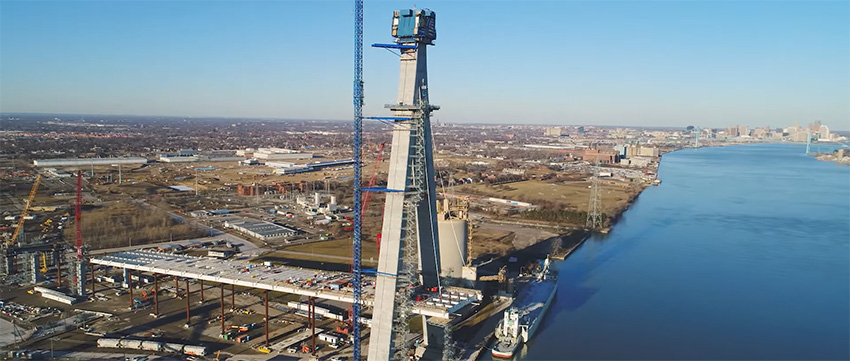
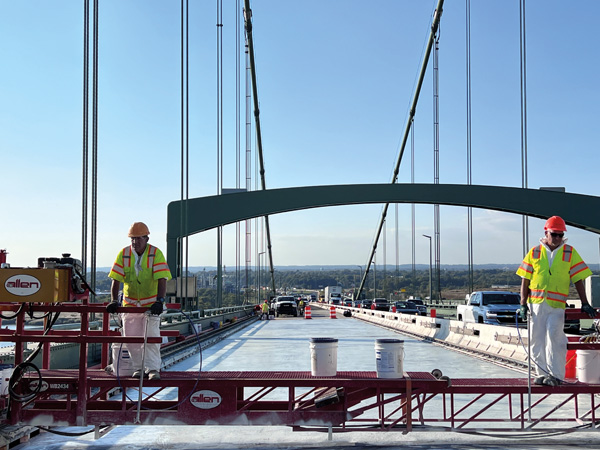
The first phase of the Delaware Memorial Bridge’s new UHPC deck overlay was completed in November (DRBA)
Delaware Memorial Bridge comprises of twin suspension bridges spanning the Delaware River between Delaware and New Jersey. The main spans are 655.32m in length and the suspended spans have an overall length of 1,112.5m. Construction on the first (northbound) bridge was completed in 1951, while the second (southbound) bridge was opened in 1968. Delaware River and Bay Authority (DRBA) are owner operators of this busy tolled link, which features eight lanes in total and serves more than 80,000 vehicles a day.
Given the age of the northbound (New Jersey) span and the fact the deck required frequent repairs and patchwork, in 2017-18 the DRBA engaged consultants WSP to undertake an exhaustive evaluation of the condition of the bridge deck, involving coring and a variety of non-destructive testing methods. Their report highlighted that while the deck was in need of rehabilitation, the majority of the deterioration was within the top 50 to 60mm. This – combined with a lifecycle costing analysis comparing a UHPC overlay with other overlays and with full deck replacement, among other options – gave the DRBA a clear idea of how to move forward with the structure’s deck rehabilitation.
“When we did that comparison looking at lifecycle costs, it became clear to us that UHPC presented a significant advantage, even from the point of view of minimising disruption to traffic on our bridges,” says Shekhar Scindia, technical principal, bridges at DRBA. Indeed, the options study showed cost of a UHPC overlay would be roughly 60% of the cost of a full deck replacement, with minimal to no maintenance requirements, unlike some other overlay options. “It was also clear that a full deck replacement would create much more disruption to traffic when compared to installing an overlay,” he adds.
Scindia emphasises several other major benefits which fed into the decision to use UHPC, including its high compressive strength of 18,000 to 35,000psi compared to regular concrete’s 3,000 to 5,000psi. Moreover, UHPC develops a strong bond with old existing concrete making it especially suited for use as an overlay: “If you were to take a core out of concrete on which a UHPC overlay had been placed, and subject it to a tension test, the failure would not occur at the bond between UHPC and concrete. It would occur in the lower concrete. The UHPC-to-old-concrete-bond-strength is actually higher than the strength of the old concrete, pointing to an important consideration in choosing UHPC as the overlay material”
What followed the options study was a successful pilot UHPC overlay project undertaken on part of two lanes on the northbound structure in 2020. This pilot program provided information on the performance of hydro demolition to the existing concrete, the existing condition of the top reinforcing mat, and the required full depth of the UHPC layer.
Phase one of the project started in September 2022 and its scope included installation of the overlay on the two right lanes (lanes one and two) west of center of the suspended span on the northbound structure. Apart from installing the deck overlay, the three-phase project involves removing 50.8mm of the old deck, repairing the reinforcing mat , and replacing transverse deck relief joints and expansion joints. Principal contractor UHPC Solutions – a joint venture comprising WALO and Posillico – performed surface preparation as the first step. The company opted to expedite removal of the first 25.4mm of deck through mechanical milling and removed the remaining 25.4mm through hydro demolition. The sub-contracted hydro demolition work hit some initial delays with the water being pumped from around 1.2km away in some locations, causing difficulty obtaining reliable performance of the hydro demolition equipment.
Detailed surface preparation was undertaken using hand lances to remove areas of concrete that had not been completely removed with hydro demolition. A longitudinal joint runs in the middle of the four lanes that requires separate details outlined in the project specifications since it will be the seam between the overlay installation. For this, a different formulation of UHPC mix was specified for the joint and a separate detail was developed to accommodate construction across multiple phases. The detail is also developed such that the old concrete is protected from ingress of moisture by the UHPC placed in the joint. The overlay for phase one has been installed on lanes one and two of the northbound bridge, to the right of the joint.
“While getting the hydro demolition operation going smoothly was a challenge in Phase I, the actual placement operation of UHPC went really well. The main credit for that I would say is because the JV partner WALO had flown in their team of experts from Switzerland, including some of their top experts in UHPC work, who were on site making sure everything went well with the placement operation,” says Scindia
UHPC’s durability and impermeability to water stems from its dense matrix, consisting of 500-800-micron silica sand, cement, 0.2mm-diameter steel fibres and fillers such as silica fume or slag. For this project, bags of the cementitious material and steel fibres were mixed on deck in two custom-built mixing plants before being hauled to the placement area using a fleet of six buggies. The minimum fibre content required by the project specifications is 3.25% of the overlay UHPC mix’s dry volume. For the joint fill UHPC that percentage is 2%.
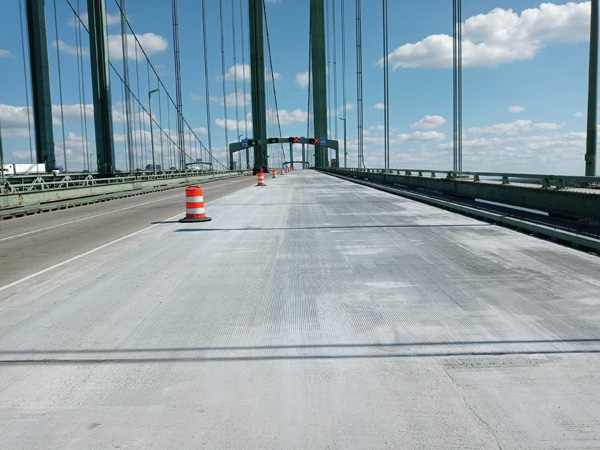
The application of a UHPC deck overlay requires expertise unlikely to be found in a typical contractor (DRBA)
The contractor’s expertise, Scindia explains, was particularly important to manage the thixotrophic behaviour of UHPC, whereby its viscosity decreases with applied stress and its spread over the deck surface needs proper control. Vibrations are partly introduced by the custom paver as its smooths the UHPC material, but several construction workers are also needed to physically adjust the spread of the material. However, the team also had to deal with the unpredictable and irregular vibrations caused by traffic in the two adjacent lanes which remained open during construction on the northbound crossing. On top of this, because the bridge comprises three different types of span support systems at deck level – suspended, truss and girder – the frequency of the vibrations caused by traffic varied significantly.
“The suspended span has lower frequency vibrations at most locations, but on the truss and girder spans, you get a completely different set of vibrations. So, even though it’s the same bridge, the vibrations on deck are different at different segments of the bridge.”
For these reasons, Scindia stresses that a typical contractor would likely lack the expertise and experience to conduct this kind of work: “The spread of the mix is also affected by ambient conditions and the slope on different parts of the deck, so you need experts watching over the formulation of the mix to make sure that the constituency is just right; so that it spreads, but not too much, and is able to absorb the vibrations from the trucks and vehicles in the adjoining two lanes. All those things have to be considered. They constitute important practical and constructability considerations in achieving quality outcomes in UHPC bridge deck overlay construction.”
Despite the delay at the surface preparation phase, phase one was successfully completed in November, with phase two of the project set to start on 1 February and finish 25 May. Phase two requires covering twice the surface area of phase one – the full length of the left lanes (lanes three and four) of the northbound bridge – in a little less than twice the amount of time allocated for phase one. Another challenge is that the weather will be significantly cooler than during phase one, which was completed before winter.
Phase three will see the rest of lanes one and two completed on the northbound bridge by 21 November this year. Given the scale of UHPC’s use, the project is being followed keenly by other bridge owners and operators across North America, as well as by the FHWA.
Cured in no time
A rapid-cure version of an expansion joint that uses a specially developed polyurethane material to form the driving surface has been used on the Delaware Memorial Bridge rehabilitation project
The Tensa-Polyflex-Advanced expansion joint has been used in bridge construction and renovation projects all over the world for over a decade and a half. Mageba claims that it can be poured to form virtually any shape of expansion joint, such as sidewalk details, upstands and intersections, and can also be installed within the depth of a bridge’s road surfacing and in phases. These benefits relating to installation are significant where the joint is being installed to replace an old joint on an existing structure, since they enable the impact on the bridge structure to be minimised.
To further improve the installation-related benefits, by enabling traffic to drive over the new expansion joint even more quickly, the Rapidcure version of the Tensa-Polyflex expansion joint has now been developed. The polymethylmethacrylate material of the new version cures in three hours, regardless of temperature, compared with 12 hours at 20°C with the polyurethane Advanced version.
First installations have already been successfully carried out, most notably on the Delaware Memorial Bridge in the USA, where the deck rehabilitation project presented an excellent opportunity to also replace the bridge’s expansion joints after many years of service.
Following a successful trial installation completed in September 2022, it was decided to proceed with using the new joint for the rest of the westbound structure. In the first phase of work, the expansion joints were renewed across half of the bridge’s length in two of the structure’s four traffic lanes during November 2022. Half the length of each 8m-long expansion joint was replaced at a time, which corresponded to a total length of 200m at the 25 bridge axes where the existing expansion joints were located.
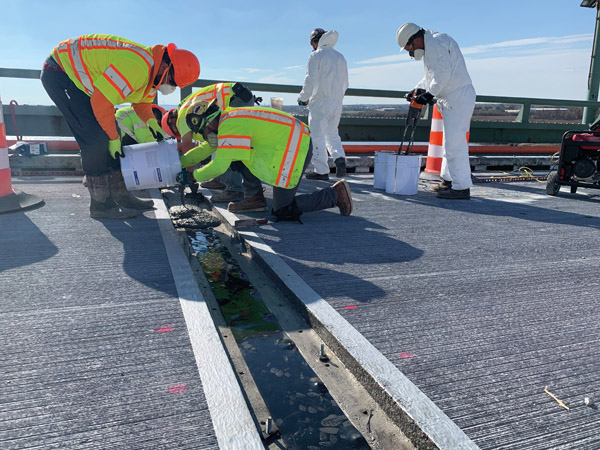
Pouring of the newly developed and exceptionally fast-curing joint at the Delaware Memorial Bridge
Each new joint is designed to accommodate longitudinal deck movements of 40mm, although movements of up to 120mm can be facilitated by the joint type. In general, four expansion joints, each 8m-long, were installed each day during an eight-hour shift. The daily work cycles typically comprised three hours for cleaning and drilling anchor holes for steel angles and the gap cover-plate; 30 minutes for installation of gap cover-plate and EPDM strips; 30 minutes for blockout primer application; 30-minute lunch break; 45 minutes for application of first layer of Polyflex PMMA and installation of steel angles; another 45 minutes for a second layer of Polyflex PMMA material; concluding with a third layer and top-surface finish, again lasting 45 minutes.
In the case of the Delaware Memorial Bridge expansion joint replacement project, the blockouts were easily formed during the placing of the UHPC deck overlay, and the hardened UHPC material was water-blasted to roughen its surface to ensure good bonding with the poured expansion joint material.
Although the Delaware Memorial Bridge’s wider deck rehabilitation project allowed for the expansion joint replacement work to be carried out during day, Mageba says that the work could have been equally carried out during a night closure.
The ability of the joint to be installed in phases enabled traffic to be maintained throughout the work. With Phase 1 of the project completed on 22 November 2022, the newly installed expansion joints have already been exposed to millions of axle loads. The remainder are to be installed in 2023.
The new Rapidcure version has been subjected to extensive testing at MAPAG-Gumpoltshofen and OFI–Vienna in Austria, and TU Munich and BAM in Germany, and a European Technical Assessment was awarded in January 2023.