The challenge of juggling multiple projects is one that many structural engineers can relate to, particularly those who work in design offices where their expertise is likely to be called upon by other teams. But the next time you are cursing your workload or struggling to meet the latest deadlines, take a moment to reflect on whether these seemingly discrete projects are really so far apart.
Schlaich Bergermann & Partner associate Lorenz Haspel recalls that it was under such circumstances that the idea of replacing steel hangers with carbon fibre hangers on a network arch railway bridge was first proposed. The bridge in question, in the German city of Stuttgart, has a main span of 80m and will carry an extension of the city’s light rail system over the A8 highway towards the airport and city’s trade fair grounds. The main span was moved into place in May and is due for completion later this year by main contractor consortium ARGE (Bd&e issue 99).
.jpg) Use of carbon fibre cables over steel resulted in a cost saving of 20% (Octonauten)
Use of carbon fibre cables over steel resulted in a cost saving of 20% (Octonauten)
Haspel explains that the change from steel locked-coil cables to carbon cables came about through a combination of chance and budget pressures while the bridge scheme, which was selected through a design competition in 2013, was under design. “We developed the details and started planning for fully locked-coil cables with forked sockets and turnbuckles; that’s how we entered in the first phase,” he says. But unexpectedly, a series of events and change in circumstances prompted a radical proposal.
“To be honest it was pure luck that I had two projects on my desk at the same time,” Haspel admits. “One was this bridge, the other was a research project for an extremely large gridshell structure. We were talking about using carbon cables for the gridshell, and when I started looking into it and learning about the material properties, talking to the companies that make the cables, the researchers and so on, I started to realise that carbon is almost completely insensitive to fatigue.
“At the same time as we were starting to understand this, the bridge project was in a crisis because of the budget, and we had been asked to look at all sorts of options to get it back within the budget.” The idea of using carbon fibre cables — which generally come with a higher price tag — to resolve a budget crisis might seem counterintuitive. But as Haspel points out, the high comparative cost of the material can be entirely offset– in some cases even undercut — by the associated savings both in other materials and in construction costs. Not only that, but the material characteristics made it ideal. “It came to me that if I have a material where fatigue is not the design criteria, that would be exactly the right solution for the bridge hangers!” he explains.
The design with steel cables demanded 65mm-diameter fully locked-coil cables for the hangers, but the carbon-fibre alternative, use of which eliminated the need to address fatigue, could be reduced right down to 32mm diameter. “When we calculated what the project would cost with carbon fibre cables, we found that it would actually save about 20%!” adds Haspel.
He acknowledges that the support of the client was crucial in pursuing this line of enquiry: “We told the client that we had found an option, and that it was a bit risky considering nothing like this had been done before, but that we thought it would cost less even when you took into account the tests that were needed. It was a really extraordinary move by them to have such trust in our proposal — otherwise we would never have been able to progress it.”
The bridge in question has a steel arch with a prestressed concrete tension tie creating the 80m span, and in addition it has 24m-long concrete side spans. It is designed to carry light rail trains on a line with regular services, and it was this frequency and type of loading, with its associated high fatigue cycles, that initially prompted consideration of carbon cables. “The bridge experiences the full load cycle every ten minutes or so when a train goes over — and if you calculate it for 100 years of use, you find out that it’s 11.4 million load cycles; significantly higher than most other rail bridges,” says Haspel.
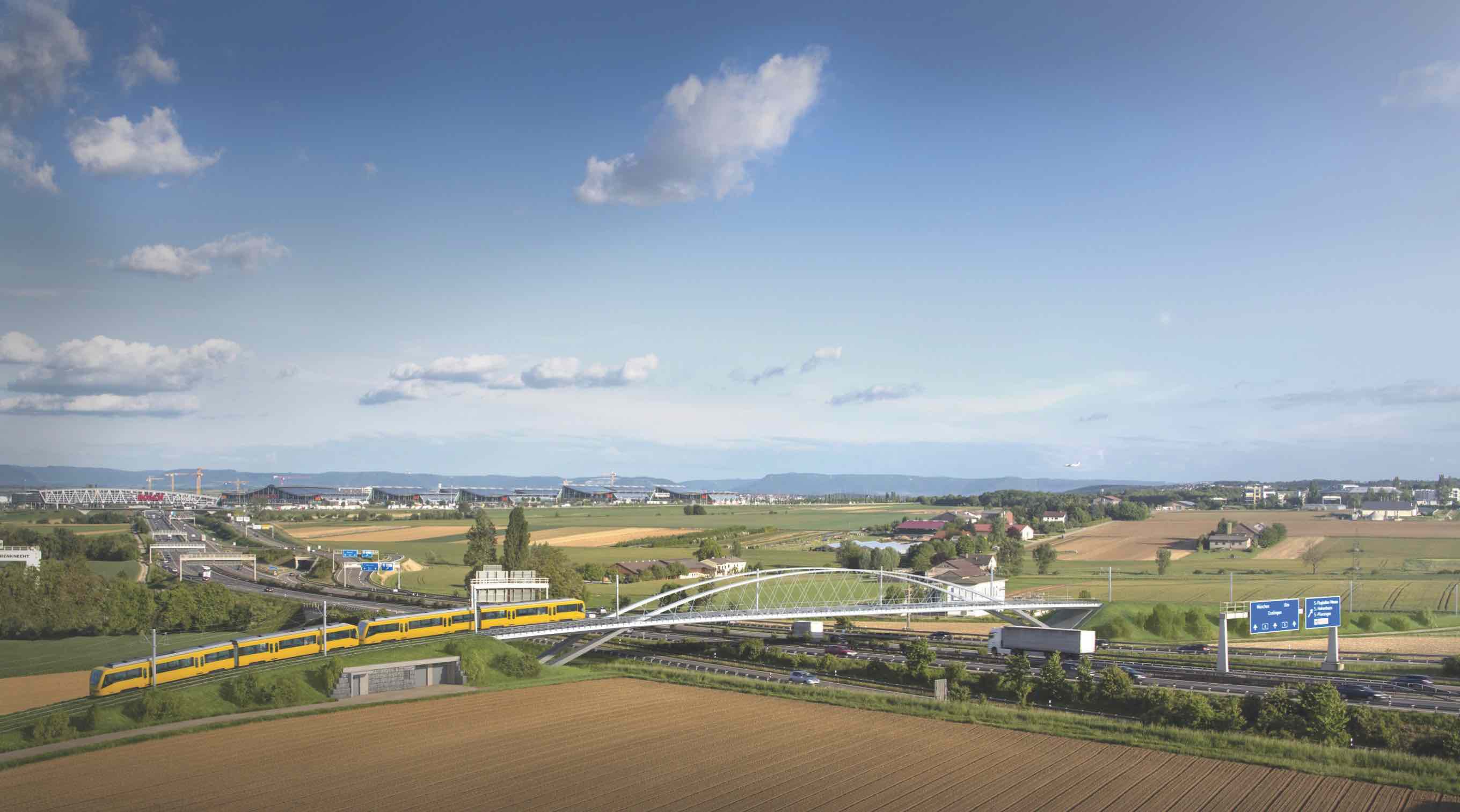 Render of the completed project
As the train crosses the bridge, the inclined hangers go from being partially unloaded to being additionally loaded. On the Stuttgart bridge, trains are intended to run once every ten minutes, so the load cycles repeat regularly. “These hangers go through about four times the load cycles of normal vertical hangers,” says Haspel. “These are very high fatigue loads.”
Hence eliminating fatigue as a design criteria was a key factor — and while swapping out steel for carbon cables initially led to the reduction of cable diameter and cost savings in materials and construction work, it became clear that it had additional benefits. “As far as wind and rain-induced vibration goes, for the steel fully locked-coil cables we would be within the critical area for this phenomena,” reveals Haspel. “But with the carbon cables we are actually way above it due to the smaller diameter and the lighter weight.” Hence cables with a circular cross-section can be used — which makes manufacturing much easier.
The E-modulus of the carbon fibre cables is lower than steel, which also proved a big advantage, as Haspel explains: “Network arches can suffer the problem that cables go slack when trains pass over the bridge, and this has the potential to cause damage if the cables go slack and then tighten again. Even without doing anything else we solved this problem,” he says.
Although things looked good on paper, and the client was willing to back the pursuit of a novel solution, a great deal of testing was needed to provide the proof, and a slew of questions had to be answered before it could be fully signed off.
For fatigue, says Haspel, it was possible to draw on an example of carbon bridge cables that have already been in use for almost 25 years — the 1996 Stork Bridge in Winterthur in Switzerland was the first road bridge in the world to be built with carbon-fibre reinforced polymer (CFRP) cables and is still in operation. “This was a different technology, being parallel wire bundles with conical anchors, but fatigue tests were done at the time, and so we did have some data available from that, even before we started our own tests,” he adds. More recently, in 2016, a series of tests by Giovanni Pietro Terrasi and Fabio Baschnagel investigated the fatigue properties of CFRP straps and these also showed excellent performance with fatigue.
SBP worked to develop the cable design with Carbo-Link, a Swiss-based firm that was founded as a spin-off from Swiss federal materials laboratory EMPA two decades ago. For the Stuttgart bridge, two samples of cable were tested for fatigue — one with a full-scale 2.8m-long CFRP hanger complete with an eye at each end; a second as part of a full-scale replica of the whole arrangement including pins, anchors and a section of arch at the upper end.
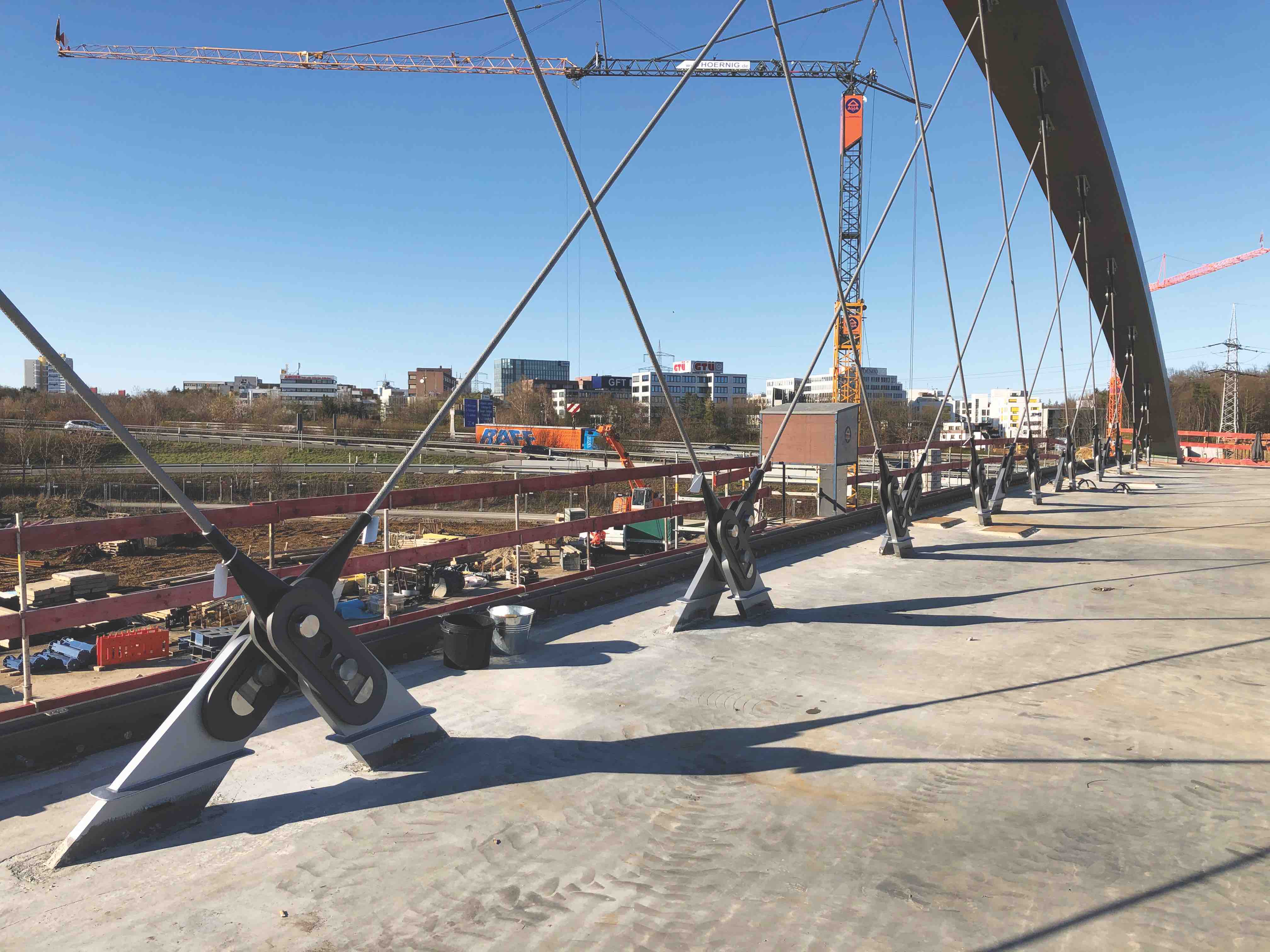 Adjustable connection detail at deck level (SBP/Lorenz Haspel)
Testing took place at EMPA and both were tested over 11.3 million cycles to represent the full 100-year design lifetime — and confirmed excellent fatigue behaviour, says Haspel.
“Results of the tests by Baschnagel and Terrasi indicated that in terms of the fatigue resistance of the carbon loops, we could expect to be a factor of five above a steel section and even about a factor of six above a fully locked cable,” he states.
Haspel also points to use of carbon fibre in applications that undergo similar load cycles such as for crane ropes — Liebherr has been using carbon fibre cables as ballast ties for more than ten years. This reduces the dead weight of the cables and enables the same chassis to achieve 20% higher load capacity, he says. “It’s not very different to the use on the bridge: you have high load and a lot of load cycles. Every time the crane picks up a load, it’s a load cycle.”
Designing the hangers for appropriate mechanical characteristics is straightforward. “There are so many different carbon fibres on the market, you can more or less tune the properties to what you want. You can have a soft or very stiff cable, high or low breaking load, it’s just a matter of the cost of the fibres. As far as stiffness is concerned, we found that you can tune the behaviour of the overall system significantly by choosing the right properties.”
Carbo-Link is more accustomed to supplying the marine industry than bridge projects, and Carbo-Link’s project manager for the bridge, Arne Guelzow, says that marine is a very different application. It involves a very harsh environment and the main benefit of the material aside from strength is its durability. For bridge applications, in particular with the network arch, there are structural benefits and the important characteristics are the lack of fatigue, and the breaking load.
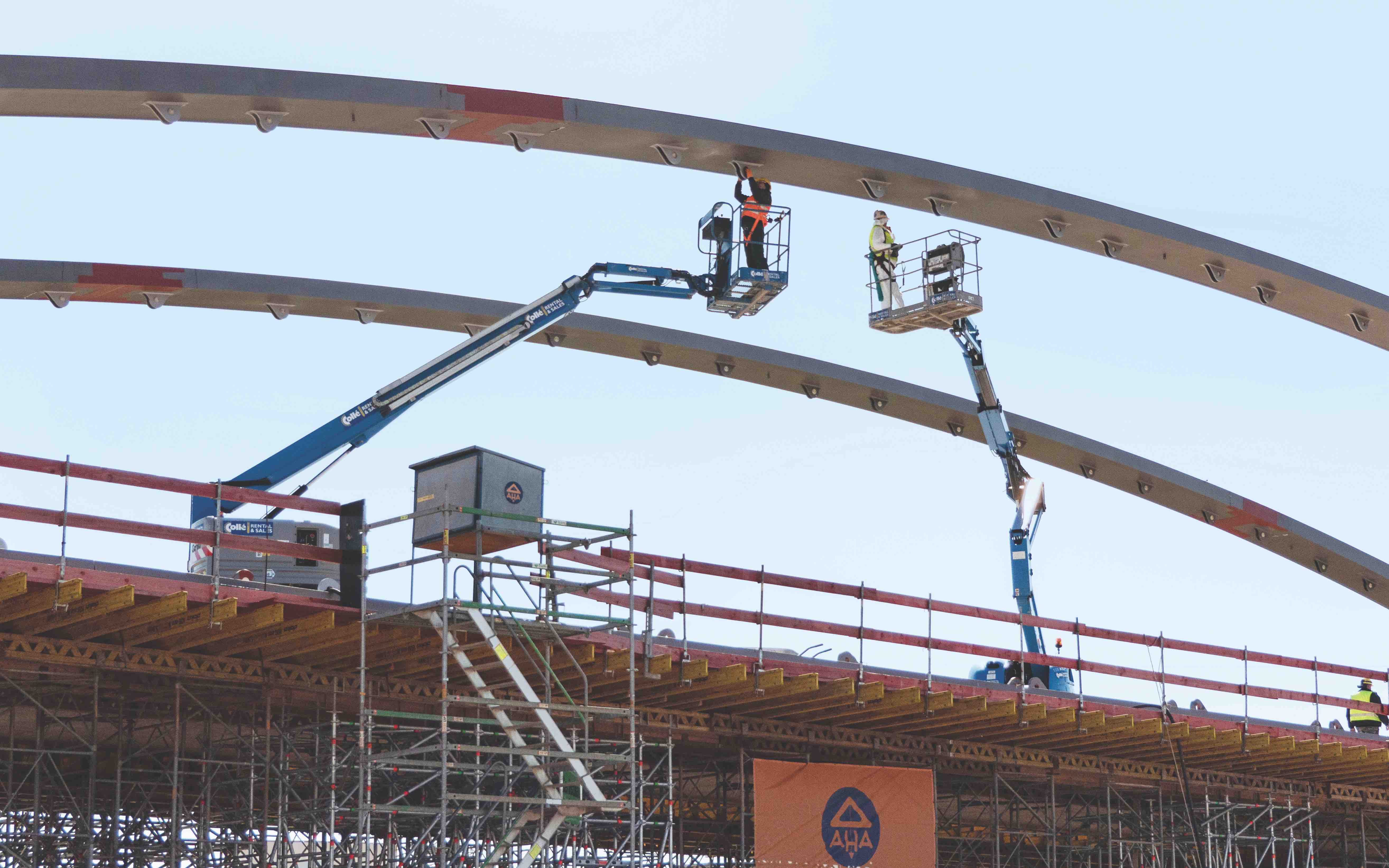 Hanger installation was extremely rapid as no special equipment was needed and the cables could be lifted by a single person (SBP/Lorenz Haspel)
“The testing was quite time-consuming, but it proved that fatigue was not an issue,” he says. “In the lab they wanted to try and destroy the cable in the fatigue tests, but it just wasn’t possible. When the samples were eventually taken to failure, the breaking loads were almost exactly the same as we had measured with the brand new cables.”
The cables have a ceramic coating which serves as protection against vandalism. Fire damage was also raised as a possible issue, and Haspel says more testing is planned to explore this further. “We were able to demonstrate that carbon behaves rather like wood, in that heat transmission is very low,” he says. “The outside is flammable, but it takes some time before the inner part gets warm. It’s quite probable we will find that even though the carbon cables are thinner, they are able to survive fire for longer than a thicker steel cable, because in steel the heat is transmitted straight to the core.”
Redundancy was another question, in particular in relation to carbon fibre’s brittle nature. “In fact the E-modulus is much lower than for steel, so even though it is a brittle material, it undergoes quite a lot of elongation before it breaks, and as this happens, loads will be distributed to the other hangers,” Haspel explains.
Overall design follows the usual protocol for cable-stayed bridges: the structure will be able to operate safely after the loss of one cable, and if more than one is lost, operation could be restricted to a single track, or closure may be necessary, depending on the circumstances.
Haspel sees great potential for much greater use of carbon fibre cables on network arch bridges, and in particular railway bridges, due to their specific load cases — although this structural form has not been widely used for railway bridges yet. Bars are mostly used as hangers on shorter network arch bridges — anything up to 150m, he says — and above that, parallel strand is generally used. The opportunities for carbon cables could be even greater than anticipated. “We don’t really know where carbon will end up, but it’s quite possible that this technology will work even for really long spans,” he suggests.
Even when it comes to the material’s ecological footprint, a comparison between steel and carbon fibre is illuminating for this specific application; when you compare 1kg of carbon cable to 1kg steel, the carbon footprint of the former is about 40 times higher, says Haspel. “But, since you need only small proportion of the material it is balanced out. For example another bridge we are studying at the moment requires around 107t of steel cables, but this can be replaced by about 3.4t of carbon cables.
This would make it almost zero-zero if it was just the cables,” Haspel continues, “but we can cut a lot of concrete and steel from the overall structure by using carbon cables, so there is actually a net saving in the range of around 1,000t of CO2,” he says. “It’s a financial advantage and an ecological advantage, and creates a totally different structure where you can distribute forces better.”
Similarly with cost: although by direct comparison carbon fibre is much more expensive, not only is less needed but the additional savings in other materials and speed and cost of erection can be significant.
Guelzow agrees, and points out that another big challenge for the Stuttgart bridge was educating the contractor on how to carry out construction. “They were not used to the lightweight nature of the elements and were used to erecting just a single hanger per day with traditional systems. In this case, they were able to erect all 160 cables in just three days, which is a massive saving in time,” he says. “This was not the only big difference — all of the cables arrived on just two pallets on a single lorry, reducing the transport costs and associated energy use/CO2 emissions hugely.” SBP and Carbo-Link are currently working with the German railway authority Deutsche Bahn, pursuing certification for carbon fibre cables to enable them to be considered for future rail bridge projects.
Guelzow says that load tests have already been completed and fatigue tests were due to start towards the end of last month (July). “We have already supplied 15 cables that are being used for these tests, which are being carried out in the laboratory at EMPA,” he reveals. “The first rail bridge where they could potentially be used would need cables to be delivered early next year.”
Haspel recognises that it is early days for the application of carbon fibre cables on network arch bridges, and that connection designs are likely to be refined in the future. “In 20 years we will probably laugh at the details we are using today; dealing with a new material is a learning curve.” But the suitability of the material for the task makes it worth pursuing, he says. “There is no other application where you can make use of all the properties — some applications use some of the properties of carbon, but I’m not aware of anything else where they are all beneficial.”