
Engineers in Hungary are planning a dramatic bridge installation to erect the main span of a new Danube bridge. Helena Russell reports
Some time at the end of the month, depending on water levels, a dramatic spectacle will take place during a three-day closure of the river Danube just downstream from Budapest. The 312m-long, 162m-high steel tied arch span of the new Dunaujvaros Bridge will be manoeuvred into place across the river using a system of barges, anchors and strand jacks.
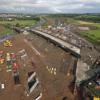
The new crossing of the river will form part of the M8 motorway, which is planned to be Hungary's main east-west link connecting Austria and Romania directly through the middle of the country. From end to end the structure, which consists of two approach viaducts over the flood plain, and the central arch span, measures 1,683m, and is being built using a variety of different techniques.
Launching of the deck for the approach viaducts was completed earlier this year, and the final section of the steel arch was welded into place at around the same time. With the installation of cables under way when Bd&e visited the site, and waterproofing and painting of the decks on the approach viaducts taking place, the contractor was on schedule for the planned completion in the middle of next year.
Client Hungarian National Motorways instigated the bridge project back in 2002, inviting tenders from consultants to prepare tender documents based on a feasibility study that had been carried out a year earlier. Design-build contractors were invited to tender, with the option of submitting alternative designs, which was what the winning tenderer, New Danube Bridge Consortium did with its 'basket handle' arch main span.
Two main criteria influenced the selection of this type of main span - the requirement for a 300m clear span to allow manoeuvres of barges at nearby ports obviously restricted the choice of structural types, but this was really not long enough to make a cable-stayed bridge with towers feasible. The proximity of overhead power lines also made this impractical. But the main benefit of the arch design was that it could be built on the side of the river and then floated into place when it was finished, minimising the disruption to vessels on the river and making it safer and easier for site personnel. The span of the central arch is believed to be a world record for its type.
Once the total €195 million contract - which includes 5.2km of motorway - was signed in September 2004, work started on the piling for the 19 supports that carry the bridge over the Danube and its floodplain. The bridge consists of a 1067m-long approach viaduct with 13 spans on the right bank, and a shorter, 302m-long four-span approach viaduct on the left bank. Only three of the piers are in the river at normal water levels, however the Danube is prone to flooding, which is the main reason why approach viaducts had to be built rather than embankments, which would have obstructed the flow.
On land, the piers are concrete, but the two main river piers are a combination of steel shells and concrete - the steel shells being used as permanent formwork to eliminate the need to install sheet piles around the river pier locations. Interlocking piles were used for pier 13, which is in shallow water on the river's edge, and for the floodplain piers. The deck of the approach viaduct consists of two separate steel box girders with orthotropic decks, one to carry traffic in each direction, and these are supported on two separate concrete piers. At each pier location, however, the two piers rise from a single concrete pilecap structure.
The construction of the piers, both in the river and on land, was quite a demanding task due to their shape and size. Architectural input resulted in a lens-shaped 'plum-stone' cross-section both for the pilecaps and the piers themselves, and on the main piers, this cross-section reduces as the height of the pier increases. This design presents a minimal obstruction to the direction of the water flow, and reduces the visual impact of the viaducts when viewed in elevation.
Construction of the substructure for the longest approach viaduct began with pier 13, which is at the edge of the river. This was the most difficult to build, but had to be installed first due to the way in which the bridge decks were due to be launched. Contrary to normal practice on launched bridges, the contractor elected to launch the decks from the river pier towards the abutments. The reverse is usually chosen because the abutment site provides ample space for assembling and connecting steel sections of the bridge, as well as for the launching equipment.
In this case, however, the steel deck units were being fabricated at a site just upstream from the bridge, and to transport them by road to the abutment would have been expensive and difficult. The obvious answer - although creating other challenges in terms of welding, alignment control and so on, was to bring them by river and lauch from the riverbank towards the abutment.
Hence the pier construction was carried out in the same direction - unfortunately meaning that subcontractor Mahid, part of the Vegyepszer Group, had to build the most difficult pier first. Meva supplied the formwork for the 'plum-stone' piers, starting with the base of the largest one, almost 26m long, 6.3m wide and 12m high. However this formwork could then be adapted for each of the subsequent piers, which were smaller.
For the river piers, steel shells were built which acted not only as pile driving templates, but also as permanent formwork for the piers. These were fabricated next to the riverbank, in the same position where the arch span was later built. Seven shells of approximately 1.8m height were built for each of the two piers.
Once the first shell had been installed, with careful monitoring by two teams of surveyors, piles were driven using the template as a guide, and then the remaining shells were floated into place. Underwater concrete was used to seal the base of the unit, after which it was pumped dry and the pier was built inside it.
On the right bank of the river, the steel deck spans are mostly 82.5m long, with one of 86m, next to the main river span, and a shorter one of 75m at the abutment. On the left bank, there are three 75m spans and one of 78.5m, this side was erected using traditional assembly methods, with mobile cranes and scaffolding. Deck units were fabricated into typical 16.5m lengths; the volume of fabrication demanded by the bridge meant that six different factories were involved in producing deck units for this bridge. Structural elements for the deck sections were brought by road to a site at Ganz on the river near Budapest, for assembly into approximately 100t units ready for installation.
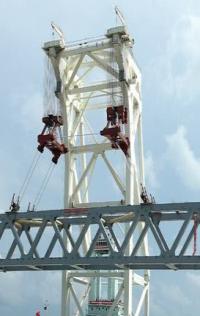
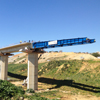
As mentioned, the units on the right bank were launched from the river bank back towards the abutment - this proved beneficial in relation to the longitudinal slope. The viaduct slopes upwards towards the abutment, meaning that the launching process could be easily controlled without needing to incorporate a braking system. A system of scaffolding was erected to provide a platform onto which the deck units could be lifted from the river, and where they could be connected to the launched deck. A steel nose at the front of each deck cantilever is used for the launching procedure.
As Bd&e went to press, engineers on site were gearing up for the main event - the floating into position of the 9000t main arch span. The steel span which consists of two inclined arches, and main beams integral with the deck structure, is 308m long, 41m wide and 50m high. The arches and deck are connected by cable stays, and th