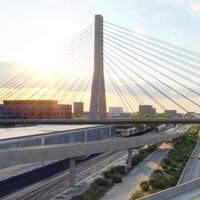

Access to the USA’s two busiest ports needs to be retained in the event of a major earthquake. Mark Yashinsky explains how this is being addressed
The Port of Los Angeles and the Port of Long Beach are separate facilities that were founded about 100 years ago in San Pedro Bay, California. Terminal Island, which is in the centre of the bay, was originally a mudflat that was expanded when shipping channels were dredged in the bay. Today, about 70% of the container terminals for the Port of Los Angeles and about 30% of the container terminals for the Port of Long Beach are located on the island. As well as container terminals there are passenger terminals, automobile terminals, dry and liquid bulk terminals and so on. Oil fields and refineries in the area mean that there are also oil terminals at the ports. More than 40% of all the shipping containers that move through the United States go through these ports, making them the two busiest ports in the United States.
Business at the ports expanded with the completion of the Panama Canal in 1914, and again following the economic boom in south-east Asia after World War II, and it continues to expand today as a result of increased trade with China. The ports are working together to address the challenges associated with these increased volumes. This has involved directing a great deal of effort at improving intermodal transportation at the ports. The Alameda Corridor which was completed in 2002 provides unrestricted railway access to and from the ports through the city of Los Angeles. The corridor eliminated more than 200 at-grade railway crossings. By 2020, predictions suggest that 100 freight trains a day will visit the ports. They are also working with the California Department of Transportation to transfer their roads and bridges to state control so that Route 47 can be extended across Terminal Island and provide a direct link for trucks to the interstate highway system. The ports are also working to improve pipeline transport of goods and to automate the identification, storage, and transport of cargo as it moves into and out of their facilities.
One of the many problems that the harbourmasters must address is the risk from a variety of seismic hazards. There are several faults within a few kilometres of the ports, and one fault that goes right through the Port of Los Angeles. Moreover, the ports were built from loose, wet material that is subject to liquefaction and failure. San Pedro Bay is also at risk from a tsunami caused by earthquakes occurring anywhere in the Pacific as well as from nearby submarine landslides. Ensuring these hazards do not cause the ports to have to be closed after an earthquake may be difficult. The magnitude 6.4 Long Beach earthquake in 1933 occurred on the nearby Newport-Inglewood fault. It killed more than 100 people, caused millions of dollars worth of damage, and changed the way that bridges and buildings are designed for earthquakes. Similar earthquakes took place in 1855, 1812, and in 1769; a recurrence interval of approximately 60 years. Hence earthquakes are expected at any time on one of the faults that surround and cross the island.
After the 1995 earthquake in Kobe, Japan, the city's large port was disabled not only by damage to cranes and other port infrastructure, but by damage to highway and railway bridges that prevented the movement of goods into and out of the port. It took years to repair all of these bridges, by which time much of the container traffic had moved to the port at Hiroshima. But a performance-based design, in which ordinary bridges are designed to remain in service after small earthquakes while important bridges are designed to remain in service after large earthquakes, could be used to keep vital lifelines like ports in service following such disasters. However, designing bridges not to collapse is cheap and straightforward while designing bridges to stay in service is more difficult and also very expensive. Furthermore, deciding which bridges are most important is often influence more by politics rather than science.
Railway bridges are designed for three levels of earthquakes: for a moderate event, train safety is required; for a large event, structural integrity is required; and for an intense event, the bridge must not collapse. The return periods for these earthquakes are determined by calculating the bridge's importance, which is based on such things as whether hazardous material is being carried on a bridge (in a heavily populated area) and how many passengers go over the bridge every day.
Caltrans uses a peer review panel to determine the appropriate ground motion used to design, or retrofit 'important' and 'non-standard' bridges for the safety evaluation and the functional evaluation earthquakes. However, most bridges are categorised as 'ordinary' and designed not to collapse for a rare earthquake in the belief that this will keep it in service for smaller events. Caltrans is still working to determine if special design criteria is required for bridges on designated 'lifeline' routes. At Caltrans, one of the following criteria must be met for classification as an important bridge; the bridge must remain in service for post-earthquake seismic safety; bridge closure would cause an unacceptable economic impact; the bridge is formally designated as critical by a local emergency plan.
Three highway bridges and one railway bridge connect Terminal Island to the mainland. The Vincent Thomas suspension bridge was designed and built by Caltrans in 1963 and has a 460m main span, 45m vertical clearance over Cerritos Channel, and connects the west side of Terminal Island to the city of San Pedro. This bridge was analysed by Weidlinger Associates and retrofitted almost ten years ago to prevent collapse in the event of a very large earthquake. Although this bridge was not considered an important structure and was not designed to remain in service, it should still perform well even during the most extreme event. The design ground motion was large, because the Mw = 7.4 Paleos Verdes fault passes between the towers. A recurrence interval of 950 years, with peak rock accelerations of 0.97g horizontally and 1.05g vertically was estimated for this site. The 1992 Landers, California ground motion recorded at Lucerne was used and modified to match the target spectra. To account for near-field directivity, a large pulse was put into the time history at about 10 seconds and to address the fault slip, the bridge was designed for a 2.7m offset occurring over 5 seconds. The bridge was modelled using Adina, checked for damage, and then the model was modified with the proposed retrofit and rerun.
The retrofit design included reinforcement of the towers with doubler plates, to prevent buckling due to the high stresses in the towers. There was no retrofit of the pile foundations, which will rock slightly during a large earthquake. The cable saddle was also retrofitted to provide greater shear strength, along with devices to control the transverse movement of the truss. A new concrete deck, with a 7.9m-long expansion joint and hydraulic dampers, was added to allow longitudinal movement between the stiffening truss and the cable bent.
Because of the large vertical motion at the side spans, structural fuses with hydraulic dampers were installed. These allow large vertical displacements while limiting the forces to the adjacent stiffening truss members.
At the deck, slotted plates were installed between the deck and truss to provide added strength without overstressing the truss. Hydraulic dampers were installed to control the amount of movement between the truss and the tower.
But since then, routine inspection of the bridge revealed that some of the hydraulic dampers were leaking, perhaps d