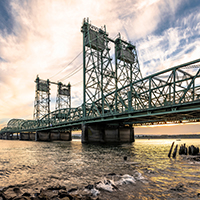
Following a successful lift to install the new main span last year, work is continuing on the Fore River Bridge in Massachusetts, with road decks on the approaches and lifting span expected to be completed by April this year.
No one would call the temporary bridge that was constructed in 2002 over the Fore River between Quincy and Weymouth, Massachusetts, a work of art. The bridge replaced a 1936 Art Deco gem that could no longer safely carry the 32,000 cars that cross the river each day. It is being replaced with a US$272 million steel vertical-lift bridge that will smooth traffic flow and reduce waiting times by opening and closing in half the time of the current, temporary bridge.
The design/build team White-Skanska-Koch was selected to build the new, permanent Fore River Bridge; a 1,500t bridge featuring a 99m-long structural steel lift span and 76m-high supporting towers. Each of the towers is situated on a 15m-high cast-in-place concrete plinth that is in turn supported on two individual pile caps at each end, supported by over-drilled shafts. In addition to the lift bridge, the project also includes a three-span approach structure on each side of the crossing. The expected life of the new bridge is 75 years.
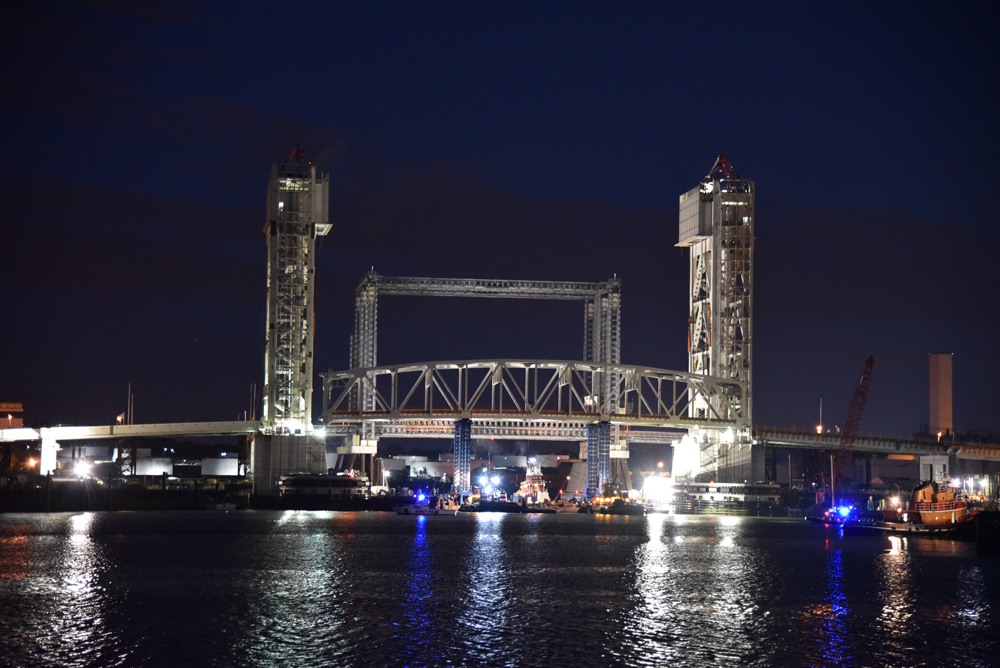
Although the bridge was originally scheduled for completion this year, the project suffered a setback in 2014 when the sheaves for the lifting span were damaged during transportation from Alabama. At 76m when raised, the new Fore River Bridge will provide 23m of higher navigational clearance than is available at present.
Larger ships will be able to pass beneath the new bridge, providing better access to the Fore River's designated port area, which was established to promote and protect water-dependent industrial uses. Even when set at its lower position, the 18m clearance will enable most vessels to cross without the lift span being raised, simultaneously improving both vehicle and boat traffic flow.
The Fore River Bridge is being replaced through the state of Massachusetts’ US$3 billion accelerated bridge programme. This programme, which officially concluded at the end of 2016, has reduced the number of structurally deficient bridges across Massachusetts and prevented others from falling into this classification.
Replacement of the Fore River Bridge is one of the most significant projects undertaken through this programme and, as the project is already budgeted, its construction will continue past the sunset of the accelerated bridge programme.
As is well known, the primary benefit of accelerated bridge construction is to minimise traffic delays. Its principles rely on three main methods of bridge construction: building prefabricated components off-site and quickly installing them once on site; building the entire structure off-site and moving it into place using a self-propelled modular transporter; and building the bridge off-line/adjacent to the existing bridge and sliding it into place.
In addition to building a crossing that would function well in cold and/or windy weather with minimal maintenance, the Fore River Bridge project was challenged with minimising disruption to vehicle and boat traffic during its construction.
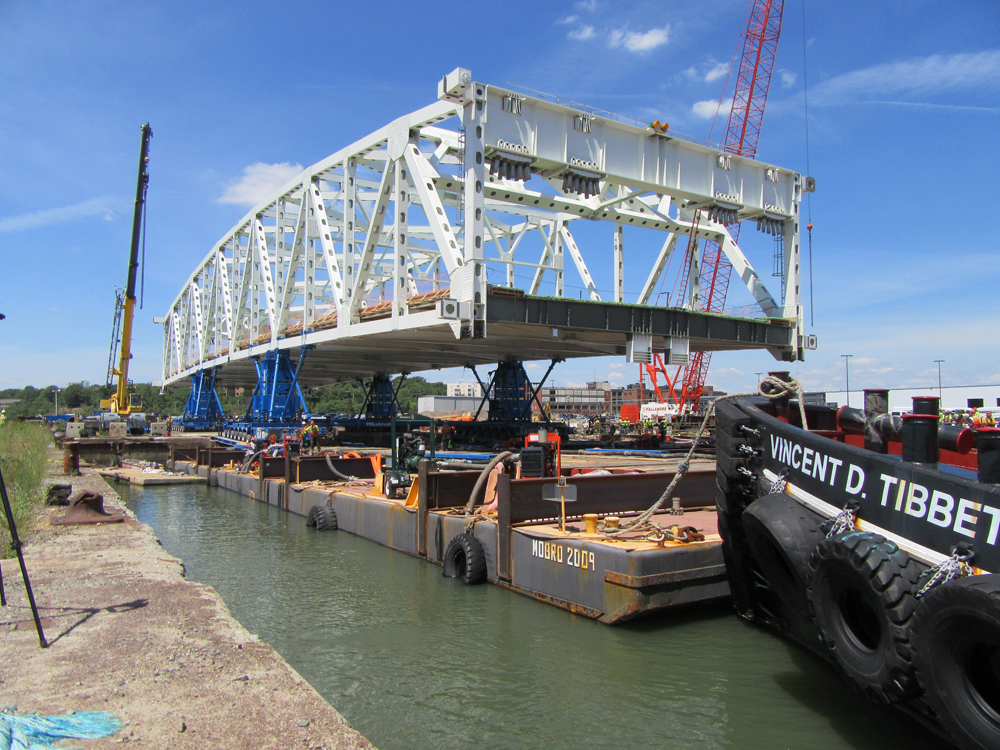
Safety was another primary concern, particularly while lifting very heavy loads into place from barges on the bridge. As per accelerated bridge construction principles, the entire Fore River Bridge was built off-site at the Fore River Shipyard and moved into place using a self-propelled modular transporter and a barge.
Charged with lifting the 1,500t lift span into place, Burkhalter Rigging worked with Enerpac to select the most suitable heavy-lift technology for performing the lift safely and correctly. The chosen solution was Enerpac’s JS-Series jack-up system, a custom-developed multi-point lifting system that typically includes four jack-up towers positioned under each corner of a load.
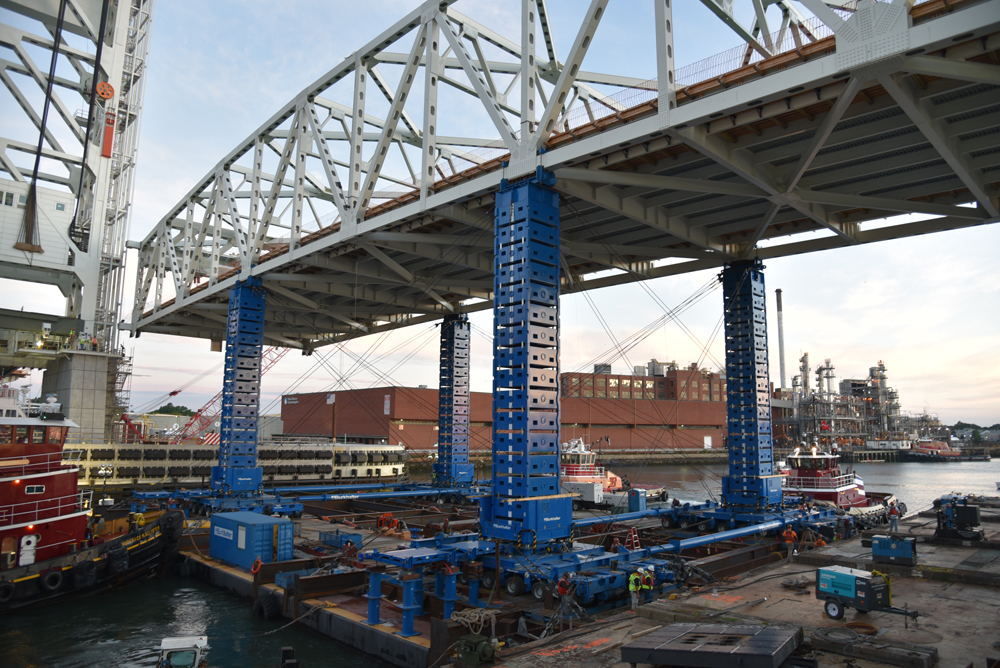
The four-tower set-up has a lifting capacity of 2,000t, 500t per tower. The lifting frame of each jack-up tower contains four hydraulic cylinders in each corner, with lift and stack steel boxes measuring 1m high and 2.3m by 2.3m. A load is lifted in increments as boxes are inserted via an automated system, lifted and stacked, thus forming the lifting towers.
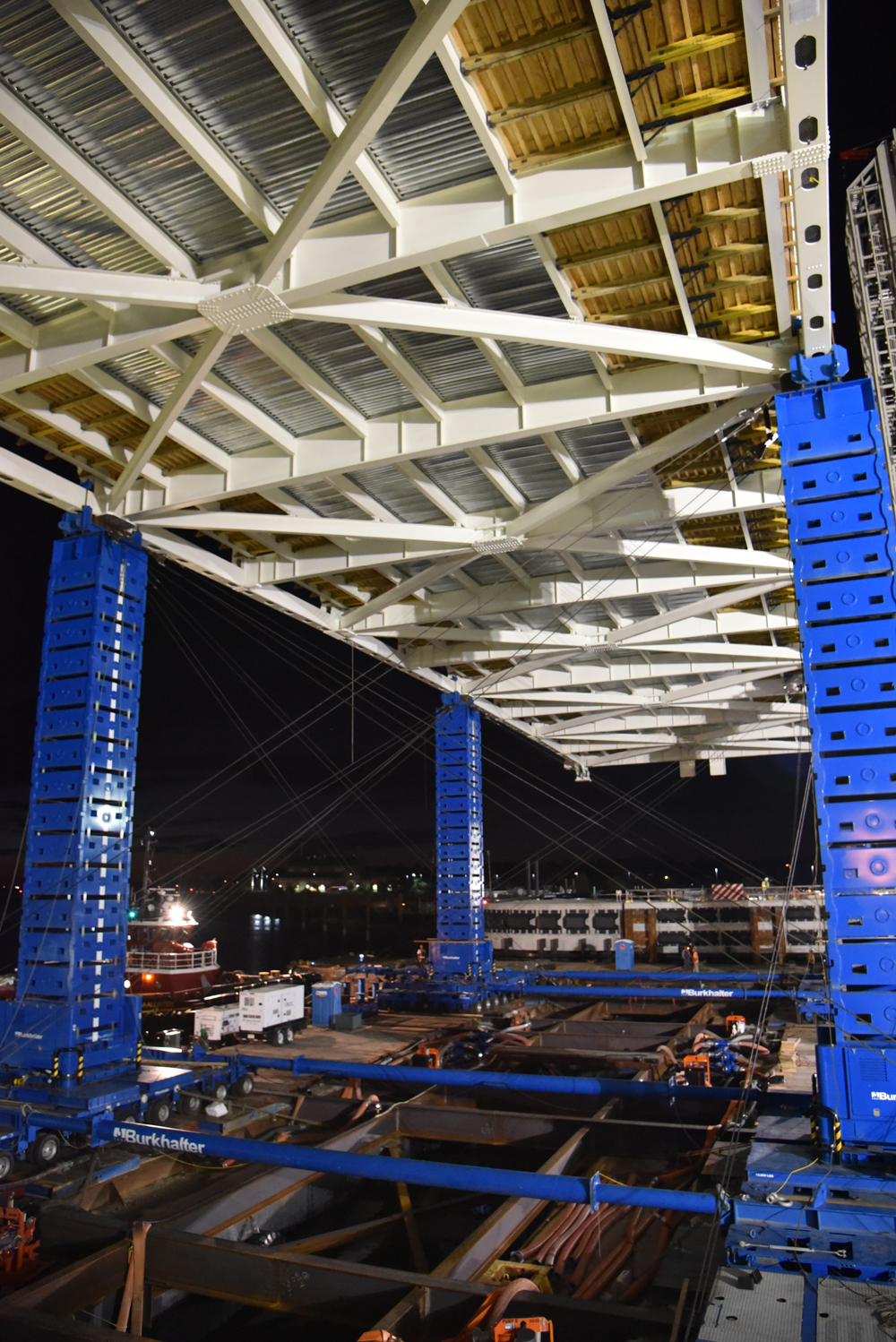
Once the new Fore River Bridge’s lifting section had been transported by SPMT onto a waiting barge, the jack-up was raised to its full height, 20m above the barge, in readiness for the lifting span’s installation. Shepherded by tugboats the barge made its way 1.2km down river where, on nearing the bridge, it was rotated and held in position between the two towers until the span was lowered naturally into place by the outgoing tide.
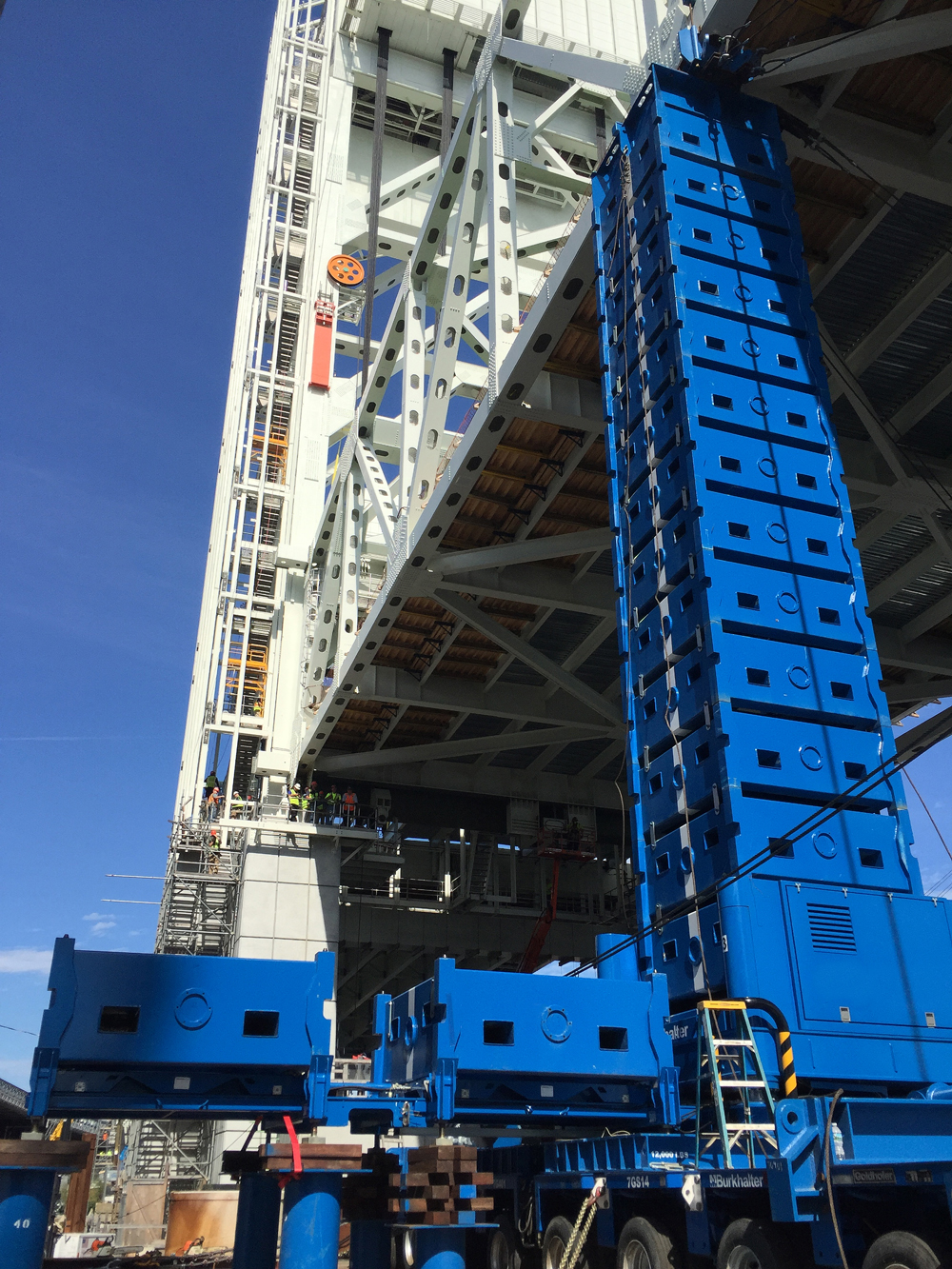
Supervised by an Enerpac support crew and an electrical engineer, the jack-up system provided the precision control that enabled the bridge to be held stably while being secured to the towers. Despite challenges including potential storms, general bad weather and moving water affected by two high tides and two low tides every 24 hours, the lift went off without a hitch, with the section floated into place at almost exactly the correct height.
As the river was closed to shipping during the lift window, it was critical to carry out the lift within the coast guard’s indicated lift time frame, to minimise disruption and enable river traffic to return on time.
Construction of the lifting span and towers, shipping protection, approach spans and rehabilitation of the retaining walls is expected to continue until April this year, after which work will start to connect the bridge to the approaches between May and October, 2017.
This phase will include a reduction in capacity on the temporary bridge while the approach ramps are connected to the new structure. Testing of the lifting equipment for the movable span will also take place in this phase. Traffic will subsequently be diverted onto the new bridge, so that the old bridge can be demolished with final completion currently scheduled for June 2018.