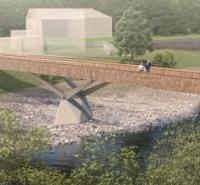

A new 'living bridge' over the River Shannon in the Republic of Ireland is designed to allow students at Limerick University to enjoy the natural landscape as they traverse the campus. Keith Brownlie and Conor Lavery report
Ongoing expansion of the University of Limerick has created the need for new bridge links across the river which now divides its academic buildings and student residences. The original location of the campus on the south bank of the river has been extended onto the north bank, an area which was first opened up for development with the completion of a road bridge back in 2004. The new footbridge, which was opened late last year, will make access much easier and more pleasant for students and staff.
The 150m-long 'salmon-tail' road bridge is located some 420m upstream. By contrast, the new footbridge is placed at the heart of the campus, providing a direct route for pedestrians across the river, its banks and floodplains. Wilkinson Eyre Architects and structural engineer Arup are responsible for the design of the new bridge; in fact Arup's link to the site goes back several years, when it worked with Murray O'Laoire Architects on the design of the road bridge. When the university decided to build the new footbridge, it commissioned Arup to carry out the design, and Arup invited Wilkinson Eyre to work with it on the project.
The two sides of the university are separated physically and visually by the River Shannon and the riparian landscape of the river corridor. This ecologically-sensitive and internationally-important environment is a hidden delight, and the design responds to this quality in its creation of a structure that threads through the landscape and invites users to engage with their surroundings. The bridge presents a deliberately modest visual statement, and spans the site at relatively low level.
Its 350m length follows a curved alignment, with six equal spans which each trace a 300m radius on plan. Each span is effectively an independent bridge structure crossing between table-like piers. The most southerly span crosses the pedestrian riverside walk and its environs, the four central spans cross a secondary waterway on the south side, and the river itself, whilst the most northerly span crosses the boggy floodplain. Each bridge deck varies in width from 7m at the pier to 4m at midspan, and the curved edge profile is counterbalanced by a tangential reverse-curve on the pier sections, creating a continuous 'pulsating' geometry that binds the component parts into a coherent whole.
At this location, the Shannon's water flow is considerably reduced by a hydro-electric diversion upstream, so the waterway is wide and shallow, and fragmented by islands of woodland growth in the channel. The horizontal alignment is arranged such that each river pier coincides with one of the wooded islands. The pier footings are designed as upstream extensions of the existing islands, and are intended to act as cutwaters to protect these transient landscape features from erosion and movement. From the riverbanks and the campus, the bridge is seen not as a continuous structure, but as a series of short bridges spanning between tree clusters.
For the pedestrian, the islands are effectively stepping stones, connected by spans like an ancient 'clapper' bridge. From each end the curving deck seems to disappear into the landscape; the other end cannot be seen, and the bridge user is temporarily enclosed within the natural environment of the river corridor. Views of the ultimate destination unfold as the journey across the bridge progresses.
A key component of the brief from the university was to provide a facility for enjoyment of the river landscape, as well as a linear connection between the two halves of the campus. To reinforce this situation the deck is separated into two delineated zones. On the outer edge of the curved deck a 2,560mm-wide continuous aluminium walkway provides a sinuous 'fast lane' for pedestrians. The remainder of the deck, with its bonded aggregate surface finish, varies from a narrow strip at each midspan to a wide gathering space at the pier locations. These spaces have seating and shelter against the backdrop of the tree canopy, and are intended to provide students with an off-campus location for informal meeting and study. The university speculates that the presence of the Irish World Performing Arts Village planned for the northern end of the bridge will result in spill-out rehearsal and impromptu performance on the bridge itself, giving rise to its Living Bridge title.
The bridge structural system is formed of six independent 44m-long spans with nominal 8m-long pier sections. The primary load-bearing structure is located below the deck in the form of a pair of edge cable-trusses, providing a restrained aesthetic and allowing unobstructed views from the deck. The choice of this unusual structural type was aided by the fact that the shallow water cannot be used for navigation, and the river experiences only limited flooding. At midspan, the clearance of the bridge above the river is just 4.2m.
Each truss measures 3m vertically at its deepest, from the centre of the top chord to the cables, and the tensile lower chord of the truss consists of three 40mm-diameter spiral strand cables. Profiled steel compression struts spaced at 2.2m centres transfer the applied loading from the deck into the cables, via cast-steel clamps at the base of each strut. The top compression chord consists of a 245mm-diameter grout-filled circular hollow section, which is set out on a horizontal radius of 160m. Each truss is inclined outwards from the deck at 22.36 degrees to the vertical, under permanent loading. The combined geometric effect is of a concave cylindrical segment on each side of the bridge.
Above deck, inclined parapet posts are configured as visual extensions of the cable-truss compression struts, reducing the perceived number of bridge components and reinforcing the cable-truss geometry. A 50mm-diameter stainless steel handrail follows the sinuous line of the deck edge and a tensioned stainless steel cable mesh provides transparent infill.
The deck structure consists of a longitudinal fabricated steel beam, which is inset from and integral to the cable-truss top chord. The longitudinal beams support 'fish-belly' transverse girders at 2.2m centres to match the spacing of the cable-truss compression struts. Longitudinal T-section purlins span between the transverse girders, and are parallel to the curved edge beams. Each bay is cross-braced by 42mm-diameter tensioned steel bars beneath the level of the T-beams, providing lateral stiffness to the deck.
The five pier locations have been designed to minimise their impact at ground and river level. They feature a steel deck supported on a four-legged steel tetrapod in an inverted pyramidal form. The cross-section of each member varies from a filleted square at its root to a circle at the top, where it flares to create an elliptical bearing plate. These are formed by cutting a 406mm-diameter circular hollow section into four pieces along its length and then welding individual tapered steel plates between the quarter sections. At the footing, the steel members are welded to a cast steel base-plate and the assembly is bolted to a profiled in situ concrete pile cap which looks like a four-leaf clover in plan. Each pile cap is supported on a single 1.8m-diameter concrete pile which is approximately 22m long and has a 2.5m-deep rock socket into the competent limestone bedrock.
The pier deck acts in tension to brace the tetrapod. On the western edge of the pier decks, a 'vertically'-cantilevered glass screen is inclined at the same angle as the adjacent parapet. The screen follows the curve of the d