
A major construction milestone was reached at midnight on 29 July 2021 on Pelješac Bridge as the deck of the extradosed cable-stayed structure was closed successfully. Set to be Croatia’s most iconic infrastructure asset, it will unite the mainland with Dubrovnik, which has been an isolated territory since the country declared its independence from Yugoslavia in June 1991.
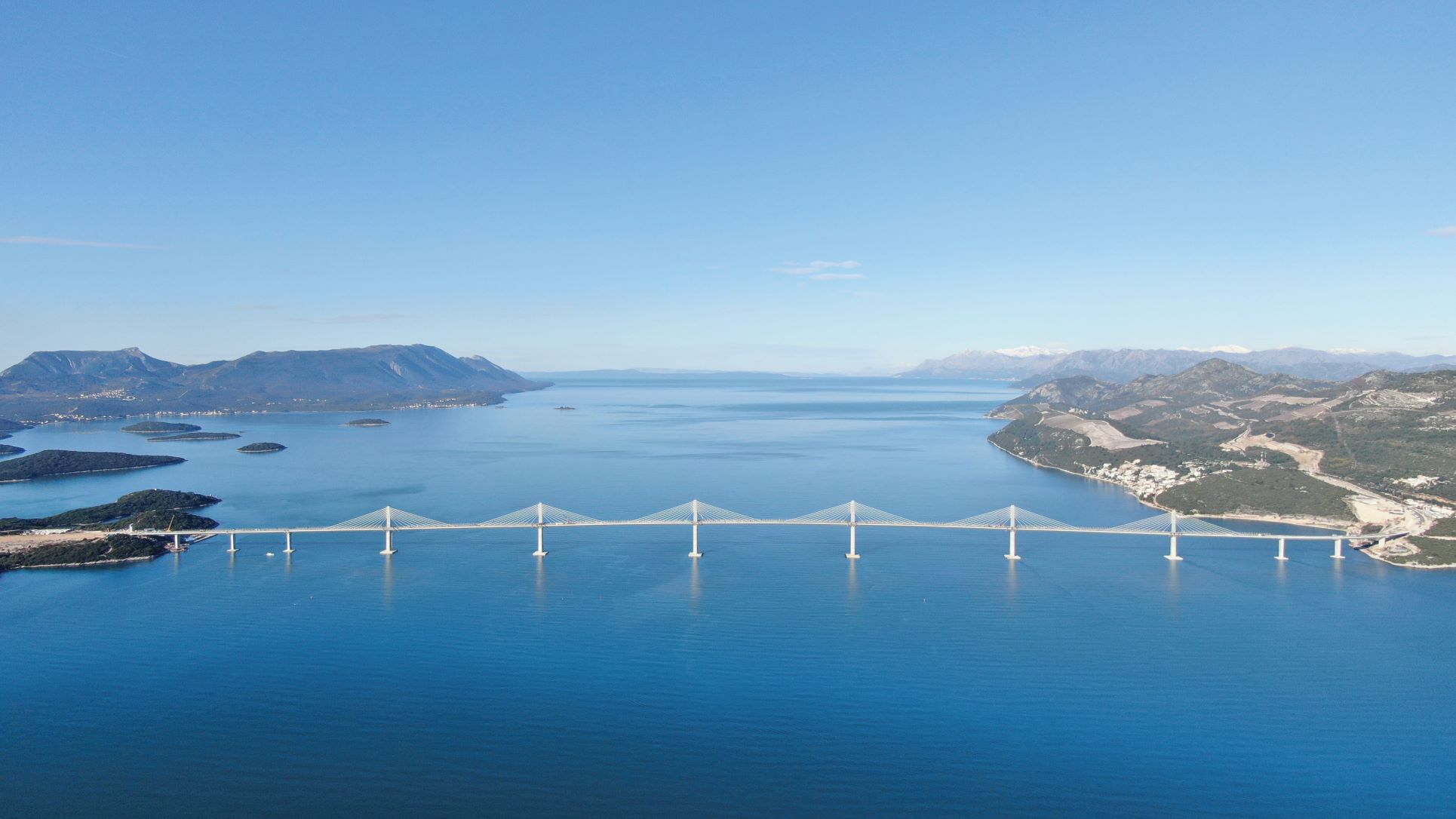 The bridge’s opening is now slated for summer this year (CRBC)
Construction started in August 2018 and is being undertaken by contractor China Road and Bridge Corporation (CRBC) for client Hrvatske Ceste. Although the outbreak of the Covid-19 pandemic has had a serious impact, many other unprecedented challenges have been overcome to achieve deck closure.
The bridge’s opening is now slated for summer this year, and will allow vehicles to drive across the Bay of Mali Ston, which lies between the northern part of mainland Croatia and the Pelješac Peninsula to the south. With a length of 2,440m including approach spans, the extradosed cable-stayed bridge has six towers with single central cable planes and five main spans of 285m. A total of ten supports are located in the water with two piers on land.
The required minimum navigation clearance of 200m by 55m was contractually agreed with Croatia’s southern neighbour Bosnia and Herzegovina, and the average depth of the seabed along the bridge alignment is 27m.
Steel tubular piles and box girders were adopted for the sub- and superstructures, respectively, with the corresponding quantity of steel used on the project totalling 31,000t and 34,700t. This accounted for over 74% of the entire bill of quantities, making the manufacture of the steel structures, their shipment, and on-site installation critical components of the project and a great challenge to achieve within a short period of time.
A total of 150 pieces of straight welded tubular steel piles were fabricated for the foundations, with design lengths ranging from 36m to 130.6m and a diameter of 2m. The proportion of piles with a design length of more than 100m exceeds 70%. The pile body comprises S355NH and the wall thickness is 40mm, while the pile shoes are 2m-long and made from S460NH with a thickness of 60mm. To provide corrosion protection for at least 25 years, the upper 33m part of the pile was painted with glass flake epoxy coating with a dry film thickness of 850μm. The steel piles are equipped with a cathodic protection system ensuring the lifetime of the main structure for up to 100 years.
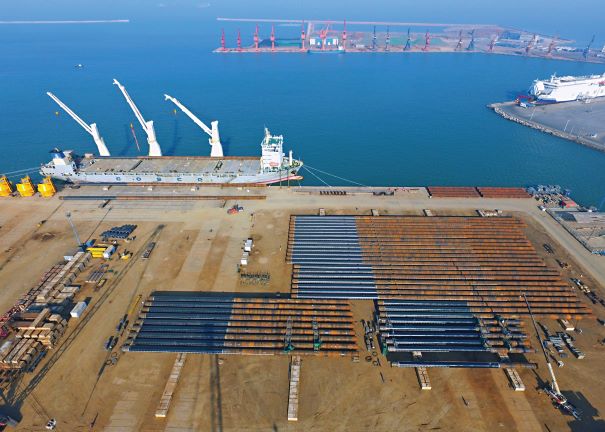 Steel tubular piles uploaded at the workshop port in China (CRBC)
According to the original proposed method statement, the tubular steel piles were to be first processed in two large segments over 60m long in the workshop and then spliced vertically in the air and welded on site. However, this would have compromised safety and product quality: First, it would have required the welders to enter the narrow pile body. Second, the preheating process is essential for the double-side butt weld of 40mm seams, and the wind and waves of the bay would have had a major influence on the quality of weld seams, meaning the construction platform and barges would have had to be anchored in the sea to make them as stable as in a workshop. Third, the execution class of steel structures for this project is the highest possible at EXC4 B+, so the construction period of the pile foundation could not have been ensured or fully controlled, and the welding of the thick steel plates, repair and non-destructive testing would have taken too much time on site. Fourth, erecting temporary offshore construction platforms and renting flat storage barges would have resulted in additional costs and time.
It was determined that a pile driving barge could be used instead of a floating crane to unload the piles from cargo vessels and transport them directly to their positions. The contractor abandoned the initially proposed method and decided to drive the whole steel pile to the design elevation using an extra large pile driving barge usually employed for pile construction of offshore wind power and oil platforms. As a result, the extra long steel tubular piles were entirely manufactured in China, and the cargo vessel transported them to the bridge site in six batches.
The fabrication of all the steel tubular piles was assigned equally to two steel fabricators, JSGG and AMP/PJOE, both of which have an annual production capacity of 150,000t and collaborated to reduce manufacturing time greatly. The mechanical welding process spliced the extra long steel tubular piles from 3m-long standard segments one after the other into three large components in excess of 30m. The large segments were then fitted together and welded with circumferential seams on steel bed-jigs in the workshop, and the entire manufacturing process achieved fully mechanised welding. When a sizable segment was completely spliced, pile shoes were installed as additional components, and the roundness and straightness as dominating dimensions of the piles were strictly controlled and checked.
The pile driving barge used in this project was 78m by 36m by 128m with a draft depth of 4.2m and displacement tonnage of 12,000t. It can drive piles with a maximum diameter and weight of 7m and 500t, respectively, and was the world’s largest pile driving barge at the time of its use. For this project it was equipped with a hydraulic hammer with a kinetic energy output of Ek max=800kJ – exceeding the 600kJ proposed in the design.
The maximum pile driving length was 133m and the average pile driving rate was two to three piles per day. The first permanent pile was driven to the design elevation on 20 January 2019, and the last pile was installed on 9 May that year. Due to the enormous influence of the famous ‘bora’ wind and the impact of marine customs clearance on each batch during this period, the effective working time was shorter than three months.
From starting production of the piles in November 2018 through to the completion of pile driving on site, the foundation works were accomplished within six months.
The superstructure of Pelješac Bridge uses the traditional box girder design and comprises a three-cell box with a 22.5m-wide and 4.5m-thick orthotropic deck plate. For this project, there were some 165 segments which were split up into the various erection methods required for their installation on site.
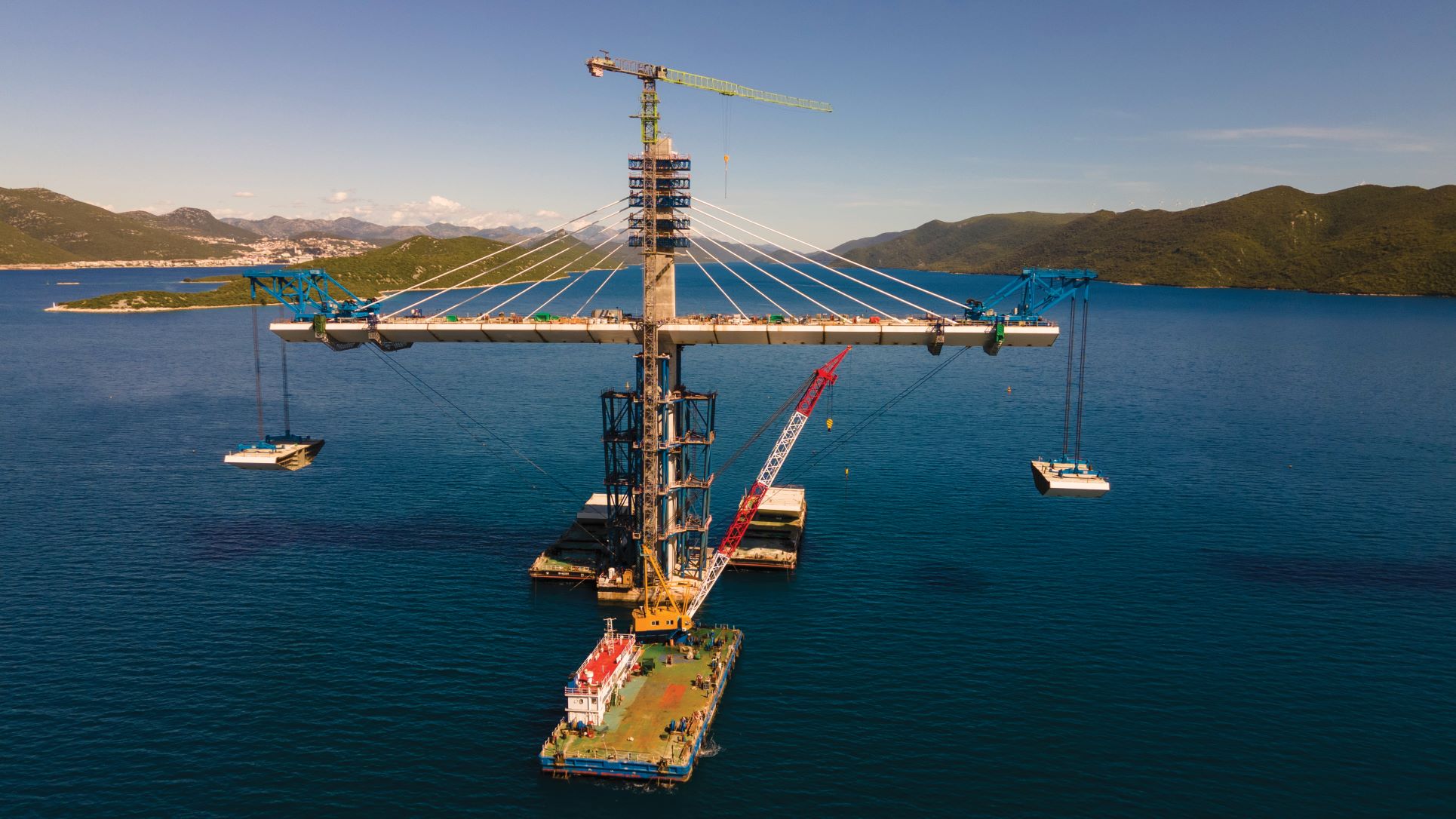 The installation of standard segments with the balanced cantilever method (CRBC)
For the main span, the segments were 12m-long and installed using the balanced cantilever method. Ten pairs of girders were installed for each of the six pylons using flat barges to transport them beneath derrick cranes which hoisted them into position. To speed up the installation of the bridge’s six side spans – which have a combined length of 657.6m – and decrease the amount of on-site welding, extra-long segments ranging from 36m to 56m were fabricated and lifted into place with a 1,000t-capacity floating crane. Curved and straight sections for the on-land portion of the bridge were 12m long and lifted with a floating crane onto temporary onshore platforms before being moved along skid tracks using hydraulic jacks.
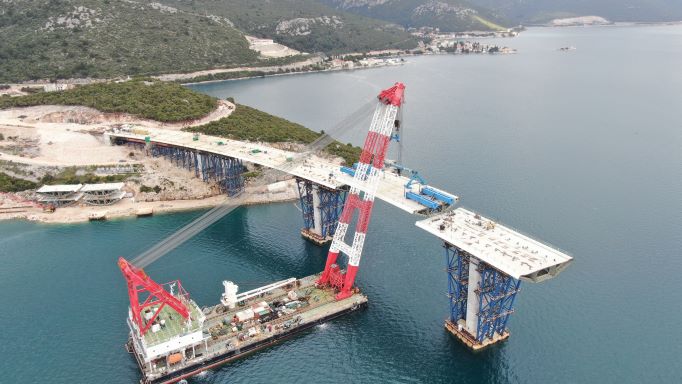 Unloading the first batch of steel box girders with the floating crane (CRBC)
To complete the superstructure, seven closure segments were also fabricated and installed using derrick cranes. Closure segments between the main spans were 18.6m long while those for the space between the side and main spans were 29.7m long.
The box girders were manufactured in China by ZPMG and CRBBG, who have an annual production capacity of over 250,000t. Both manufacturers are equipped with factory production control systems and are authorised with the highest execution class EXC4, as per European standards. The raw materials were purchased from Chinese steel mills which had acquired production licences under European CE-certified product standards. The huge plant capacity available from the nearby steel mills, as well as the short-haul distance, ensured a constant supply of steel plate during production, which started in August 2019.
The assembly workshops were equipped with 30t-capacity gantry cranes, which could ensure fit-up of up to 18 standard segments simultaneously, and the shop dimensions were large enough to allow the segments to be spliced in accordance with the camber design required. Automatic and mechanical operation and assembly were fully applied in this project, which made use of various mechanical equipment at each processing step.
Four U-rib orthotropic deck panel units could be welded simultaneously, significantly improving the deck’s fatigue-resistance capabilities. During on-site installation, closure segments were embedded into the openings and adjusted during constant midnight temperatures, with the gaps of the circumferential welds precisely controlled within 20mm.
High weld quality was ensured by improving the accuracy of manufacturing and assembly, and raising the level of mechanisation, which saw the need for manual polishing decrease remarkably. Furthermore, phased-array ultrasonic testing was adopted to cooperate with traditional NDT methods for high weld quality, and the frequency of NDT was higher than requested by the design specifications. High-quality weld appearance will also enhance the durability of the anti-corrosion system, which is key as the bridge is located in an aggressive coastal area with high humidity and salinity. All steel plate and weld surfaces have a three-coat anti-corrosion system with dry film thickness up to 320μm, zinc-rich epoxy primer, epoxy-based mid-coat, and polyurethane final coat. The welding and inspection of the superstructure on-site was accomplished in less than five months.
Once the six concrete pylons had been completed in February 2021, the contractor began installation of the 12m-long segments that make up the main spans, with the final closure segment raised and welded on 29 July 2021.
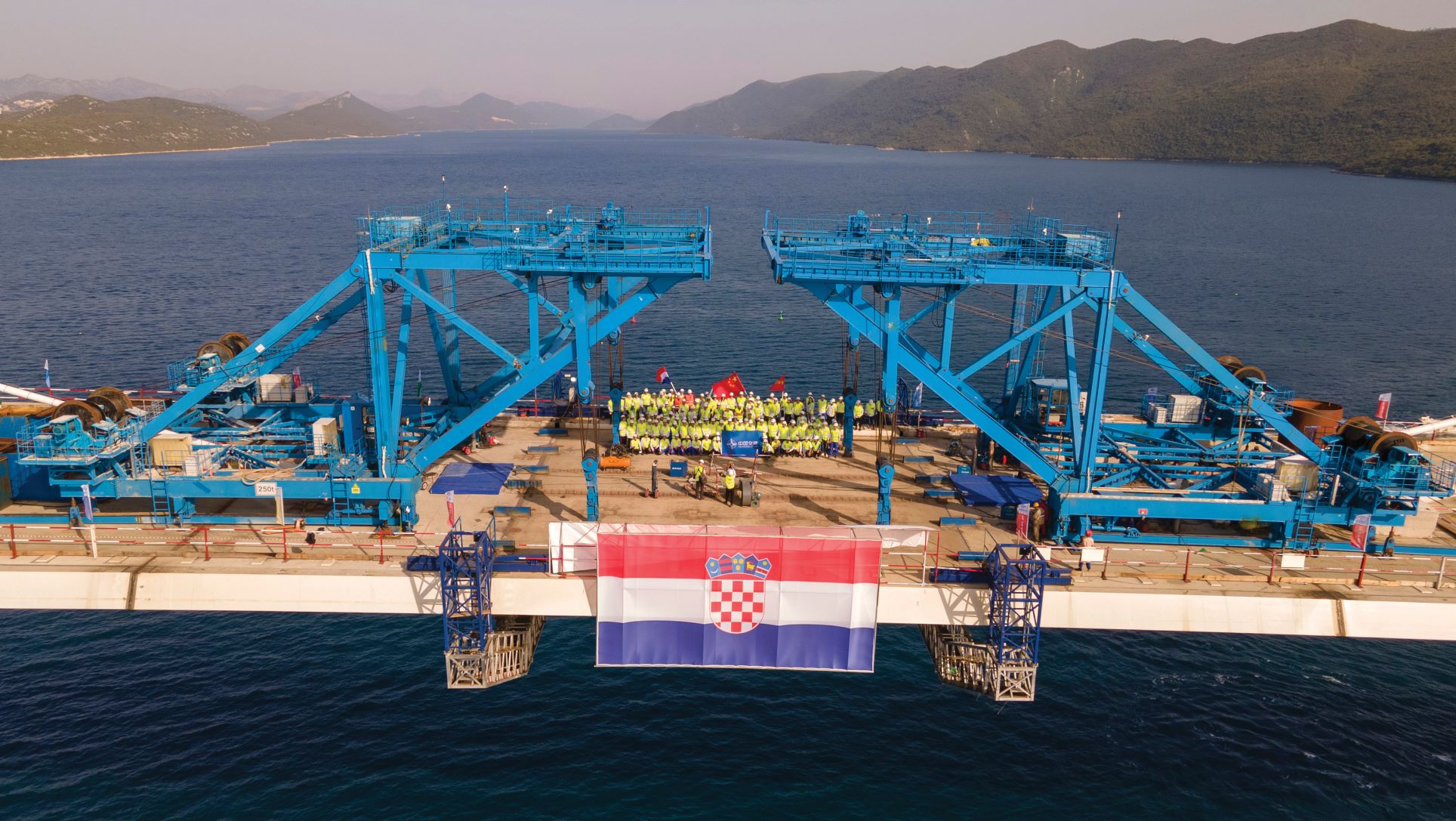 The last closure segment was installed on 29 July 2021 (CRBC)
There were more than 400 Chinese workers and engineers on site, including welders, assembly workers, NDT inspectors, and anti-corrosion professionals. The team was divided into three groups, which rotated in eight-hour shifts, allowing work to progress 24-hours per day.
Given the distance between the steel fabrication yards in China and the bridge site in Croatia, long-distance cargo shipping and equipment dispatch have been an essential aspect of the project. The tubular steel piles and box girders were transported from China to site in six and seven batches, respectively. Meanwhile, the contractor utilised a semi-submersible barge to dispatch numerous construction barges from China to the sites, including the extra-large pile-driving barge, anchor boats, flat storage barges, hopper barges, and floating cranes. During the full construction phase, there were up to 19 different barges on site at the same time. Due to the impact of the pandemic, CRBC mainly relied on the shipment resource of its parent company China Communications Construction Company (CCCC) to deal with ship shortages in the global shipping market.
The cargo vessel took roughly one month to arrive in Croatia, passing through regions with monsoons and strong ocean currents, which made it important to fix cargo firmly ensure safe shipment. Furthermore, steel box girders were sealed with waterproof materials to avoid their internal areas being polluted by seawater. During the shipment, each vessel’s stability was calculated and approved by international maritime organisation rules, while their structural strength was analysed and verified by a third party using the Det Norseke Veritas standard.
Following the global breakout of Covid-19 in February 2020, international commercial flights between China and Croatia were halted for more than six months. Because concrete works occupy quite a small portion of the overall project and there was a lack of skilled structural steel workers in the local area, the contractor used a charter flight to transfer Chinese engineers and workers to Croatia in August 2020 to meet staff demand. In addition, the contractor brought doctors on site to undertake nucleic acid testing and arranged vaccinations for all project staff. The entire workforce was required to wear face masks and to keep a safe distance from others in daily and work life. The majority of official meetings were held online and once someone was diagnosed with the coronavirus, they were isolated and given medical treatment.
At present, the contractor is completing the steel deck pavement and the installation of auxiliary structures. The bridge will open to traffic in the summer of 2022, and although the outbreak of the pandemic as force majeure had a serious impact on the whole project, the contractor overcame unprecedented challenges and mobilised worldwide resources to accomplish the connection on time.
Bicheng Tang is construction manager and CRBC representative of Pelješac Bridge. Xuefeng Wang is chief engineer and deputy general manager at CRBC Zagreb