Masonry bridges are associated with robustness, eternal life and a never-changing landscape but nevertheless they may undergo deterioration – albeit much slower than steel or concrete structures – and may become victims of scour and sudden collapse. This happened to Deba Bridge on 5 July 2018, when a 0.8m sudden settlement of the central pier provoked a partial collapse of the adjacent vaults, leaving the structure in a precarious condition and exposing it to a global collapse. The traditional methods used in the subsequent reconstruction of this pedestrian masonry bridge are rather unknown to today’s engineers, and therefore undoubtedly worth sharing.
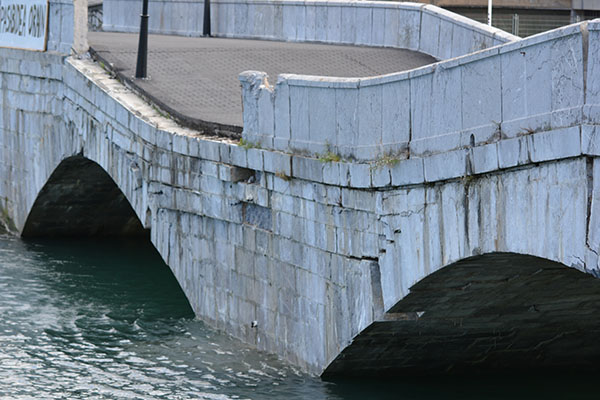 Partial view of the almost ruined Deba Bridge
Deba is a beautiful town on the western coast of Guipúzcoa – or Basque Country – in northern Spain. In 1866, a bridge was completed there that linked with the neighbouring and also charming town of Mutriku. The bridge consists of three main masonry vaults - 14.7m, 14.6m and 14.7m in length – plus a shorter fourth span. The masonry vaults are supported by two piers (10.57 by 3.7m) and circular cutwaters. The third pier has a larger width of 5.1m in order to support the unbalanced horizontal thrust coming from the adjacent masonry vault, as well as the forces from a former movable metallic structure. The pier foundations are on wooden piles set in muddy soil mixed with sand and pebbles. The main material of the bridge is grey ashlar limestone.
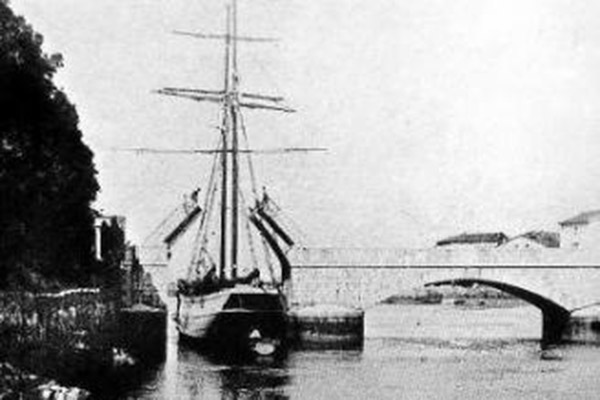 The Deba Bridge by the 1880s
Pier 1 and the adjacent vaults had suffered many problems in the past, until a strengthening operation was carried out in 2002. On July 5 2018 however, the sudden collapse of Pier 2 caused the greatest damage to the bridge to date. The river bed around the foundation piles of this pier had been washed away by the water flow, leaving the timber piles uncovered, but still standing. A species of saltwater clam, Teredo navalis, commonly known as naval shipworm, began to eat the timber piles, reducing their cross section and, consequently, their capacity to carry gravity loads.
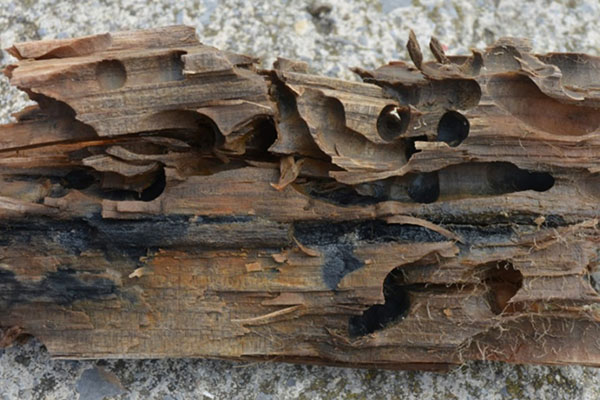 A portion of one eaten wooden pile from Deba Bridge
Due to Deba Bridge’s heritage and historical value, a rehabilitation process was undertaken to restore the bridge to its original configuration. The Guipúzcoa Provincial Council awarded the emergency works to contractor Freyssinet, who stabilised the bridge and saved it from structural collapse (Bd&e issue 95). Several limiting factors had to be considered in the process, including the influence of great spring tides, which ruled out any reduction in drainage capacity below the vaults. In addition, due to its damaged state, P2 could not be used to support any kind of auxiliary structure necessary for sustaining the partially collapsed adjacent vaults. All these constraints led to the deployment of a Warren-type truss movable scaffolding system (MSS) that was launched to finally rest on P1 and P3 during the course of the entire rehabilitation process.
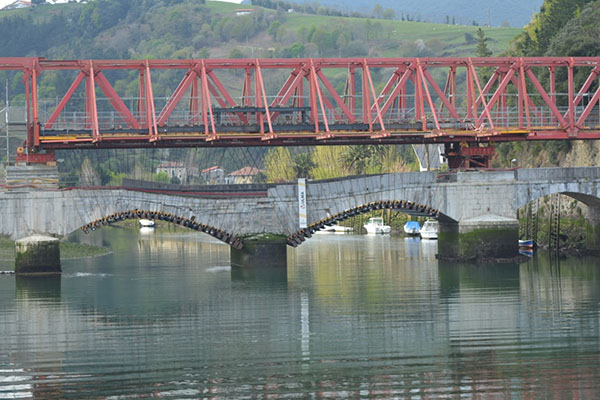 The MSS supported the damaged Deba Bridge vaults using a system of steel rods and ties
Before installing the MSS above the bridge, the foundations of P1 and P3 had to be reinforced with micro-piles to support the additional loads of the MSS and the vaults previously supported by P2. The temporary system designed to support the damaged vaults consisted of under-vault modules suspended from the lower horizontal chord of the MSS through a set of two types of steel rods: vertical ties to adjust the position of the modules; and ties following the radial direction of the vaults to actually support their load.
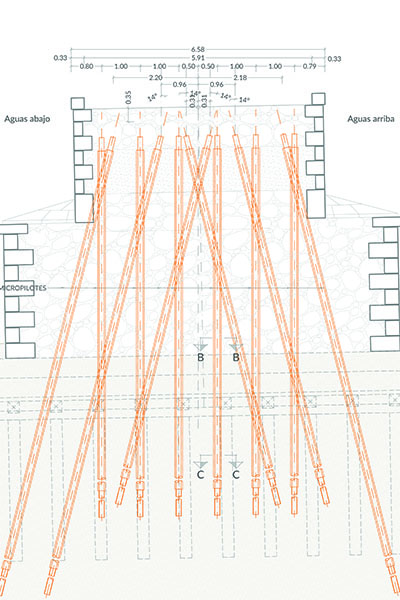
Layout of micropiles
The reconstruction team was comprised of engineers from Fhecor and Injelan. The works consisted of a number of steps, starting with foundation strengthening. These were started in April 2021 by the contractors Moyua and Harri and focussed on strengthening the foundation of P2. A set of micropiles 37m long and 200mm in diameter were installed to carry the entire estimated load of P2 in its final position. As hammering was explicitly forbidden to avoid damaging the masonry, drilling in the body of the pier was carried out exclusively by rotation.
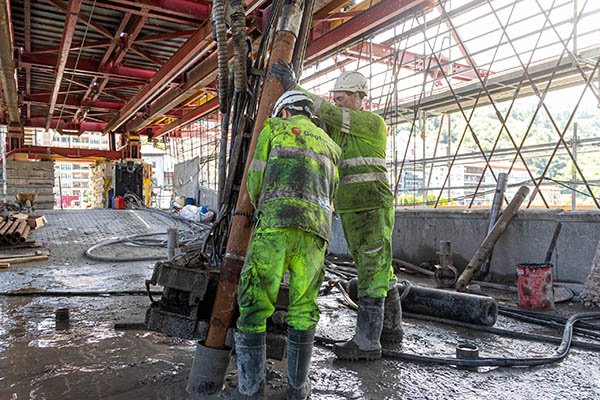 Execution of a micropile
The first part of the rehabilitation process consisted in removing the pavement and the backfill between P1 and P3. As the reconstruction technique adopted for the restoration was anastylosis, the central vaults had to be disassembled and later reconstructed using the existing voussoirs as much as possible and, only when necessary, new masonry. Since each piece was of great value, the attempt was made to save most of the stone blocks, which for some meant repair. The technical team established a set of criteria to define a unique identification code for each block.
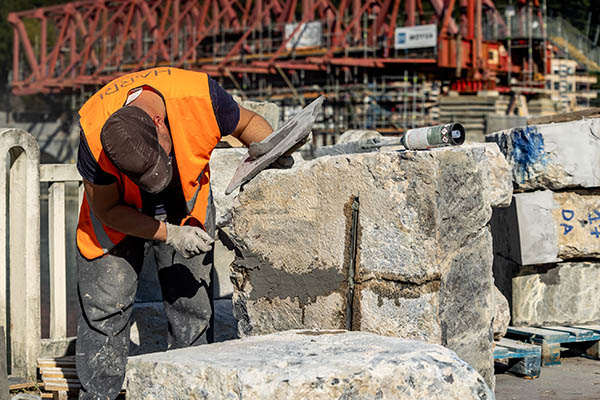 Restoration of a voussoir
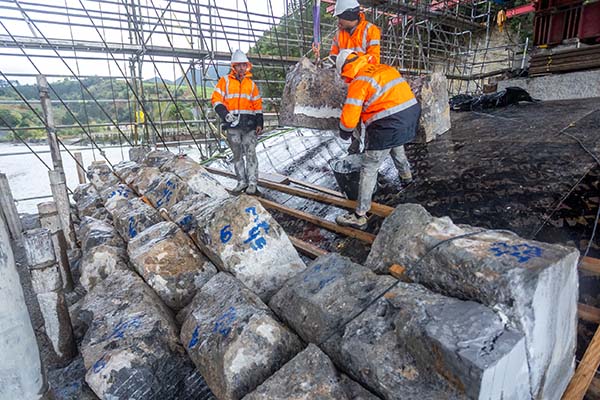 Numbered voussoris arranged on the scaffolding while reconstructing
The bridge disassembly process began with the transfer of the self-weight load from the vault to the supporting steel structure. Although the vault was severely damaged, it still worked under no negligible compressive forces. In order to extract the stone pieces, such compression forces had to be, at least, partially released. The MSS, in combination with the rods and modules, was crucial in this task. The vaults disassembly started with the keystone of V2 and V3, followed by two to three adjacent rows. After that, the process continued by removing ashlars symmetrically in both vaults.
For the next stage of the restoration the project engineers considered it essential to assemble a full-scale masonry arch mock-up that could be used to test the proposed construction techniques and the defined geometry. The mock-up arch consisted of masonry blocks sourced from the arch ring on the downstream side of V3. Notably, none of the arch joints opened up either on the day that the structure started working by itself nor the days that followed. Furthermore, the vertical displacement of the key could be assumed as zero.
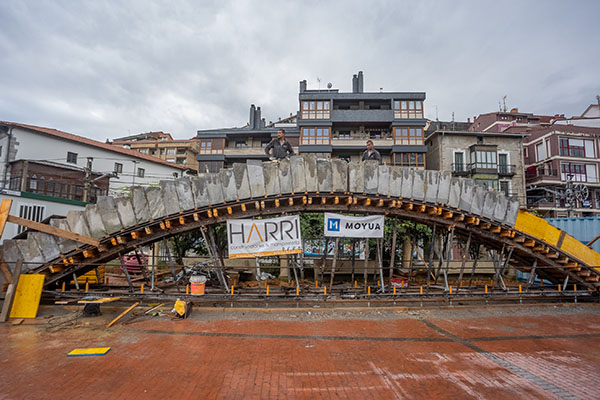 A full-scale masonry arch mock-up was constructed to test the construction techniques and defined geometry
There were two possible solutions for P2, which had experienced a vertical dis-placement and a downstream differential settlement. The options were either to dismantle the pier as far as where it made contact with soil, or to dismantle the impost and arrange two new courses consisting of a lower course of variable thickness and a regular course on top. Although attractive, the first solution was discarded because it was much more expensive. The second solution was then adopted.
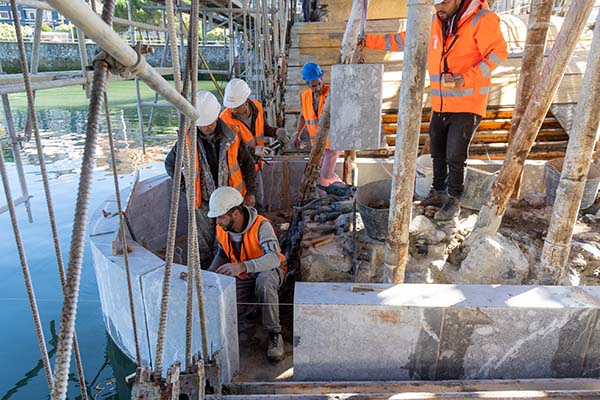 New courses were laid to recover the height of Pier 2
For the reconstruction of V2 and V3, the modules formed by metallic beams and wooden panels were adjusted to obtain the optimal geometry. Nevertheless, the module on the vault key was free to move independently from the others, as it was crucial to avoid mistakes in the geometry of each half arch, which would affect the geometry of the other half.
The reconstruction process began symmetrically from P2 and in each vault. In order to ensure adequate filling of joints, the technical assistance team was supported by Sika Spain in the use of an additive in the hydraulic lime. This led to a low viscosity grout with good mechanical properties that were confirmed by on-site tests. Finally, the last and most crucial stage was to fit the blocks in the key row to ensure the vault would work after removing the centring. Although some stone blocks had been lost and others damaged or fully cracked, fortunately it was possible to reuse most of the original pieces.
The vault-supporting structure – ie MSS and suspended rods – allowed the geometry to be adjusted during the construction phase. Each piece that was laid could cause a small drop in the centring, but the geometry could be corrected by readjusting the length (or tension) of the tie rods to avoid major errors at the end of the process. As geometry is obviously the prevailing criterion in building masonry arch bridges, this phase of the project was the most critical and thus required extreme precision to obtain the expected result.
Wooden panels while adjusting the optimal geometry before reconstruction
Prior to the decentring and the consequent compression due to self-weight in the vaults, backfill and spandrel walls, it was necessary to engage the confining action of the piers. This was obtained through horizontal rods anchored as close as possible to the external surface, but without affecting the final aspect of the completed walls.
After the vaults had been fully reconstructed and the piers’ new structural system completed, work progressed to decentring V2 and V3. The process had to be done symmetrically in both vaults. It consisted of gradually lowering the steel and timber modules using jacks to release tension from the tie rods, starting from the keystone module and continuing towards the vaults springing. It was possible to observe the gradual detachment of the vault from the centring. From that moment onwards, piers were supporting the weight of the vaults, and the vaults were properly working in compression.
The vertical displacements of the four external arch ring keys were around 4mm, reaching a maximum value of 6mm in V2 and 8mm in V3 in the days that followed.
The reconstruction of the vaults represented the most critical and delicate phase of the process. Thanks to the technical team’s meticulous and systematic approach, the main elements of the bridge were successfully restored. After removing the MSS, the process continued with reconstructing the spandrel walls, the impost and the parapets in order to complete the structure. Additionally, a longitudinal drainage system was installed, as well as the pavement. Many details can be appreciated from the final result of the bridge, such as the perfect coherence between the new and old stones in terms of colour and texture. In fact, a thorough bush hammering was used to confer the same appearance on the new masonry blocks as on the old ones.
In conclusion, this reconstruction and overall rehabilitation represented a technical challenge for the working team, which had to face the total disassembly and anastylosis-based reconstruction of two partially collapsed vaults of a bridge with special protective designation. The importance of an effective classification criterion for an anastylosis process was illustrated and proven to be achievable without any notable difficulties. The reconstruction of the vaults was carried out step by step as in their original construction, and following the stereotomy techniques described in ancient treatises on masonry bridges, while also adapting them to modern auxiliary means such as the MSS and overhead cranes instead of wooden centrings and clamps. Moreover, as was common practice in the past, an on-site full-scale mock-up of a stone arch was built to assess the correct building procedure as well as to estimate possible deformations and movements. As a result of these initiatives, the bridge was restored to its initial configuration.
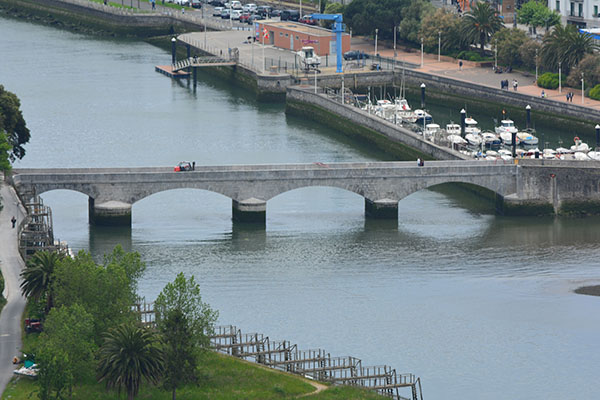 Deba Bridge shortly before reopening to the public
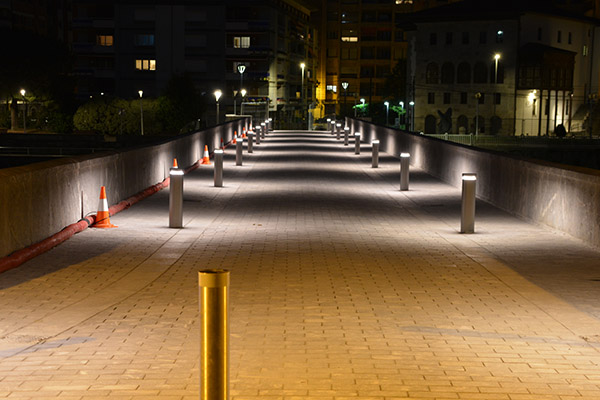 Night view of the bridge shortly before reopening
Javier León is a civil engineer at Fhecor and a professor at the Higher Technical School of Civil Engineers of the Polytechnic University of Madrid