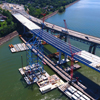
After a set-back during its construction, a new bridge over Ethiopia’s Omo River had to be recovered and rebuilt. Being the only crossing of this major river, the bridge is a crucial one for the country’s highway network and development of the region. It is on a major Ethiopian transportation route connecting Addis Ababa and the future agricultural region near the border with South Sudan and Kenya.
Important developments in the sugar production industry and oil prospecting are planned for the other side of the river. The bridge lies approximately 800km south-west from the capital Addis Ababa and links the Jinka and Kelem banks near Omorate town.
The crossing was designed as a two-lane bridge which had a 36m-long approach bridge on the Jinka bank, a 128m-long main span truss and a 36m-long approach bridge on the Kelem bank.
Both approach bridges are designed as conventionally-reinforced cast in situ concrete box girders, while a Callender-Hamilton type steel truss is used for the main span. Initial attempts to construct the bridge were not successful, and a new contractor had to be brought in to take over the contract.
The original construction process involved the main span truss being launched from the Jinka bank of the river using a temporary launching nose extension attached to the truss. The approach bridges were due to be built after the truss had been launched into position and the nose removed.
But client Ethiopian Roads Authority reported that under the previous construction contract, the main span truss and the nose were assembled on the Jinka side in early 2011 and truss launching began in April 2011.
During the launching operation, just as the launching nose reached the pier on the Kelem side, the connection between the truss and the nose failed causing the truss to rotate around its supporting points at the Jinka pier. The truss rotation only stopped when the bottom chord end node reached the river bed.
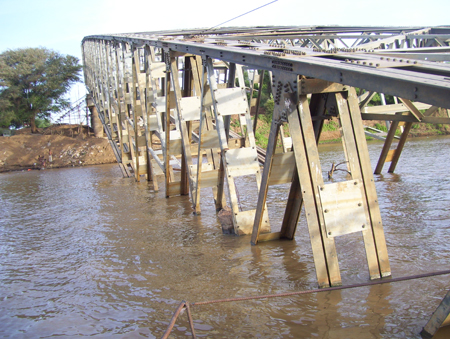
In 2012, the Ethiopian Roads Authority contracted Pan Africa Construction Engineers, commissioning them to carry out bridge recovery using a concept solution developed by VSL Heavy Lifting in Dubai.
DNEC was employed by VSL as engineering consultant for the project. Some pictures taken soon after the accident show the truss lying parallel to the longitudinal axis of the bridge. The initial plan for the recovery operation involved rotating the bridge around the existing temporary supports first and then launching the truss into its final position. This launch would be carried out using a 45m-tall temporary tower constructed on the Kelem bank, and a retaining cable connected to the approach abutment on the Jinka bank.
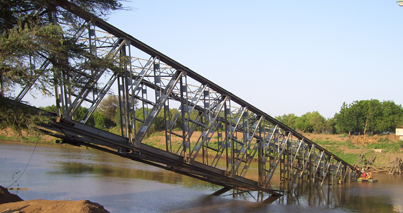
But during the months after the bridge collapse took place, the truss end which was next to the Kelem bank was washed downstream by the river flow, causing serious damage to the bottom chord and secondary members that were supporting the truss on the Jinka pier. The extent of the damage demanded fundamental changes to the recovery procedure to allow the damaged members to be repaired before launching could begin.
As a consequence, a recovery job that was already quite demanding became an even more serious engineering challenge. The anchor points for the retaining cables had to be relocated to the Jinka pier, the retainer cables also had to be reconnected beyond the damaged truss members and the bottom chord of the truss had to be strengthened.
Three additional temporary towers had to be introduced to ensure stability and geometry control during the repair works. Moreover, once the capacity of the Jinka pier to receive and transfer retainer forces to the foundations had been assessed, it was discovered that the pier needed major strengthening works.
Design of temporary works had to take into consideration the unknown weight of the nose, which was still connected to the truss. There was also a risk that the nose would be stuck into the river bed; it was very difficult to assess the actual conditions at the site due to the fact that there was near-zero visibility in the Omo River water.
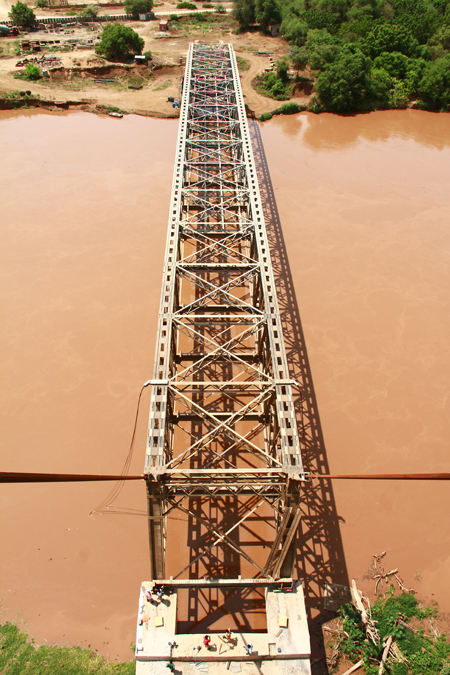
For those reasons it was decided to use two 330t-capacity VSL jacks in order to have approximately 50% reserve in lifting capacity for the operation to rotate and launch a truss weighing approximately 500t. Connection of the lifting cables to the steel structure also had to be carefully assessed, as the bridge had not originally been designed for such an eventuality.
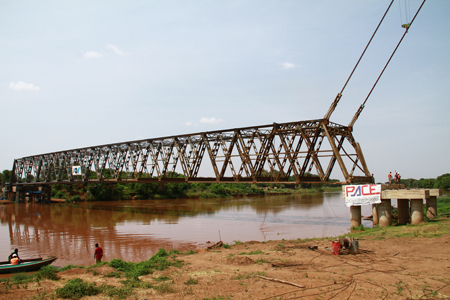
Strengthening of the truss required the addition of more members, hence the contractor had to carry out underwater welding in a river which was inhabited by crocodiles, with zero visibility in the water – all in a very remote region. Additionally the client wanted to use locally-available Bailey bridge sections for the construction of the 45m-high temporary tower.
Due to the relatively low load-carrying capacity of Bailey bridge sections under compression, special attention had to be given to bracing the tower legs. The recovery was carried out in three steps by a team which consisted of half a dozen nationalities. The first step involved the rotation of the truss; the truss was shifted 400mm to the side over the Jinka pier until it was aligned with the bridge axis.
It was then rotated further until the truss was supported on the temporary towers located near the Jinka pier. Truss repair works involving the cutting and removal of damaged members were then carried out, followed by adjustment of the truss geometry using hydraulic jacks located on the temporary towers and installation of new members.
Once the repairs were completed, the truss was launched over the river and placed in its final position. The launching operation was conducted from a control room on the Kelem side of the river, using a wireless system to synchronise the release of retaining cables, with the lifting jacks on top of the towers. Three additional sets of strand jacks were required for the control of towers verticality and bridge alignment.
Marwan El Jamous is Omo Bridge project manager for VSL Heavy Lifting; Nenad Jovanovic is managing partner of DNEC Abu Dhabi.