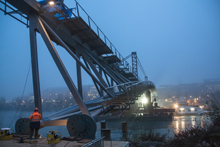
The cable saddle weighs approximately 450 US tons (408t). The curved top is designed to carry the cable over it twice, making it one of the few double cable saddles in bridge construction and the largest and heaviest for a suspension bridge. The base is 7.25m long and 6m wide. At the saddle’s curved apex, it is 4.2m tall.
The operation to lift the final structural piece into place on the tower started at 6 am, completing in the early evening.
Strand jacks hoisted the steel saddle more than 152m into the air to place it onto a single steel component known as the grillage that was placed atop the four tower legs on 15 April. This grillage will distribute the weight of the cable saddle, and eventually the cable, amongst the four tower legs.
The saddle, which was cast in Japan, will carry the SAS’ 1.6km single cable. The self-anchored suspension bridge’s cable will be anchored into the deck. The cable will anchor into the east end of the roadway, travel up and over the tower to wrap around the west end before traveling back up and over the tower to anchor back into the east end.
"The 2.6-foot-wide [0.8m-wide] cable will act like a giant, unbelievably strong sling," said Caltrans spokesman Bart Ney.
The tower will be complete this summer when the tower head is placed. The new East Span is key element in a bridge seismic upgrade programme overseen by the Toll Bridge Program Oversight Committee, made up of Caltrans, the Metropolitan Transportation Commission's Bay Area Toll Authority and the California Transportation Commission.