
The second of a pair of five-span continuous steel structures which will create a new bridge over the Spree River is currently being assembled in Berlin, Germany ahead of a two-day shipping closure.
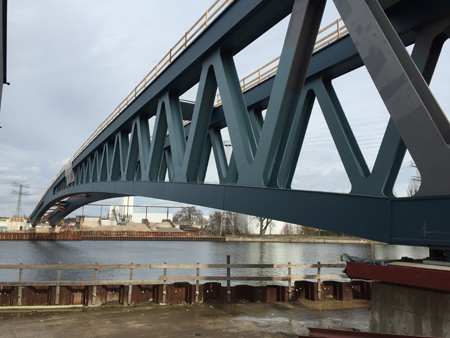
The 415m-long bridge, which has a 158m-long main span, is being built on the river bank ahead of a complex procedure that is set to take place next month (June). Not only does the bridge have five different span lengths, but it is curved in plan and elevation, adding another layer of complexity to the erection process.
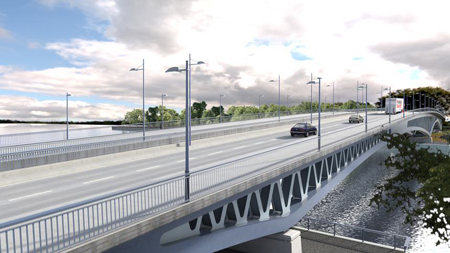
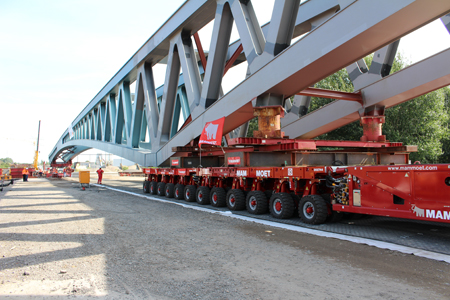
Next month the front end of the main span will be jacked up on self-propelled modular transporters and shifted forwards onto a pontoon, linked to hydraulic jacks on the other side of the waterway by steel strands. The barge will be pulled across the water to the other side, with the busy waterway closed to shipping traffic for two days.
Luckily the team working on the project has the benefit of having already carried out the launching operation once, to install the eastbound span, so the second weekend closure is expected to be a more straightforward process, with lessons learned being brought into play.
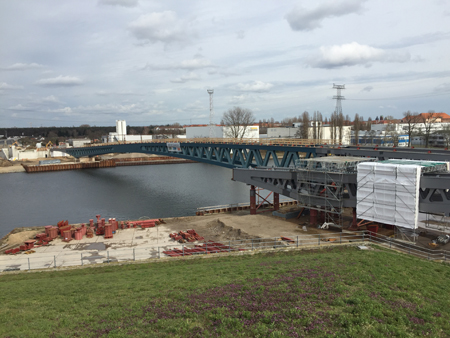
The new bridge is being built for client the Berlin city authority (Senatsverwaltung für Stadtentwicklung & Umwelt) as part of the new south-eastern link, and will supplement the existing river crossings, improve access to an area of the city which is being redeveloped, and alleviate traffic congestion on local roads .
According to the city engineer Lutz Adam, the concept chosen for the new structure was to combine a conventional beam bridge with low slender arches. The design of the crossing has been carried out by Schultz-Brauns & Reinhart Architekten und Stadtplaner BDA, and Ingenieurbüro Grassl and the emphasis on the spans was a conscious decision to have them lengthening towards the main river crossing – the shortest, next to the abutments are just 45m long. From the west abutment to the east, the five spans have lengths of 45m, 70m, 102.5m, 157.5m and 45m, which gives the structure an harmonic appearance, says Adam. The main span itself is asymmetric.
The twin bridges will be 3.9m apart once they are on their permanent alignment, and each will carry two highway lanes as well as separate cyclepaths and pedestrian walkways. The concrete superstructure is added to the steel once the launch is complete – on each structure the deck is 12.45m wide in total which includes 6m for highway traffic and 5.15m for the cycle path and walkway combined.
The bridges share the same abutments and their fixed point is located at the west end of the main span – all other piers have movement bearings. The structural depth of the steel deck superstructure ranges from 1.2m at mid-span to a maximum of 10m at the piers, and works as a truss girder. It is only solid across the mid-span section; the remainder of the girder is designed as an open truss to give the bridge a lighter appearance.
Creating a ‘gateway’ for drivers was also considered important, and the crossing will have 6.5m-tall lamp sculptures at each end when it opens to traffic.
The approach spans of the bridge on the west side of the river cross a former industrial area, which required intensive remediation prior to the start of construction, Adam explains. Radioactive material was present in some parts of the site, and this had to be excavated and removed for proper disposal before any work could begin. And industrial waste was not the only problem below the surface: “Ground which was not contaminated was peat,” he adds. Foundations for the main span are mass concrete, raft foundations, while raked concrete piles up to 20m deep are used for the other piers.
Consultation on the new crossing was completed in 2012 and construction, which is being carried out by contractors Glass, Matthäi and Zwickauer Sonderstahlbau, began in 2013. The original programme was for completion in 2016 but this has now been pushed back to 2017 due to a number of factors, says Adam. Under current plans, it is possible that one bridge will be opened as soon as it is completed, at the start of the year, with full completion expected in August of the same year.
One of the issues that has affected this project in particular is the current skills shortage in Germany, says Adam. “There is a real lack of experienced and knowledgeable bridge engineers,” he says, “and we don’t have enough operatives with expertise in steel and concrete construction.” A lack of steel fabrication capacity in Germany is another issue that has been problematic.
With a large proportion of welding required on site, getting skilled welders has been a major challenge for the contractor. Steel is delivered from ZSB’s fabrication plant in Zwickau, some 300km south west of Berlin, in sections of up to 70t weight and 4m width. Elements for the top and bottom chords are brought as separate pieces, and the truss connections are all welded on site in huge tented enclosures which encapsulate the steel assembly. The boxes are welded airtight to prevent internal corrosion, and this is tested by a 24-hour air pressure test once welding is completed.
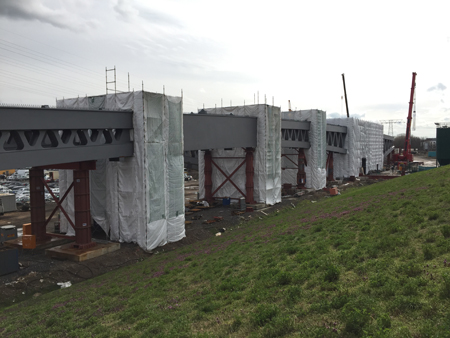
The east and westbound carriageways are being built as two independent bridges in order to provide redundancy for future maintenance work as necessary. “It’s a must these days,” Adam says. However this does require two separate closures of the waterway to launch the two spans, and this can only be done for up to three days maximum at a time, he explains. Due to the fact that it is an active shipping channel, no construction works were permitted in the waterway, and a six-week notice period is required to close the channel to boats. The River Spree is not a major shipping channel at this location and is more commonly used by pleasure craft.
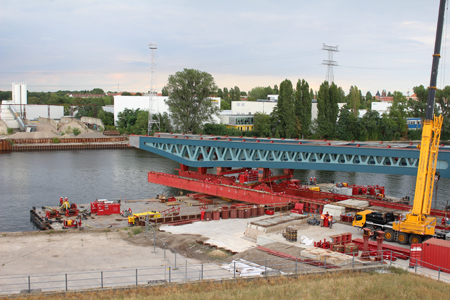
The launching operation, which is scheduled to take place next month, involves longitudinal translation of some 230m of steel truss – the whole of the main span plus cantilevers of side spans at each end. Two sets of SPMTs will be used, one at the front and one at the rear, and the whole deck assembly and temporary intermediate supports, weighing some 2,000t, will be pushed forwards until the front set of SPMTs is on the pontoon. The movement of the pontoon will be restricted by cable anchors during the launching procedure, and a boat is also used to redirect the pontoon if necessary.
Subcontractor Mammoet which carried out the first span launch will be back to repeat the procedure with the second.
Once the launch is complete, assembly of the remaining steel trusses will be carried out on each side of the main spans before casting of the concrete deck can begin. A special movable formwork carriage is used for this process, to pour the concrete deck slab which is up to 450mm thick and ranges from 18m to 25m long.
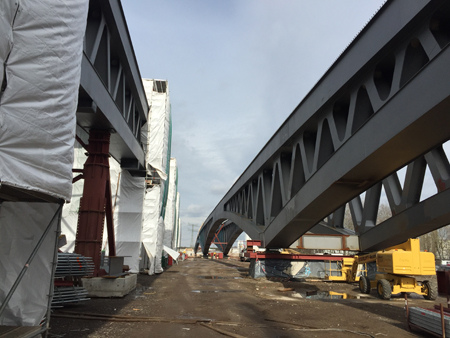
When Bd&e visited the site at the end of March, construction of the deck on the first of the two bridges had just begun. The steel superstructure for this bridge had been launched into place in August 2015 and since then, the remaining spans had been assembled. The first five concreting steps east of the abutment were carried out one after the other, and then the contractor was planning to progress the casting on alternate sections. Construction cost of the bridge is approximately US$54 million.