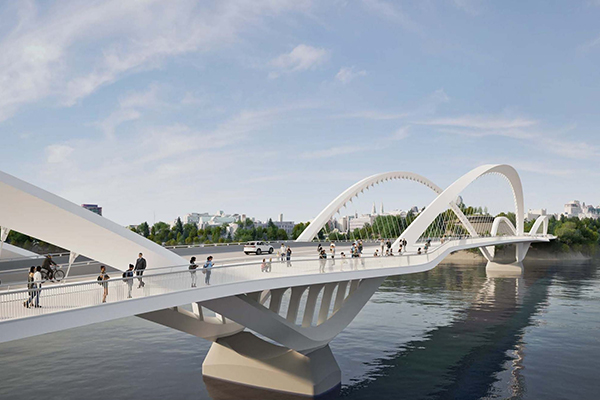
The replacement Alexandra Bridge between Ontario and Quebec is being delivered using the PDB model (Government of Canada)
The development of alternative procurement and delivery methods provides bridge owners with more flexibility in how they manage new construction projects. But how do these methods work, what are their advantages, and how should owners decide which to use? I spoke with Marwan Nader, senior vice president, bridge sector leader, and chief bridge engineer at global infrastructure services company TY Lin, to explore these questions.
“In North America, there is a shift from the design-build project delivery model to a more progressive design-build approach,” says Nader. In the design-build model, contractors first qualify to their bids by meeting minimum requirements, followed by a low-bid process where teams have a certain window of time to submit proposals and compete on cost.
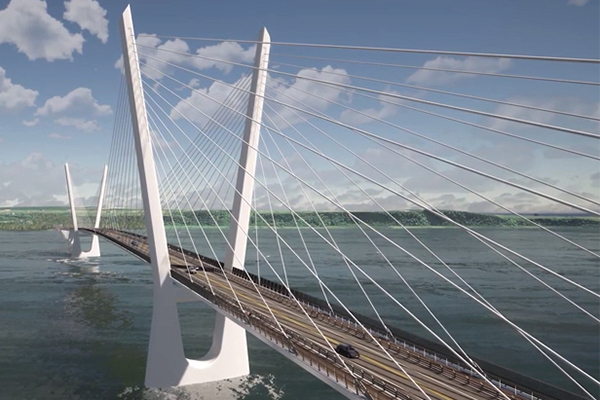
The Pont d'Orleans Bridge in Quebec is being delivered via the design-build model
In contrast, the progressive design-build method selects a team to both design and construct a bridge based on qualifications, a proposal providing billing rates, and a scope of design work for the preconstruction phase. Once selected, the team develops the project design to an agreed level of completion – typically 60% to 90%, or even 100%. Afterwards, the team and client negotiate a guaranteed maximum price before moving into construction. If the design is not fully complete, any remaining work is finalised during construction. “This model varies between Canada and the USA and among the states, mainly regarding the required design completion percentage, qualification criteria, and how maximum costs are calculated,” adds Nader.
In the USA, the progressive design-build approach is structured to better assess project risks and reduce the chances of unforeseen claims between the client and the design-build team once construction begins. “In Canada, it’s a bit different,” explains Nader: “Instead of a guaranteed maximum price, an agreed target price is used as part of a pain-gain incentive mechanism.”
Under the Canadian model, if the project is completed below the target price, the team earns a financial reward and higher profit. However, if costs exceed the target price, the team faces financial penalties, reducing their profit. There is no monetary reward for completing a project under the maximum agreed price in the USA. Instead, contingency mechanisms can be included in the contract agreement to address specific risks if the agreed maximum price is exceeded.
“The main driver and attraction to adopting the progressive design-build approach is the excessive risk that contractors face under the traditional design-bid-build,” says Nader. “In the traditional model, contractors are required to provide a fixed lump sum bid early, based on limited design details and understanding of the project.” If contractors submit higher estimates to cover uncertainties around the design, materials, and timeline, they risk losing the bid. Conversely, bidding too low to win the contract can leave them exposed to unforeseen costs and budget overruns, eating into or erasing profits. “The key advantage of the progressive approach is that it allows for a better understanding of the project and its requirements, enabling shared risk between the client and the design-builder,” explains Nader.
While the progressive design-build method reduces risks for contractors, it can pose challenges for clients. Negotiating with a single bidder may result in a higher proposed price than expected. “This is likely because more project risks are identified and accounted for early on,” notes Nader. “However, owners typically have an independent cost estimator to help evaluate the bid. These discussions can be difficult, especially when the required budget turns out to be higher than anticipated.” When that happens, clients have several options: seek additional funding, reduce the project scope (such as scaling back work or opting for a simpler design instead of a landmark bridge), or switching to traditional delivery. “More than half of US projects using alternative delivery are adopting the progressive design-build model,” estimates Nader.
Another alternative procurement method being explored by USA bridge owners is the construction manager/general contractor (CM/GC) approach. Here, the designer and contractor are hired separately: the designer is selected first, and the contractor is chosen based on qualifications and unit prices midway through the design process. The owner, designer, and contractor then collaborate to deliver the bridge. Similar to the progressive design-build method, CM/GC involves bringing the contractor on board early, without requiring a lump sum bid or total cost estimate before the design is complete.
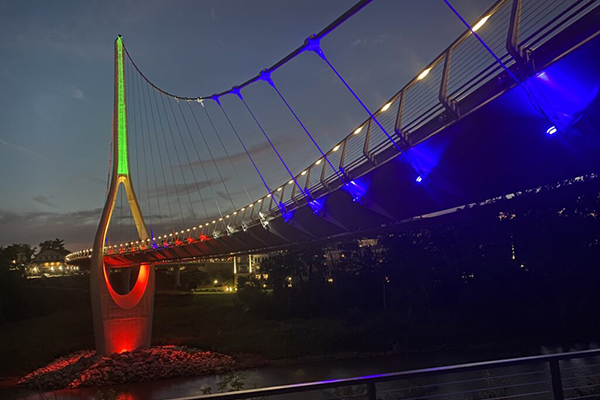
The City of Dublin Dublin Link in Ireland was delivered using the CM/GC approach (City of Dublin)
Another trend gaining traction in Canada’s bridge industry is the use of integrated project delivery (IPD). “It was first introduced for building hospitals and was later adopted in bridge construction. IPD is particularly interesting because it shares risk not just between the owner and contractor but also with the designer. It’s a complex commercial model,” explains Nader.
Unlike design-bid-build or design-build contracts, IPD involves the key parties (typically the owner, designer, and contractor) signing a single shared contract. The agreement outlines the expectations for each party, sets shared project goals, and aims to encourage ongoing collaboration and joint decision-making instead of top-down directives. If the project is completed under budget, all parties share the savings in addition to their profits. Savings are split based on terms set at the start of the project, regardless of the specific degree to which each party stayed under or exceeded the budget during design and construction. While IPD may require additional time and training to implement, its use can improve communication, reduce resource waste, and provide financial benefits for project participants.
For projects requiring greater collaboration between public and private partners, clients can reduce their risk by adopting a public-private partnership (P3) approach. In this model, the private partner takes on a stake in the operation and maintenance of the asset for an agreed period, creating an incentive to complete the project on time and within budget.
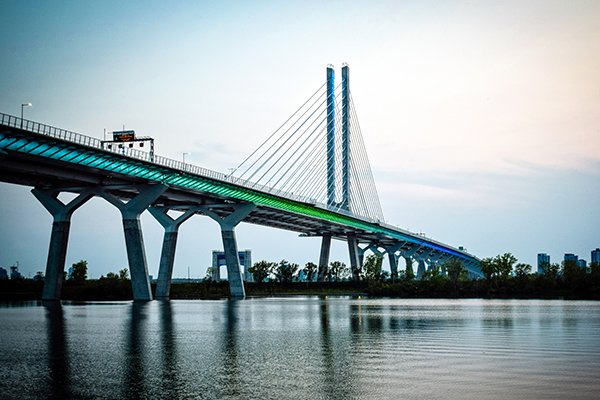
The Samuel De Champlain Bridge in Montreal was delivered via the P3 model
One popular P3 model is the design-build-finance (DBF) method, widely used in Europe and Canada and gaining favour in the USA. The DBF model can be particularly useful when asset owners are facing cash flow constraints or need to defer payments. In this procurement method, a single contract covers the design, construction, and full or partial financing of an asset. The design-builder is responsible for most of the design work, all of construction, and the short-term financing for the entirety or part of the project, taking on the risk for providing these services at a fixed fee. While owners typically retain responsibility for long-term operations and maintenance, in some cases, separate agreements for operations and maintenance are bundled with the DBF contract. The approach combines the efficiencies of a design-build with the ability to defer financing, either fully or partially, during construction.
Considering the veritable smorgasbord of procurement and delivery models now available, a question that emerges is, how can clients make the most suitable choice for a specific bridge project? “Depending on variables like project size, schedule, and risk management, there is a right fit. The key is defining what successful delivery looks like for each case. In some projects, traditional design-bid-build is still the best option,” says Nader.
While the progressive design-build model with pain-gain incentives and IPD are becoming more popular in Canada, many projects in the country still use traditional delivery. In the USA, progressive design-build is currently favoured for non-traditional projects, but other alternatives, such as the CM/GC and P3 approaches, are also being explored. “It is important to recognise that the right delivery method may vary depending on a project’s circumstances,” adds Nader.
Factors to consider include environmental permit requirements, project complexity (such as loads, vessel collision risk, wind loading), and the structure’s design (eg functional, aesthetics-driven, iconic). For a replacement, the client must also consider traffic management and utilities. In emergency repair and replacement cases, after a bridge collapse or accident, it can be beneficial to bring the contractor on board quickly, regardless of the procurement model. “For example, after the 1989 California earthquake, Caltrans [the California Department of Transportation] hired multiple contractors and worked alongside them on the design to rebuild collapsed bridges in record time,” says Nader.
All of the listed factors contribute to the overall project risk and schedule. While certain non-traditional procurement and delivery methods might offer advantages in terms of speed or budget management, choosing the best model ultimately depends on how a project’s competing demands balance out.
Shifting more risk to the contractor can seem appealing, but it can also lead to unwanted results if not handled carefully. If the goal is an iconic crossing and the project is set up to allow the contractor to modify its design for budget reasons, the final bridge might meet the budget but lose its iconic qualities, leaving the owner and public dissatisfied. “Start by defining your priorities and goals, and make sure they are clearly outlined in the project agreement – this is often more important than the procurement model itself,” advises Nader.
He predicts that alternative bridge procurement methods will not fully replace traditional design-bid-build but will continue to evolve. “The industry is moving toward more collaboration and shared risk between the owner and design-builder: progressive design-build and CM/GC are the leading trends in North America right now. However, in 10-15 years, we’ll likely see new delivery methods emerge. Having several options to choose from is beneficial, and the industry shouldn’t be tied to just one model,” concludes Nader.