
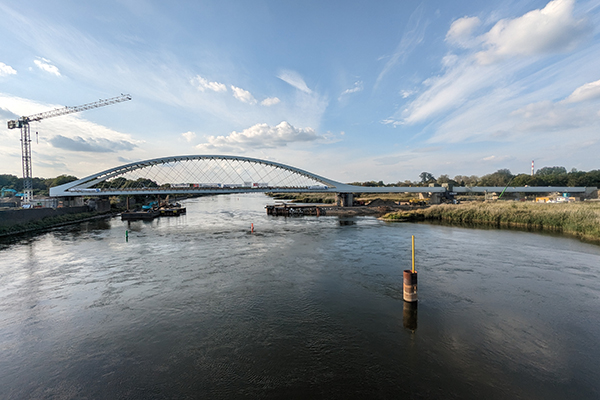
The Oder Bridge's carbon hangers reduced the weight of the structure by 23%
The first time I catch sbp director Lorenz Haspel on the phone he is in jubilant mood – he has just witnessed the successful launch of a 130m-long span that has been long in planning. The new network arch bridge connects Germany and Poland over the Oder River near Küstrin, about 90km east of Berlin. With celebrations under way on site, we agree it is time to write the next chapter of a journey that started ten years earlier, in Stuttgart (Bd&e issue 100).
Back in 2015, Haspel had overseen the design of a light rail bridge with an 80m-long main span crossing over the A8 highway towards Stuttgart’s airport. It was the result of a design competition held in 2012 by the civil engineering department of the City of Stuttgart on behalf of the Stuttgarter Stadtbahn, or Stuttgart light rail service. In this project, an original plan to use steel locked-coil cables in the network arch crossing was replaced with the decision to use carbon cables. The use of 32mm-diamenter carbon fibre instead of 65mm locked coil reduced the cost of the hangers by around 20%, a significant factor for the project. The carbon underwent extensive fatigue testing, with remarkable results showing – amongst others – that the material outperformed fully locked cable by a factor of six on fatigue.
Two years after the Stuttgart competition was held, Deutsche Bahn organised a competition for a replacement rail structure with a main span of 130m. The competition for the bridge over the Oder River was won by Knight Architects and Schüßler-Plan with a network arch bridge. “Funnily, we also took part in the competition but came third,” remembers Haspel. “We had also wanted to design a network arch bridge but, strictly speaking, the competition rules did not allow any design requiring special approval, which the network arch did at the time, and still does.”
Four years later, while the bridge in Stuttgart was under construction, Deutsche Bahn contacted sbp with a request for a desktop study into the potential use of carbon hangers at the Oder Bridge too, which was already in detailed design. “And when they realised the potential benefits, they asked us to come up with a detailed design,” remembers Haspel, adding that for a period of time the hanger design was being worked upon by both sbp and Schüßler-Plan, although the latter’s design used flat bar steel hangers. “We were then asked to come up with the testing regime. We intensely worked on the bridge and then it went out to tender in 2021. So it was really a very fast-track design process.” The final design with the carbon hangers reduced the weight of the structure by 23%, saving around 1,350t of concrete in the deck and 500t of steel. “And that is one of the reasons why Deutsche Bahn decided to go down that route.”
Aside from the span, a main difference between the two carbon projects is the diameter of the cable, which in the Oder Bridge is 50mm, “Basically a factor of about two in terms of the capacity. And then, obviously, the stressing devices and all the details had to be scaled up and redesigned for a railway bridge. But we used the same technical principles,” says Haspel.
As in the case with the network arch in Stuttgart, where several samples of cable were tested for fatigue as well as braking loads, a series of tensile and fatigue tests were conducted to gain the Zustimmung im Einzelfall (ZiE), or ‘approval for application in an individual case’.
A significant concern revolved around the bending effect of the longitudinal girder on the hanger connection when under load, and how the connection would be affected when not in perfect alignment. “We had to investigate a lot about the magnitude of this imperfection and carry out various tension tests with the connection – and even the pin – out of plane. Even though a pin is usually considered to be a hinge, in fact it isn’t. When the load is there, the pin freezes and further movements due to bridge movements will create local bending in the termination of the hanger. And all these effects had to be first studied and calculated and later included in the testing scope. We did tests with rotated pins and with inclined locks to verify that the hanger would do well when in perfect state but also in this potentially imperfect state.” While the results did not alter the design of the connection, they led to a reduction of allowable normal force under certain conditions, particularly during bridge installation.
One of the requirements that had to be met to receive approval was proof that the bridge would not collapse after the loss of up to five cables. “Redundancy and unexpected loss of tension was a big topic for the expert in charge of the ZiE. We found out that, if we take out several hangers in that structure, it is not only the nearest one to the gap that takes the load, as is the case with steel cables. Due to the fact that the stiffness is comparably low in carbon, the next and the further hangers also take additional load, which was quite something. We learned that the low stiffness is beneficial because if you have a very stiff hanger system, the first hanger next to the gap takes almost all the load.”
Sbp was able to draw upon some of the learning from its previous structure, which had been constructed over the highway using temporary supports. The hangers were installed after the arch had been erected and, for a period of three weeks, the arch system was in operation whilst the supports were still in place below the deck. “And when the sun came up in the morning, the arch lengthened enough to lift the deck off the scaffold. And in the night, when the arch was cold, the deck sat on the scaffold again. This led to the pins at the hanger connections rotating. And unfortunately, our stressing device was worked with a bore through the pin. And now, due to this rotation, these bores were not aligning any more and we could not mount the stressing device. Only after we had brought the pins back into their original position were we able to stress them again.” A new stressing device was consequently developed with a circular adapter equipped with a rolling bearing that allows free rotation of the pins on the Oder Bridge, which have been lengthened for this purpose.
The use of carbon hangers affected construction methodology. Originally it had been intended to float out the bridge by barge and lift it onto the piers, but as there was not enough depth in the river for the planned date a launching process was selected instead.
Unusually, the launching process did not require the use of temporary supports between arch and deck, as is common when launching a network arch with steel hangers. Had the hangers used been normal flat bar steel sections, explains Haspel, these would have been welded at both their ends, forming stiff connections unable to take rotations and which would have buckled out of plane in compression. “That this did not happen was the big fear of Deutsche Bahn and others, because the difference in height between the hangers [in plane] can be up to 100mm, so we had to ensure that all this movement could be accepted and that the connections would not shift in a way so that they would be unusable afterwards and so on.” Indeed, the specially devised launching process was an area of particular concern for Deutsche Bahn. “It is the reason why we were there on site to carefully check the development of the forces during the launching process, making sure that we did not bring too much movement and deflection as well as stresses into structure,” he says. “But carbon hangers allow a totally new method, because you can accept the whole hanger set getting slack and afterwards coming back to force without risking any damage. And this allowed us to launch the bridge as we did, skipping the heavy reinforcement.”
To allay any fears of damage to the hanger connections during the launch, monitoring was carried out of the forces in the hydraulic jacks and sliding supports as well as the load acting on the SPMT group. In addition, the settlement of the temporary supports within the river as well as the position of the bridge tip relative to the expected axis were surveyed.
Similarly to Stuttgart, the ease of installation of the cables at the Oder Bridge was surprising. The 160 cables of the bridge in Stuttgart were installed in just three days and in Küstrin it was no different: “They had planned two weeks to install the hangers and they finally took four days. The lightness in weight and ease of manoeuvring was just something new and something that created a certain fascination.”
Haspel hopes the latest project with Deutsche Bahn will further demonstrate the applicability of carbon hangers to bridge construction. “Those who were sceptical before now accept how well the technology is working. We’re getting calls from all around the world so the interest in the technology is increasing.” On top of the technical performance there are also significant carbon savings: the overall carbon footprint of the Oder Bridge is calculated at 8,900t, compared with 11,000t had steel hangers been used.
As regards the use of carbon cables in longer span network arch bridges, Haspel sees no limitation stemming from the material itself, but rather from the construction viability in general, “The erection procedure of an arch in general may not be economic at a certain point, unless you have certain conditions that allow you to build up the deck and arch without scaffolding. I think it’s always the specific situation and requirements which show whether a network arch with carbon hangers is a superior idea or another solution may be better.”
The Oder Bridge in Küstrin is planned to go into service early next year.
Client: DB Netz AG, Anlagen- und Projektmanagement Regionalnetze Ost
Design competition 2015: Knight Architects, Schüßler-Plan
Structural design of foundations, piers, abutments: Schüßler-Plan
Structural design of the bridge structure and network arch: schlaich bergermann partner
Laboratory testing of carbon hangers: EMPA
General contractor: Sächsische Bau
Steel contractor: Mostostal
Fabrication and supply of carbon cables: CarboLink