The team formed by Arenas & Asociados and Edgar Cardoso Laboratorio de Structuras, together with local architect Jose Carlos Nunes from NOARQ, received first prize in the design competition organised by Metro do Porto. A jury presided by the Pritzker Architecture Prize-winner Eduardo Souto de Moura selected the winner and two finalists from 28 entries proposed by renowned international teams.
The new bridge will support light rail, pedestrian and bicycle paths to create a new connection between Porto and Vila Nova de Gaia, as part of funding from the European Recovery and Resilience Plan aiming for decarbonisation and improvements in sustainable mobility.
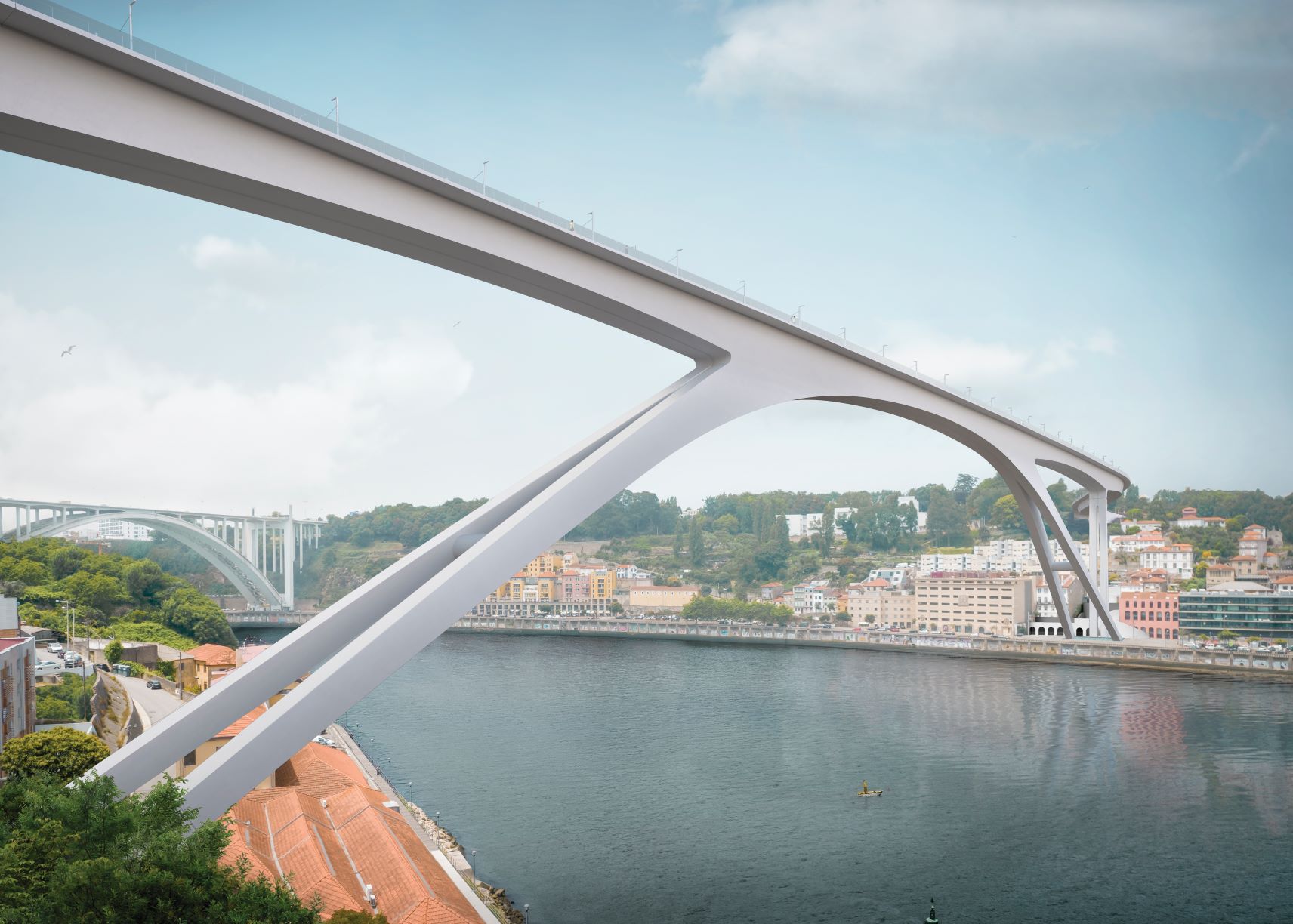 The winning design follows a minimalistic and transparent approach
The competition included very clear guidelines, such as not placing any supports in the river as well as minimising the impact on the existing urban landscape, especially in regard to the existing Arrabida Bridge from 1963, a protected national monument. The existing arch bridge with its 270m span was designed by the well-known Portuguese engineer Edgar Cardoso, and at the time of its construction was the world’s largest concrete arch.
Designing a new bridge 500m upstream from Arrabida Bridge was therefore a difficult task, and one made even more so by the nearby location of the Faculty of Architecture of the University of Porto (FAUP). FAUP is the home of several Pritzker Architecture Prize-winning architects and of the Escola do Porto architectural style, which relies on the purist models of the modern movement, and is well known for elegant, minimalistic, sober and bold designs, with no space for any extravagance.
The winning bridge design is a concrete frame bridge with a main span of 403m, between inclined supports, and total length of 692m, with spans between piers of 58+104+430+100m; the inclined frame supports enable the spans in the deck to be reduced to 58+104+125+180+125+100m. In order to avoid any visual interference with Arrabida Bridge, the main foundations are located out of the river and also outside the footprint of the roads along the river banks. This also avoids worse geotechnical conditions on the river banks, especially at the north bank where the rock is 20m deep but emerges to the surface on the other side of the existing road.
One of the main drivers of the design was minimising the impact on the existing slopes that form part of a city landscape filled with small historical buildings and narrow streets. It was considered important not only to avoid having supports in the water, but also to place the minimum number of supports in the access spans. This led to very long side spans of over 100m where concrete girder cantilever construction was considered the best option in order to minimise the impact on the existing infrastructure, as reduced access exists for any other solutions. The proposed design places fewer supports than other alternatives with only one pier to the south and two to the north.
This approach also enables the number of design elements to be reduced to the minimum, which is relevant considering that, in this case, the lowest number of elements leads to the highest transparency, respect and integration with Arrabida Bridge and the existing urban landscape.
This minimalistic approach follows the example of the San Joao Bridge in Porto, also designed by Edgar Cardoso in 1991. This frame girder bridge followed a simple three-span configuration with dimensions 125+250+125m, showing the maximum respect for – and the smallest visual impact on – the historical Maria Pia Bridge from Théophile Seyrig and Gustave Eiffel. San Joao Bridge is an outstanding example both of integration with a previous structure but also of a simple design that hides a complex and sophisticated structure, with a masterpiece of post-tensioning concrete to achieve a span of 250m. An amazing feat for a rail girder bridge, and one that has not been surpassed in the 30 years since its construction.
The new bridge creates a visual frame for Arrabida Bridge but also presents an evolution, with a curved profile that enfolds the existing arch. So, in a sense the new design brings together and synthesises San Joao and Arrabida Bridges in a visual homage to Edgar Cardoso and his two Porto masterpieces.
The new structure has inclined supports at only 30º, a slender profile and a long span of 403m. Its span length thus surpasses existing frame structures such as the Ponte Sfalassa (376m span) and the Ponte Cadore (275m span) in Italy. At over 70m in height, it is intended to be slightly taller than the existing Arrabida Bridge to reduce any visual obstruction, but this is also a consequence of the points to be connected on both sides, which are at 66m and 77m. As a result, the average height of the deck is 76m.
The deck is a box girder with a variable depth and width of 15.4m. The depth varies between 4m in centre spans, 7m over the main piers, and 10m in the connection with the frame’s inclined legs. Concrete was chosen as the main material for durability reasons, reducing future maintenance costs and operations as well as the construction cost. This is crucial because sustainability was one of the main concerns in the design competition. As mentioned, concrete is considered a better option to reduce the impact on the existing buildings during construction, using cantilever construction and concrete pumped with a piping system from the support points. The frame configuration ensures that the inclined legs are mainly under compression, as well as the post-tensioned deck of the main spans, with no in-service tension stresses, which is also a very relevant feature for future durability.
The slenderness in the deck and frame supports for the 403m-long span is obtained through the use of lightweight concrete of 19kN/m3 and 60MPa in the deck spans over the river, with special high strength and low-density aggregate, and through the reduced loads of light rail. The inclined legs are made up of concrete with 80MPa strength in order to reduce its section and weight. The concrete is protected with an anti-carbonation coating to enhance its durability and provide the white colour characteristic of Edgar Cardoso’s Porto bridges.
The direct cost for construction of the new structure was estimated at €50.5 million (US$57.1 million). This is based on detailed quantities and the experience of the design and construction of the Almonte Viaduct, which has a 384m-long concrete arch span for high-speed rail. The construction cost is significantly lower than steel bridge alternatives.
A major design concern was attaining the best possible integration of the bridge and its supports within the surrounding urban environment. This is difficult with a 403m-long span which is 76m above ground, where dimensions and scale are beyond those of humans and surrounding buildings. The strategy adopted consists of reducing dimensions by dividing the supporting elements up so that none are larger than 3m on the ground. The inclined supports are divided transversally in two, which allows for improved transversal stability but also reduced dimensions of only 2.7m by 3.3m, separated transversally by more than 15m. The transversal separation and reduced section and stiffness reduces the bending moments in the base and the foundation. The same strategy is followed with the vertical piers, which have a central void and two lateral bodies of 2.7m by 3.3m. As a result, the scale and footprint in plan of is reduced to a minimum.
The transversal A-shape of the inclined legs of the frame is also a relevant design element for resisting wind forces and seismic loads, in light of the existing seismicity of the location and the height and span of the structure.
The free space in the frame supports is used to create new urban spaces for the city, as a public square at the north support, where a gas station currently exists. This new square includes a water pond, a vertical connection with stairs, an elevator and a small footbridge to improve the connectivity to higher streets on the Porto side. At the main support to the south there is a green area with a viewing platform and an underground cafeteria between the supports.
The resulting structural behaviour is highly efficient and robust. The deck includes different families of prestressing, including cantilever construction prestressing on the top slab, continuity prestressing in the bottom slab, and external post-tensioning inside the box girder facing the effects of the live load and allowing for its future re-tensioning or replacement.
The typical section has a width of 15.4m, with 6.4m of central platform for the two Metro tracks and, to the sides, 4.3m-wide spaces reserved for pedestrian and cycling paths. The poles that serve as support for the catenary and lighting are arranged adjacent to the Metro platform, in such a way that a constant free width of 4m is released for pedestrian and cyclist use.
The structural cross section is a box girder with lateral cantilevers. The girder has a top width of 10m and lateral cantilevers of 2.7m. The lateral cantilevers are executed in the second phase at the end of the construction process, so the weight is also reduced in the key phases of the construction process, which reduces the cost of temporary elements.
The deck is built using the balanced cantilever method starting from the main piers; temporary cable stays and temporary towers are used to build the inclined legs of the central frame arch. Once the frame arch is completed, cantilever construction is used to connect from the centre out towards the side spans. This procedure minimises the impact on the river and the slopes on both sides.
 Render of the temporary supports during construction
In summary, the new bridge is not only a deliberately simple structure with incredible dimensions, but one that integrates very well in the scale of the city and the landscape. It seeks to present a synthesis of the wonderful bridges in Porto – the city of bridges – but also to represent an evolution via a technically advanced solution.
Guillermo Capellán Miguel is technical director and Miguel Sacristán Montesinos office director at Arenas & Asociados. Filipe Vasques is managing partner at Edgar Cardoso
Competition organiser: Metro do Porto
Project coordinator: Guillermo Capellán Miguel, A&A
Bridge design: Miguel Sacristán Montesinos, A&A, and Jose Carlos Nunes de Oliveira, NOARQ
Engineering: Filipe Vasques, Edgar Cardoso Laboratorio de Estruturas