On a hot day in late September, it is difficult to understand why Vietnam's new Bai Chay Bridge is being specially designed to cope with storms and high winds. But the end of the season of good weather is fast approaching, and only a day later the precautions seem wise. A new technique of cable construction on this bridge is enabling the contractors to pack strands more tightly in the stay cables, producing the same strength cables within 20% less cross-sectional area. This will be a major boon in terms of reducing the wind loading on the structure.
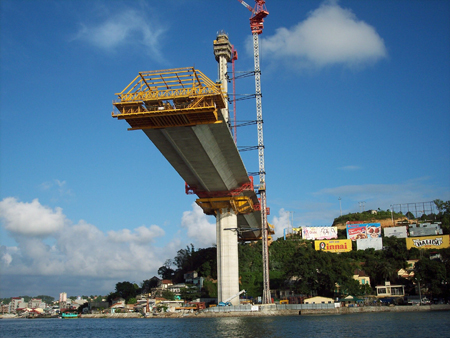
The cable-stayed bridge is being built as part of Project 18, for Vietnam's Ministry of Transport, and forms part of a new link between Ha Noi international airport and Bac Luan, on the Chinese border. It carries the road over the Cua Luc estuary, just north of the World Heritage site of Ha Long Bay, a crossing which is currently made by ferry. The new road is expected to improve trade links between Vietnam and China, and stimulate industry and tourism in Ha Long Bay and the nearby city of Hai Phong.
In fact the new bridge will not replace the ferries, which are planning to continue running once the link is open to traffic. Much of the traffic using the ferries at the moment is local traffic, and crossing the estuary by boat will continue to be the most convenient route for these travellers. The shipping clearance required results in the deck being some 50m above the water level, hence the nearest junctions giving access to the bridge's approach roads are some kilometres back from the abutments. The continued use of the ferries will not only be more convenient for local travellers, but it will reduce the traffic on the bridge.
Financing for the project has been provided by the Japan Bank for International Cooperation, an arrangement which required a certain percentage of the loan to be spent on Japanese goods and services. Design work is being carried out by a number of companies, including Japan Bridge & Structure Institute; Pacific Consultants International; Transport Engineering Design Incorporation, and Hyder Consulting. The main contract was awarded in May 2003 to a Japanese joint venture of Shimizu-Sumitomo Matsui, and work started on site in August of the same year.
As well as being the showcase for new cable technology, the bridge will be the longest of its type in the world - its 435m-long central span will be the longest for a bridge in prestressed concrete with a single, central plane of cables. This new structure will overtake the other giants of its type - the Elorn Bridge in France, the USA's Sunshine Skyway, and the Coatzacoalcos Bridge in Mexico.
The feasibility study for the new bridge began in 1999, but a lot of investigation had to be carried out into the environmental impact of the new bridge, considering the proximity of Unesco-protected Ha Long Bay, in the Gulf of Tonkin, was listed as a World Heritage Site in 1994 - it includes some 1,600 islands and islets, forming a spectacular seascape of limestone pillars. Because of their precipitous nature, most of the islands are uninhabited and unaffected by a human presence, and the site's outstanding scenic beauty is complemented by its great biological interest.
Although the bridge is not actually inside the protected area, it can be seen from there, hence a lot of thought went into the aesthetics of the structure. In the initial feasibility stage, a tunnel was also considered for the crossing, but was found to be too expensive since it was relatively short. In the detailed design stage, five bridge alternatives were studied, four of which were cabl