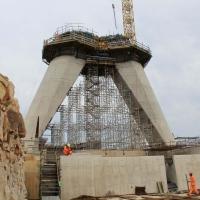
Three of the four long-span crossings that have been designed by the Danish architecture practice could easily be described as mega projects – and one could soon be taking the crown off the Çanakkale Bridge for world’s longest suspended span. The scale of the projects currently under way in China is quite astonishing.
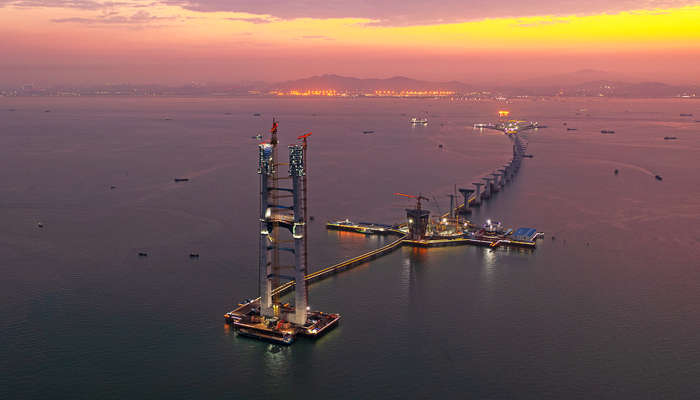
The Shenzhong Link (HPDI)
First off is the Shenzhong Link, a 24km-long ‘mega project’ with a 22.4km-long sea crossing that connects the cities of Shenzhen and Zhongshan across the Pearl River in south-east China and which is located around 40km to the north of the Hong Kong-Zuhai Macao Crossing. It encompasses two artificial islands, two high-level bridges, a causeway and an immersed tunnel. The link will provide eight traffic lanes in dual directions and have a capacity of 90,000 cars per day. It includes the Lingding suspension bridge, which has a main span of 1,666m and side spans of 580m, and the cable-stayed Zhongshan Bridge, which has a configuration of 295m, 580m and 295m. Also part of this project is a connecting tunnel that, upon completion, will set a world record as the immersed tunnel with the widest road bores.
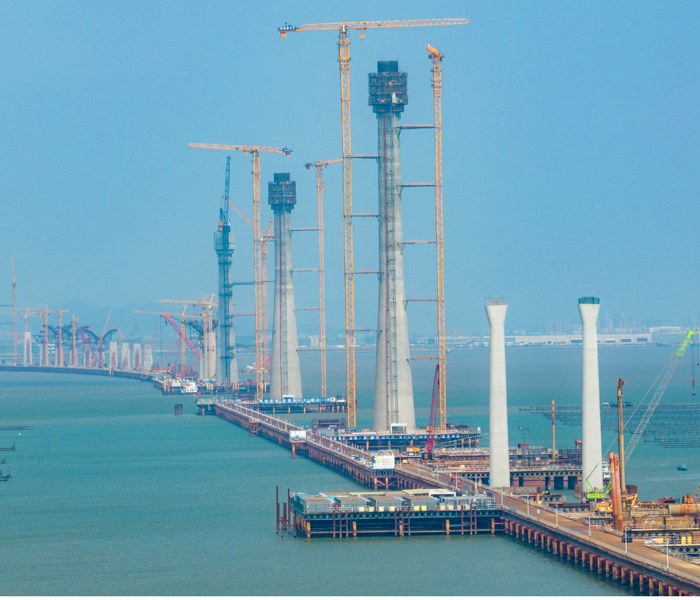
The Huangmaohai Link (Feng Zhuzai)
Secondly there is the 31km-long Huangmaohai Link that connects the cities of Jiangmen and Zhuhai, where it joins the west extension of the Hong Kong-Macao-Zhuhai Bridge. Around 21km of the crossing is located in the Huangmao Sea, an estuary bay of the Pearl River. It features double and triple-tower cable-stayed bridges at the eastern and western ends of the sea channel, respectively. The Huangmaohai Bridge has a span configuration of 380m, 720m, 720m and 380m with 255m-high side cable towers and a central pylon with a height of 263m. The Gaolangang Bridge has a main span of 700m and side spans of 358m, with a pylon height of 255m. Both bridges have a 33.5m-wide steel deck carrying six lanes of traffic.
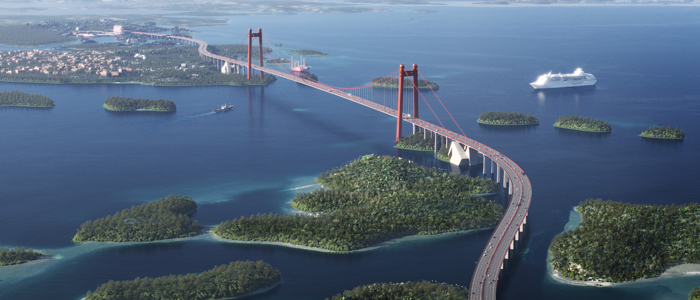
Rendering of the Longmen Bridge (Dissing+Weitling)
The Longmen Bridge, also known as the Dragon Gate, is the smallest of the large projects designed by Dissing+Weitling, but only relatively so. Connecting Longmen Harbour and Qinzhou Harbour over the estuary of the Maowei Sea, Longmen Bridge is a suspension bridge with a 1,098m-long main span, 251m-long side spans, and a 33m-wide deck carrying six lanes of traffic.
The fourth and most recently designed mega project is the Shizhiyang Link (Lion Ocean Link) which is planned to link the Nansha District of Guangzhou City with Humen Town across the Pearl River Estuary, around 3km south of Nansha Bridge. This 34km-long link includes a record-breaking suspension bridge with a 2,180m-long, 42.6m-wide main span supported by pylons approximately 350m in height.
Given that for most bridge architects and engineers the opportunities for working on projects of this magnitude are rare, how did Dissing+Weitling find itself with four such projects in a relatively short timeframe? Director of bridges Poul Ove Jensen and partner Jesper Henriksen explain that – discounting Stonecutters Bridge in Hong Kong, which Dissing+Weitling designed back in 2000 – the current ‘design spree’ in China was launched along two parallel tracks. One was the 2016 international competition win for an 11km-long elevated footpath in the City of Xiamen (Bd&e issue 101), which provided the launch pad for similar footbridge projects in China. Then there was an international design competition, this time for the aforementioned 24km-long Shenzhong Link, which the firm won with a winning proposal developed with Cowi. Cowi later withdrew from the project and was replaced by CCCC Highway Consultants Co, more commonly known as the Highway Planning and Design Institute (HPDI). The Beijing-based organisation was established in 1954 at a time when China urgently needed infrastructure construction and today has over 1,300 employees across the country working on multiple civil engineering projects.
The initial entry into long-span design in China was not completely smooth, remember the two architects. The original Shenzhong Link design that had been proposed featured a suspension bridge with 275m-high cable towers, a split deck and inclined hanger planes. The latter feature was something that Jensen believes had never before been done on that scale and would have provided a higher degree of stability during extreme weather events. “But the project gradually changed radically,” remembers Jensen, “Which was unusual,” adds Henriksen, “because unlike with other parts of the world, with Chinese projects they actually tend to stick as much as possible to the original design.”
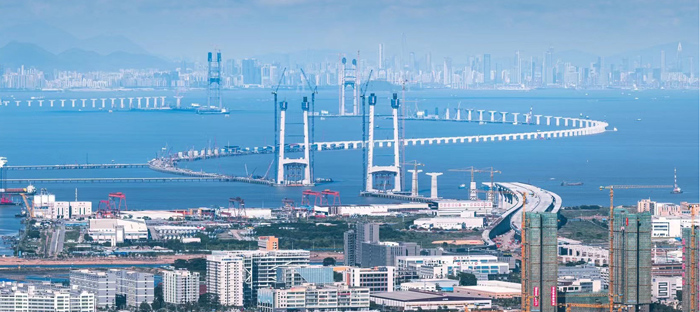
The Shenzhong Link was originally designed with inclined hanger planes (HPDI)
Many discussions followed around the practicalities of the inclined hanger planes, says Jensen: “And at last it was decided to take the conservative approach and have the usual vertical hanger planes. They were worried about the construction process because when you spin the cables, they have to be vertical, and then you have to force them apart.”
The close collaboration between Dissing+Weitling and HPDI on the Shenzhong Link proved fruitful, however, and, for the relatively small firm based in Copenhagen, it provided some highly useful practical insight into working with Chinese firms. “One of the main differences is that the engineering firms we are working with in China are huge, numbering several thousand people. Sometimes they do not really understand that [for us] it takes longer, as we are only about a dozen people,” comments Jensen.
Another lesson hard learned regards decision-making, explains Henriksen: “The decision process is very different to that which we are used to, for example, in the Nordic countries and also in the US and Australia. When we first started working in China we spent a lot of time and effort seeking direction for a bridge [design] only to find out another opinion at a higher level, and then yet another opinion at an even higher level. Over the years we have learned that there is this hierarchy which we, of course, from the Nordic countries, are simply not used to. And we’re not used to people not taking the same responsibility.”
Aside from the hierarchical processes, however, they point out that designing a bridge in China is identical to designing a bridge in any other part of the world – the architect makes a proposal, a response is received, modifications are made. One point of difference is the speed in which bridge projects are kick-started into action, they say, no matter their scale. “The whole process is much faster because there are fewer stakeholders to be consulted. And the whole bidding process also seems incredibly fast,” says Henriksen. “As soon as the contractor comes in, then it’s pretty straightforward and the bridge gets built. Our involvement is very low but as we normally have a good relationship with the client we receive updates as it goes along,” says Henriksen.
However steep the cultural learning process may have been with the design for the Shenzhong Link, the Danish firm must have impressed its Chinese partners because it was soon after awarded design contracts for the Huangmaohai and the Longmen crossings.
The contract for the design of the Longmen Suspension Bridge was the result of a phone call from Dissing+Weitling’s representative in China. At the time, there was a preliminary design for the link, but end-client Guangxi Provincial Transportation Investment Group wanted to see further options. “We started from a totally different place from their first sketches,” remembers Jensen. “They had some very strong ideas that they just wanted to have this wooden beam-like structure at the top of the pylon and of course we had many discussions with them about the options, many of which were declined.” The new design that was produced in collaboration with engineers from HPDI is instantly recognisable. It features red-coloured cable towers with large lettering signifying ‘Dragon’s gate’ written across distinctive cross-beams resembling classical Chinese timber portals.
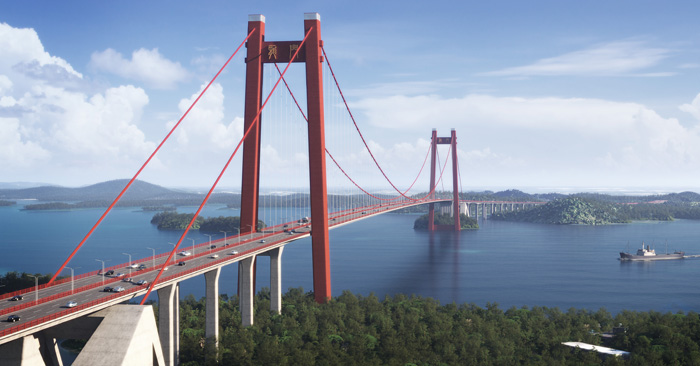
The Longmen Bridge's cross-beams resemble traditional Chinese timber portals (Dissing+Weitling)
Another lesson learned in the firm’s work in China is that, as is the case anywhere in the world, stakeholder interest can vary. While most of Dissing+Weitling’s’s design projects in China have mainly involved liaising with the engineers, the case was different with the Huangmaohai Link’s double and triple-towered bridges, where the bridge owner took a close interest in proceedings. “The person responsible at the Guangdong Provincial Highway Company was very enthusiastic to the point we were almost in daily communications,” remembers Jensen, “And I think that is the reason that many of our ideas got through, because he backed us up.” The 30km-long link presented a whole host of different sections each with differing structural systems. “To get some kind of design consistency was one of our main problems and, of course, we always try to convince the client that it is important to consider it as one link and not as a section of different bits and pieces. You often see, particularly in the United States, a bridge with six different structural system depending on water depths and clearance requirements,” he says.
The five cable towers of the Huangmaohai Bridge are all nearly identical in height (the central tower is 8m higher) and the triple-tower configuration features a unique cable arrangement design. The cables from the side towers and the main tower cross over, similarly to those of the Queensferry Bridge in Scotland, but with one significant difference. All the cable stays in the triple tower section are anchored to the side of the superstructure, with the exception of three pairs of stay cables on either side of the central cable tower. These, instead of connecting to the side of the deck, are anchored to the central section of the superstructure where they cross with those from the side cable towers. The unusual arrangement is designed to avoid deformation of the bridges girders at asymmetrical live load, something that is traditionally achieved by increasing the diameter and height of the central cable tower. The alternative design of the Huangmaohai Link cable arrangement achieves the same stability while also finding aesthetic uniformity and creating a distinct structural identity.
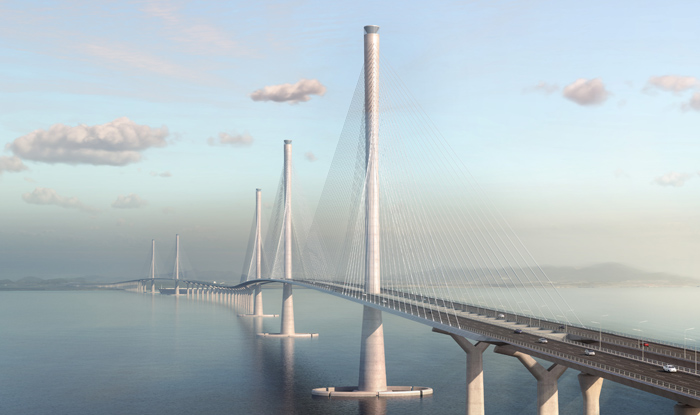
Rendering of the Huangmaohai Link (Dissing+Weitling)
The uniformity is also displayed by the shape of the five cable towers, which feature cone shapes that flare out at their lower and upper extremities, with a lighthouse shape at the top and a glass façade. “The flaring at these points were not just a matter of aesthetics,” says Jensen. “At the top of a cable-stayed pylon the dimensions are governed not by structural requirements, but by space requirements needed for the anchorages and for the fine tuning of the cables. The tower needs a certain footprint [at the lower end] and then gradually it can get slimmer, but then at a certain stage, the space requirements take over and it has to get wider and wider. And that’s what we’ve been playing with here, and that is the reason why they have this flare at the top.”
The firm is also working on another structure which is still relatively ‘hush-hush’ but one that, when it comes to fruition, will dethrone the Çanakkale Bridge’s position as the world’s longest span. “We are not allowed to show the design of the Lion Ocean Link, but we can say that the pylons will be around 350m high and the main span will be 2,180m long. It is a double decker, so two times eight lanes of traffic. It’s going to be unbelievably huge,” remarks Henriksen.
As the conversation moves to more general themes, I ask Jensen and Henriksen what they think is the reason for their current success in China. They both agree that their success is rooted in a design approach centred on buildability and experience. “No matter what kind of bridge type or length of structure, we can fairly quickly come up with a proposal that is doable. Of course, we cannot do the final calculation and all the verification that the engineer can do, but we can very easy come forward with a proposal that seems reasonable.
“Some of our colleagues can begin with radical ideas that are extravagant and may not be buildable, and then work their way downwards to something that’s more viable. Whereas we start on the other side of the table, starting with something that is pragmatic and very constrained and then start playing within the limits of the engineering side,” says Henriksen. Such an approach can be a double-edged sword, adds Jensen: “At the moment a lot of very expressive bridges are being built there – and elsewhere in the world – where the competitions have been won with proposals that are, in our view, rather crazy from a structural point of view. People are really very anxious to do something never seen before, something with a wow effect. That’s the kind of bridge where you get those 15 minutes of fame but which looks like a bad joke 20 years later. We’re trying to do something which also looks good in 100 years because we are designing bridges for a lifetime of 100 years,” says Jensen.
Later, I pose the same question to HPDI – why have they selected to work with Dissing+Weitling on so many long-span bridges? The answer, by email: “Our two companies share the same design concepts, both wishing to do bridges that have clear and rational loading system, bridges that can fit into the nature with smooth alignment and elegant geometric shape. Another reason is that Dissing+Weitling has a high level of bridge expertise, which makes communication easy and efficient. We think these are the two main reasons for our long-lasting cooperation.”
The crossings designed by Dissing+Weitling are now taking shape in China. The cable towers of the Longmen Bridge were completed last year and, with the recent completion of main cables installation, work is under way placing hangers and cable clamps.
The Shenzhong Link’s main bridges are almost completed and, at the time of writing, the Lingding suspension bridge was planning a deck closure ceremony for 28 April, 2023.
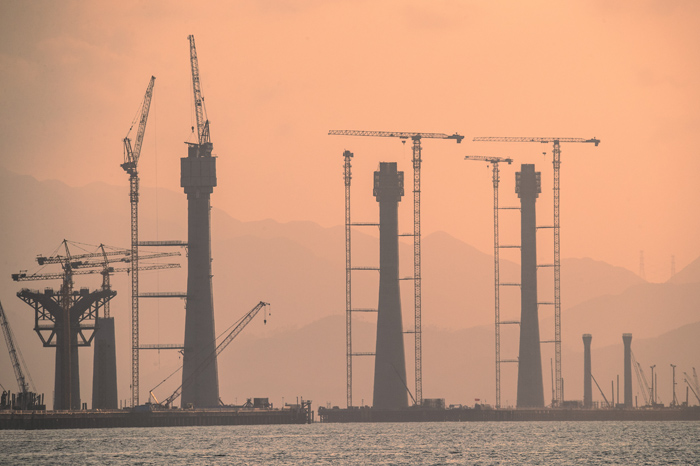
Completed triple towers of the Huangmaohai Bridge (Feng Zhuzai)
All five pylons of the Huangmaohai and Gaolangang bridges were completed in mid-April 2023 and the girders on the eastern and western approaches have been finalised.
Construction of the Shizhiyang Bridge (Lion Ocean Link) began at the end of 2022 and foundation work is currently under way.