On a grey cloudy day in early January, the final touches were being made to a light, composite pedestrian bridge newly installed across a former footpath level crossing on the outskirts of Wistanstow, a Shropshire village around 60km west of Birmingham. Designed by Knight Architects, the structure is called the Flow Bridge, a name that not only refers to its evident flowing aesthetic but also to a slightly stretched acronym: ‘Fibre-reinforced polymer, Lower cost, Optimised design, Working bridge’.
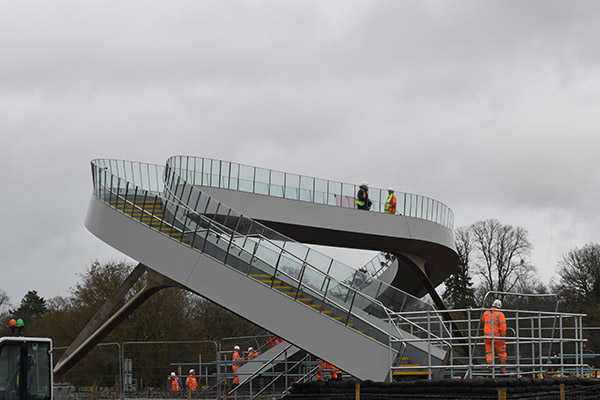 The Flow Bridge at the final stages of construction in Wistanstow, Shropshire (Davide Meucci/Knight Architects)
The Flow Bridge is part of Network Rail’s drive to reduce risk at many of the rural footpath level crossings it maintains on public pathways, as identified in its Level Crossing Replacement Safety Programme in 2010. These types of crossings account for around 2,250 of 6,000 level crossings on the UK network. Many have been closed and paths diverted, but diversions are not always possible and some such moves have been successfully challenged.
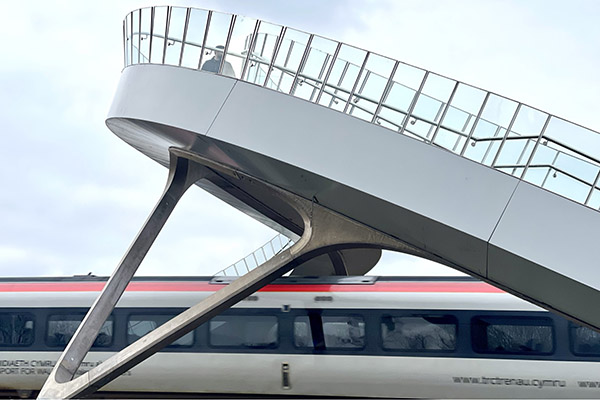 The Flow Bridge aims to reduce high-risk pedestrian ground-level rail crossings
A low-maintenance, low-cost, modular composite structure that is light and easy to install could be the answer in some of these situations. Accordingly, Flow Bridge is actually – or will be – a ‘suite’ of structures that can be adapted to cross single, double and triple sets of rail tracks in ‘S’, ‘U’, ‘I’ and asymmetric configurations with options for stairs, lifts and ramps. All configurations share a same base design that consists of a carbon fibre spine that supports a modular FRP deck. There are a wide variety of parapet options, including glazing and mesh flax panelling with variable or open/closed cross-hatching depending on the level of transparency desired.
The site in Wistanstow was chosen for a number of reasons. A pedestrian level crossing had been in place here until its closure four years ago, when Level Crossing Risk assessments identified it as the highest-risk crossing in Wales due to its route across sidings and two ‘fast’ rail lines. Also attractive for the design team was that the location presented a longer span to cross, which would challenge the prototype structure. In addition, there was a proposal for a new highway bridge just a few hundreds of meters away, which would potentially remove the need for a Flow Bridge in 10-15 years’ time, thereby testing another of the crossing’s key stated attributes – its reusability. Furthermore, as the site is in a remote rural location surrounded by green hills, the aesthetic design characteristic could be realistically tested.
The origins of the Flow Bridge’s innovative use of composite materials go back around ten years, explains Andy Cross, a programme manager at Network Rail Wales and Borders who has been key to the project’s outcome. The issue of risk at pedestrian level crossings was high on the agenda and, at the time, he was responsible for Network Rail’s structures in the Welsh regions. The role brought him into contact with many Victorian-era bridges that often consisted of cast iron columns, wrought iron superstructures and timber decking, which set him thinking. “They used different materials in a composite way, so the idea was to also try to use the most appropriate material. We happen to be using glass, flax and carbon fibres, because they all have different properties.”
The new S-shaped bridge in Wistanstow offers innovation below the ground as well as above it. The 1.8m-wide deck is supported by a 470mm-deep spine that forms a flat central arch and two smaller side arches. The spine is formed by two overlaid trapezoidal elements, the upper and narrower part 200mm in width and the lower, wider part 340mm. The spine is fabricated with a sandwich panel laminate featuring a thin layer of foam to allow cables to pass through it.
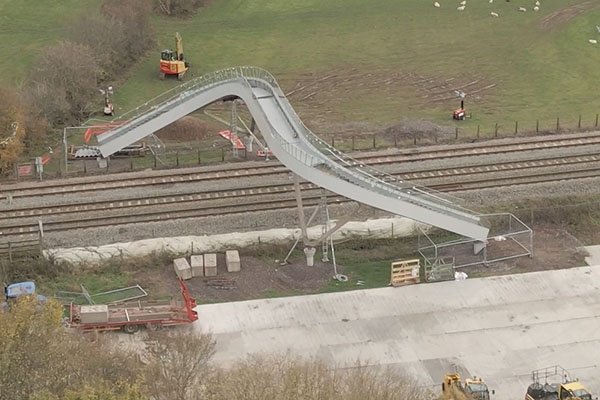 The new S-shaped Flow Bridge takes shape in Wistanstow
Modular deck units clip onto the spine and are held by a combination of self-weight and mechanical connection. The spanning deck units are 4.8m long with the longest unit 6.15m long at the bottom stair section. The structure touches the ground at four points outside the footprint of the bridge – two at deck ground level and two at heels where the arch legs meet. The superstructure is 20t in weight – 15t in FRP and 5t in glazing – which is around half of the weight of a steel bridge. This makes wind-overturn the governing factor of its design, rather than bearing capacity.
The most complex elements are the ‘heels’ that take in the two footings of the arches. The heel is so complex that it had to be modelled and analysed separately until a suitable geometry and material could be found. The final version has 25mm-thick walls formed of an outer flax exterior with inner alternating layers of carbon fibre and Kevlar. “The reason why we put Kevlar in is that carbon fibre is very rigid. But you have to make sure the stresses are similar, because if some stresses are higher than others the layers can delaminate and then you have failure. So you want to get composite-ability of the material,” says Ahmad Kamara, the senior design engineer at Network Rail who is responsible for the structural design and analysis of all the Flow bridges.
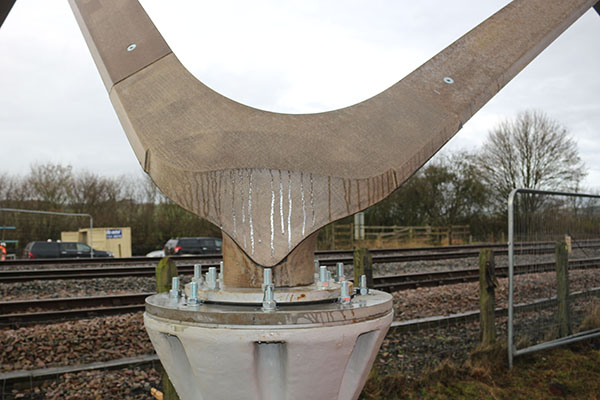 The two heels are made of alternating layers of carbon fibre and Kevlar, with a flax exterior
The foundations are made from a system called Rapid Root, which consists of recycled aluminium tubes that are driven around 1.4m into the ground and which flare outwards, forming a kind of tree root complex. Each foundation is formed by four clusters of root piles connected by a cruciform steel cap. The system was selected for ease and speed of installation. The piles can be driven by hand, their installation is weather independent and they cause minimal environmental disruption. The same need for speed extends to all elements of the structure, which are designed to be no heavier than 2.5t to facilitate transport and lifting using standard road-rail vehicles. “The idea is, if the bridge is in a rural location, we can take out all the preliminary works that are a large part of the cost,” says Cross.
The construction of the bridge in Wistanstow was a fairly practiced affair because it had already been erected and dismantled four times previously, including at the Rail Live 2021 exhibition held at the Long Marston Rail Innovation Centre in Warwickshire, arguably adding proof to its reusability capability. The four foundations took four days to be installed, after which the lateral sections of the bridge spine were jacked up onto a temporary saddle, then located and bolted. The middle section of the spine was installed in 4.5 hours during a night-time possession. During a second possession, the modular deck units – including prefitted glazing – were lifted onto the spine using balanced construction to avoid any deflection. A third possession enabled the fitting of the central deck sections as well as the placement of side fascias, ready for the stair units to be secured during the daytime.
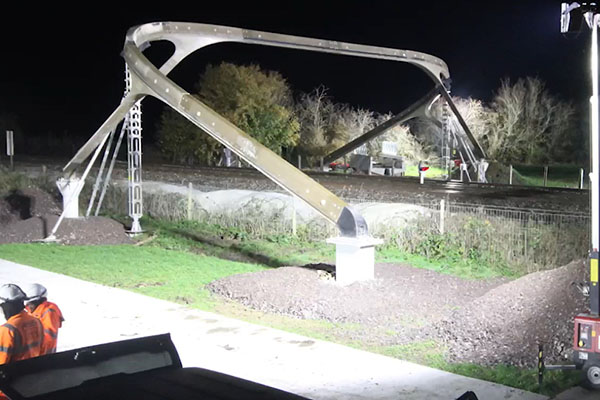 The middle section of the spine was installed in 4.5 hours during a night-time possession
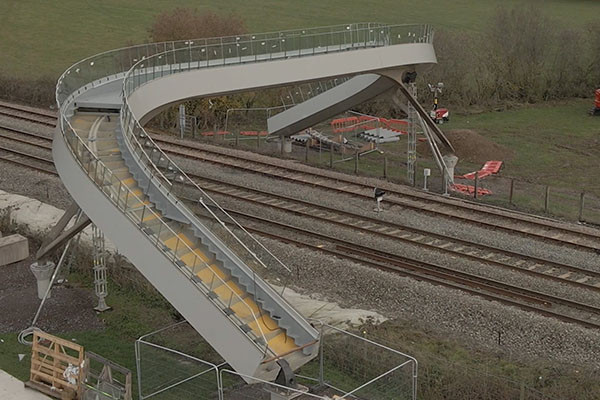 The stair units were secured during the daytime
At the time of the site visit, Dillwyn David, applications manager at Insensys, was busy installing optical fibre for the 41 sensors that will monitor the bridge during its entire lifetime. “There won’t be as many on the next bridge. This is first of design, so we’ll take all that data and work out which are the most important,” he says.
Data will be sent at a high frequency of 12Hz, or 41 bits of data 12 times a second, from which load and footfall will be derived. Data will be hosted online by Insensys and discussions are currently under way with two universities as regards data analysis. As we speak, each train passing below registers in the system, as can be seen on David’s screen, and Cross says that the data will be used for both operational decision-making as well as continuous design improvement. “To have this level of intelligence, to know how the bridge is doing or when there is an event [is unprecedented]. You can see the event and close the line straightaway… And with aerodynamic wind loading being a huge design factor, we can get a handle on it by monitoring.” The fact that footfall will also be measured will also bring benefits in the future, “It is in a rural location and it is really hard to close a bridge when no one is using it. The idea is that this bridge is very easy to put in and if, in a few years’ time, things change and you don’t need it, you have the evidence and can go to the council and just move it somewhere else.”
The construction of the prototype has provided what Cross describes as a “ridiculous amount of learning” and the next version will be modified and improved in many ways. All the deck units will be fitted out with deck elements and glazing prior to site delivery. A new, simpler mechanism will be used to lock the deck units onto the spine in order to increase the amount of fitting-out that can be done beforehand. Also being considered is swapping the toughened, laminated glazing for larger polycarbonate panels and having these in a simple vertical profile rather than splaying out, as per the prototype. “We wanted to create a sense of space, but it then creates a complicated plane, it’s a 3D plane in curves. It will look really clean, much more robust,” points out Cross. The spine will become deeper to further account for deflections, and minimum deck width is to be increased to 2m. This will account for future crossings that may be used as part of fully accessible bridges featuring a lift/stair configuration. The new width will allow for two wheelchairs to cross simultaneously on the bridge. There are also more radical changes afoot, says Kamara: “At the moment there is a foam core but for the next version I want a 3D carbon-fibre core. That will allow us to reduce the number of layers of laminates we have on the outside, which immediately reduces labour and time. So I need to weight up the cost of the material with the labour savings. And it reduces the carbon footprint of the bridge.” Additional foundation options are also being considered that make use of the self-weight of excavated soil to prevent the structure pulling upwards. Kamara is also researching other natural materials that could be used on the finishes, such as date fibre, which has fire resistant properties.
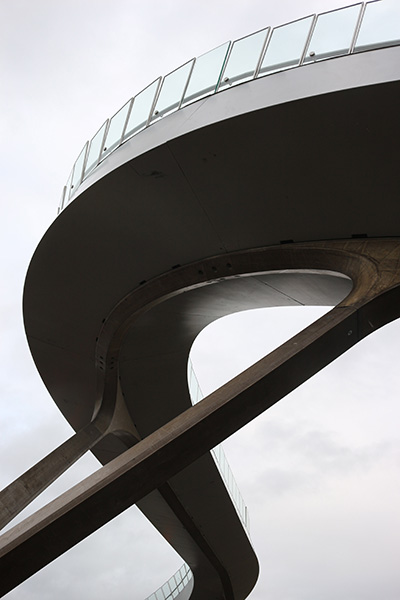
The Flow Bridge prototype has yielded an ‘enormous’ amount of learning points which will be addressed in the following versions
The pioneering nature of the project has not gone unnoticed and the team has interest for 30 more bridges all over the UK – not all of which are rail crossings. To cater for this demand, a range of parameters are being worked upon within which parametric modelling can take place for various types of Flow Bridge versions, with the aim of offering a design-build specification. “A front-end interface will have a configurator that will take into account the span, the shape of the bridge, and provide a rough cost based on local conditions. And it immediately accelerates the selection process. If the parameters fit in that model and the model fits in your site, it works,” says Cross. The end product could then be either handed over to the owner’s contractor or Network Rail could undertake the build with its own Flow-experienced contractors.
It is envisaged that a central hub will hold all the different types of Flow Bridges in Tekla models and these will be used by Knight Architects for each new Flow project. Any changes, for example to the width of the deck, will be automatically made to all associated project drawings. These changes can then be replicated in the structural model, Lusas and Grasshopper in Rhino, either manually on the model or on its script. “And I will have the load cases assigned to those elements, so that is going to speed up how we do the analysis significantly,” says Kamara, adding that the models will have been analysed for worst-case scenarios such as wind-loading and pedestrian dynamics, meaning that it will not be necessary to structurally analyse each project. “It took me three months to design this from design concept to completion, working flat at it. You don’t want to be doing that for 31 structures,” says Kamara.
As well as changing the way bridges are designed and procured, the Flow Bridge may also change how designs are approved internally by Network Rail. Each Flow Bridge exists as a digital twin and it is hoped that future parametric changes in detailing will not require CAD drawings for approval, meaning that approval takes place within the system itself. This could be an enabler for driving down costs to the point that projects that include ramps can become more affordable. “The Flow Bridge here is 55m all in. We couldn’t afford ramps because they are five times the bridge, so five times the cost, at 100m of ramps each side,” says Kamara.
The 11 months it took to design and manufacture the Flow Bridge do not perhaps reflect the difficulties that have had to be overcome to make the project a success. A first attempt to engage the bridge industry along traditional procurement lines was found to be limiting innovation by placing too many constraints – and liability – on the suppliers. “I carried out a competition within the composites industry in 2017 with a challenge of a low-cost footbridge. Whilst there were some possible solutions, they were too conventional and didn’t offer the step change I was looking for.”
To move the project forward, Cross and his team had to secure R&D funding to develop their initial concept of a lightweight, quick-to-install, reusable and low maintenance structure. Acting as lead designer and contractor afforded Cross and his team the freedom that they needed to explore various options and materials. “I took the approach, if we don’t take the lead, how do I remit someone to do something that we don’t know how to do?” says Cross. This approach has enabled Network Rail to identify and use the most appropriate materials that address its requirements, while ostensibly showing which way the future lies for a whole new generation of footbridge teams to overcome the technical challenges of this large-scale project.