Since it suffered a number of fatigue failures in 2008, the Adomi Bridge over the Volta River in Ghana has been under careful scrutiny by the Ghana Highway Authority. An extensive programme of inspection work carried out over the last year has led to the formulation of a rehabilitation plan to extend the life of the bridge and enable it to continue serving its vital purpose.
As Ghana’s principal waterway, the Volta River has always formed a barrier to transport between the Volta and Northern regions and Togo and the rest of Ghana, mainly its capital Accra. Before construction of the Adomi Bridge in 1957, ferries for cars and foot passengers were used on this principal transportation route, but the service only operated during the daytime. When the decision was made to build a bridge in the 1950s, consultant Sir William Halcrow & Partners, which was working on the Volta River hydropower scheme, was asked to investigate locations and design options.
Preliminary reconnaissance revealed an apparently ideal site for a single-span bridge at a narrow neck of the river at Adomi. Bridge specialist Freeman, Fox & Partners designed the crossing and the contract was awarded to Dorman Long (Bridge & Engineering). Construction started in 1955 and the bridge was opened to traffic in 1957.
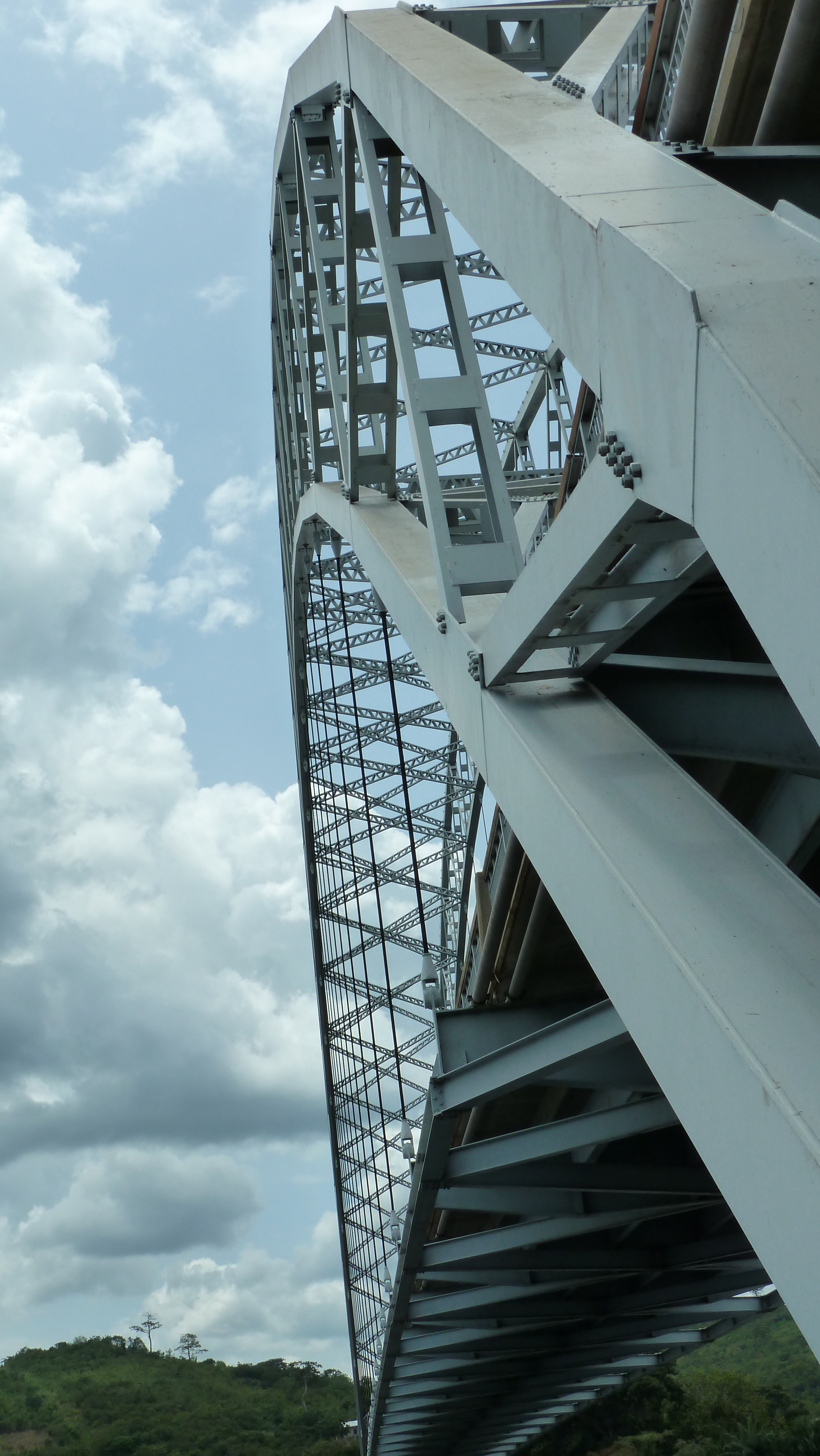
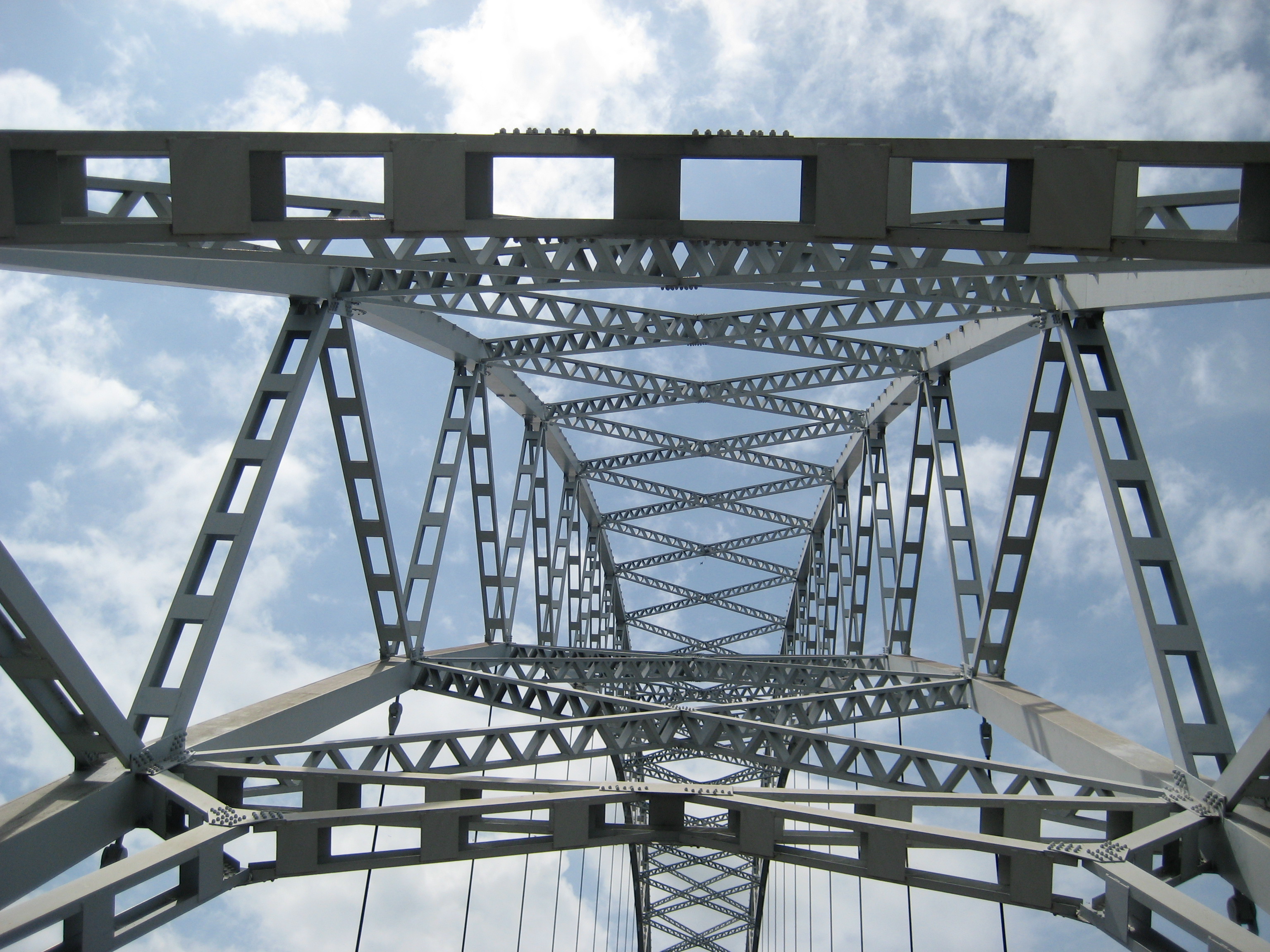
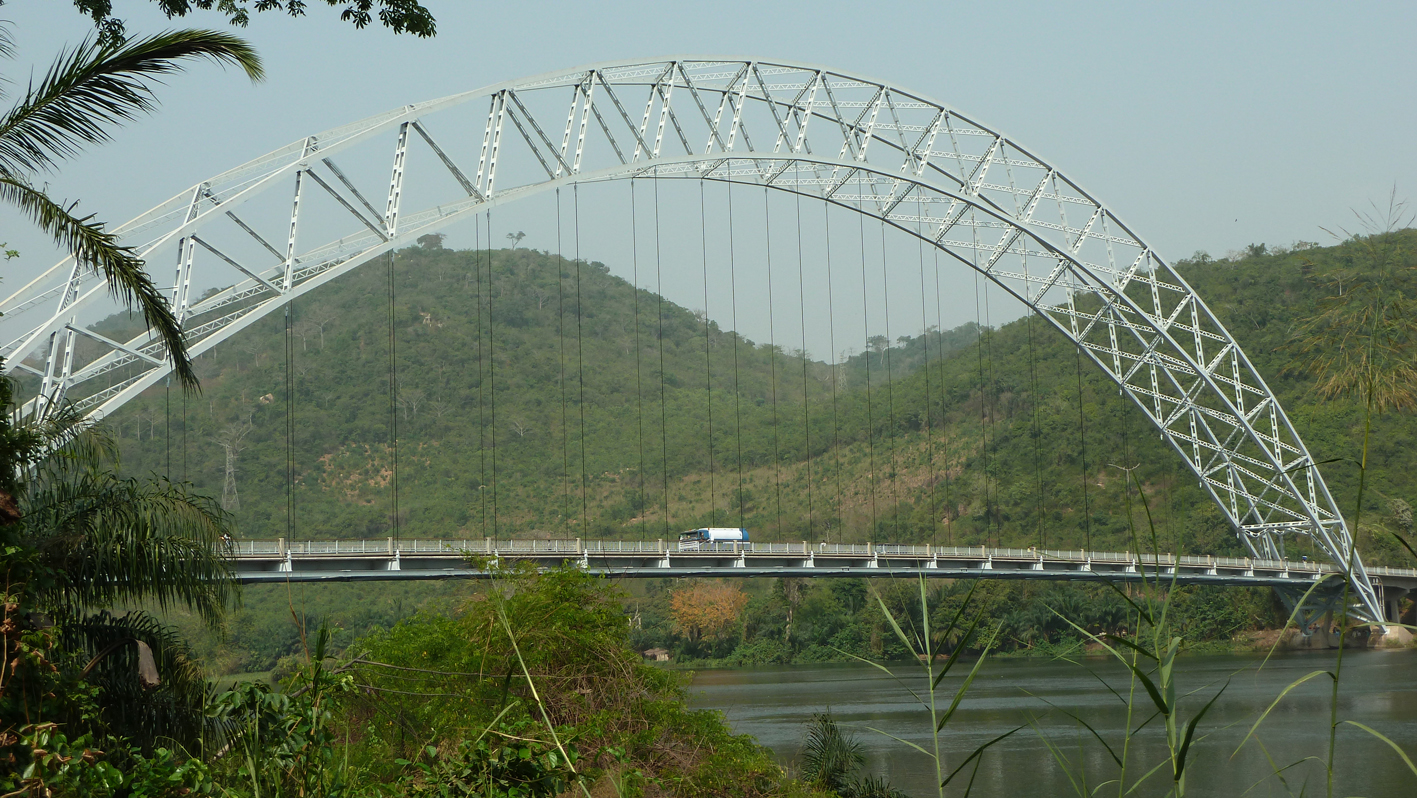
The bridge is a steel arch structure with the roadway suspended off a pair of giant arches by means of cables. It has a main span of 245m and the rise to the crown of the arches is about 60m. The deck is a steel structure with a composite reinforced carriageway slab. When it was designed, the original loading specification adopted was BS 153, which at that time although revised, had not yet been published. It was considered essential to provide for possible future heavy loading, and 45 units of type HB Abnormal Unit Loading, as specified in Great Britain, was adopted.
But since the bridge has been in service, traffic loads have continued to increase, and this eventually led to the first fatigue failures in 2008, which affected transverse beams. One of the transverse beams failed, while two others developed serious cracks, resulting in deflection of part of the bridge deck. Ghana Highway Authority took emergency measures to stop the cracks from developing further.
The cracked girders were locally strengthened by the installation of additional steel plates at the affected locations. But the continued use of the bridge by overloaded trucks breaching the 30t limit had adversely compromised the safety and stability of the bridge and in April 2009 more cracks were discovered, mostly confined to the same area as the first cracks.
The state of the bridge is serious, with the possibility that a brittle fracture might occur at any time. Repairs to the bridge deck will not solve the problem as the fatigue behaviour of the bridge indicates that the existing steel structure has reached the end of its lifetime.
Over the last year a full bridge inspection programme has been carried out and a rehabilitation project is due to start. The inspection work was carried out by a consortium headed by Austrian consultant Schindelar ZT which was appointed by Ghana Highway Authority in early 2011.
The consortium consisted of local advisor HAG Consult which is also a specialist in road and bridge construction and technical consultant Matthias Parzer, who specialises in the design of bridges. An inspection programme was developed, consisting of a complete geometrical survey of substructure and superstructure, extraction and testing of material samples, inspection of hangers, splices and bolts and a visual inspection of the corrosion protection, and this was completed in April last year.
While the inspection work was under way, Ghana Highway Authority arranged four traffic closures per day, each for a period of two hours and over a duration of two weeks. Due to the structure’s exposure to the sun and the effect this has on the surface temperature of the steel components, the use of roped access inspectors on the upper regions of the structure had to be restricted to between 6am and midday. All other inspection works took place during the defined period of bridge closure.
The main purpose of the visual inspection was to assess the integrity of connections and bolts, and inspect cracks in the carriageway slab and foundations. The entire foundation surface is covered by old shrinkage cracks, and between the second stage concrete and the abutment concrete, cracks smaller than 1mm width were observed.
Pits were excavated around the concrete foundations to inspect the rock surface for any cracks, foundation movements or settlements. The results suggest that the abutments have not settled significantly or been displaced during previous decades according to observations made after the bridge was opened to traffic and taking into account current measurements of the position of the foundations.
Since no complete or detailed as-built documentation is available, a full geometrical survey was carried out. A local coordinate system was introduced by installing benchmark points on the bridge itself and the bridge abutments to observe any movements in the future. Detailed measurement of bolted connections at the nodal points was established and controlled through a photogrammetric procedure and orthotropic conversion. In order to determine the actual material strength, single samples of the structural steel were taken. In total, nine samples were tested by a certified laboratory; four samples of the steel plates and five of close tolerance bolts which were immediately replaced. Plate samples were extracted using a magnetic drilling device and angle grinder. Holes have been either immediately hermetically sealed by bolted steel plates or plates have been completely replaced and new structural elements welded in place on the existing structure. Circular specimens of 10mm diameter and 100mm length were machined out of bolt and plate samples and tested for tensile strength and behaviour.
Furthermore, chemical analyses were carried out to obtain additional information about the material characteristics. Hanger anchorages, splices and bolts were inspected by opening access chambers in the arch, checking the integrity of internal bolts, verifying the grade of corrosion, taking measurements and documenting them with photographs. Cables and cable anchorages were checked visually. Local corrosion was found inside the arch; this may be the result of leaks through the access chamber due to a faulty seal.
Considering the age of the structure, such corrosion is not considered a cause for alarm since the structural behaviour of the arch is not affected by local corrosion. The socketing of hangers and those of the eye bolts were in good condition at the time of inspection; no evidence of overloading or broken wires was found. The bituminous coating of the hangers was found to be loose or missing in small patches and there is light corrosion on the affected wires. Bearings, expansion joints, handrails and pavement were also inspected and assessed for their durability.
However the inspection of the bridge showed that the condition of the deck in particular is worse than expected. Four of a total 20 cross girders had already suffered cracks and had to be repaired, and more repairs and r