
“Collectively, the designs have the capacity to transform what we think of as possible,” said structural engineer Jane Wernick, who is a juror in the ARC international wildlife crossing infrastructure design competition.
The designs unveiled this week have been prepared by five finalist teams that had been named in September. The teams are:
- Balmori Associates (New York) with StudioMDA, Knippers Helbig, David Skelly, CITA, Bluegreen, John A Martin & Associates and David Langdon;
- HNTB Engineering with Michael Van Valkenburgh & Associates (New York) and Applied Ecological Services;
- The Olin Studio (Philadelphia) with Explorations Architecture (Paris), Buro Haphold (London) and Applied Ecological Services;
- Janet Rosenberg & Associations (Toronto) with Blackwell Bowick Partnership, Dougan & Associates and Ecokare International;
- Zwarts & Jansma (Amsterdam) with OKRA Landscape Architects, IV-infra and Planecologie.
The competition is intended to address the increasing number of collisions between vehicles and wildlife. Collisions in the USA have increased by 50% in the past 15 years, bringing an annual cost of US$8 billion, said the organisers.
West Vail Pass in Colorado, USA, was chosen as the location of the wildlife crossing because the I-70 corridor is the major transportation artery that form a barrier to wildlife movement in the Rocky Mountain region. However the winning design is intended to serve as an international model in creating the next generation of wildlife crossings.
The winning design team will be announced at the Transportation Research Board annual meeting on 23 January 2011.
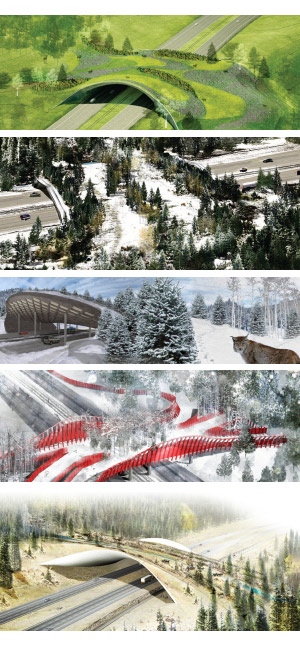
Shortlisted entries have been unveiled this week. They are by teams led by (top to botttom) Balmori Associates, HNTB with Michael Van Valkenburgh & Associates, The Olin Studio, Janet Rosenberg & Associations and Zwarts & Jansma.