Railway footbridges are often the poor relation in the world of bridge design, only being given special consideration when they fall within a heritage zone or are part of a larger station redevelopment. This has been the case in the UK for decades, as anyone who lives near, uses, or works at a railway station which has had a new footbridge installed in recent times will testify. Unless the station is a listed building, or is in a recognised conservation area, it will have been the recipient of one of Network Rail’s standard footbridge designs, developed back in the 1980s, with the focus being on cost and utility.
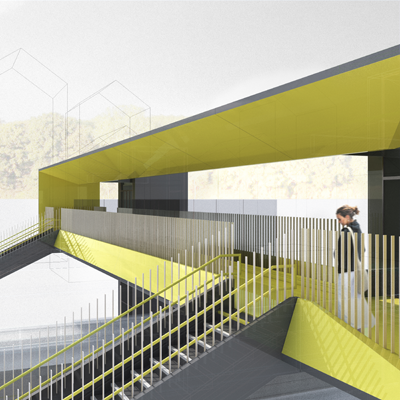
A location is currently being sought to build a pilot of the competition-winning design by Gottlieb Paludan Architects and Strasky, Husty & Partners
But a new initiative to put good design at the heart of the country’s rail infrastructure intends to change this. A major programme of accessibility improvements is under way at railway stations, which will be universally welcomed, but the opportunity to deliver other benefits alongside the improvement of physical access should not be missed, believes Network Rail’s head of buildings and architecture Anthony Dewar. He is on a crusade to raise the standard of design of infrastructure assets and acknowledges the network’s footbridges are crying out for improvement.
At the start of this year, Network Rail published Our principles of good design, and in the introduction, Dewar states his intention that ‘our smaller projects will have the same level of design thinking applied to them as major infrastructure improvements’. This document is just one of a number of strands supporting the initiative to improve the design of rail footbridges. It sets out key questions that designers should consider for all assets, such as how the asset improves the public realm and enhances the local context; whether it functions as a landmark; and how its design adds value to the local area.
The policy heralds a step change for Network Rail, whose approach to footbridges over recent decades has been that unless the site merits special treatment, being in a particularly sensitive location, a standard design is all that is required. And as Dewar explains, the design is already several decades old, having not been reconsidered or revised for some time. These structures were originally selected with cost and utility in mind, and their design was very much driven by engineering considerations. “No thought was given to the pedestrian experience,” he says. “There was always a focus on the engineering side, which tends to be dominant within the organisation.”
Now in his second year in the role, Dewar explains that the architecture division of Network Rail is undergoing something of a shake-up, in part due to this renewed focus on good design. He attributes this to two main factors; the first is the arrival of Sir Peter Hendy as chair of Network Rail in 2015. Coming from Transport for London, Hendy brought a strong philosophy about the importance of good design in transport infrastructure. The second factor has been driven by Network Rail itself, Dewar maintains, evidenced by the recent launch of a NR design review panel, as well as the new focus on footbridge design. The design panel will provide an independent review of the quality of design of all elements of the network that fall within its remit – and footbridges are set to be among them. Having external input is essential, he believes, because Network Rail is culturally engineering-led.
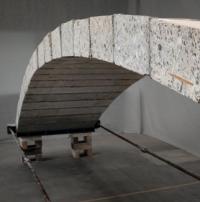
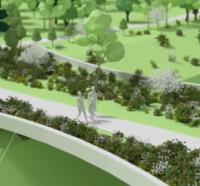
It would be impractical to require a design panel review to be carried out for every new or replacement footbridge project, hence the other strand of the initiative that is currently under way is to improve and widen the range of pre-approved ‘standard’ footbridge designs. As well as reviewing the structural and visual form of the approved designs, Dewar is keen to do away with the ‘standard’ tag, preferring to refer to them as ‘excellent ordinary’ designs. This work is being carried out through two different routes: a design competition and a more standard direct procurement process. The competition took place last year and attracted more than 120 entries from around the world (Bd&e issue 95). The Framing Bridge concept by Gottlieb Paludan Architects and structural engineers Strasky, Husty & Partners was chosen as the winner, while a submission by Hawkins Brown and WSP was highly commended. Discussions are under way with the winning team to develop the design further, Dewar confirms, and internally to identify a site for the first installation, something which he says is attracting a great deal of interest.
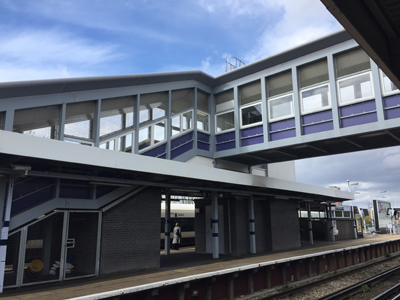
The current ‘standard’ design takes no account of passenger experience, nor is aesthetics considered
The second strand of the initiative is the commissioning of two additional generic designs that will extend the range of approved typologies and provide a choice for schemes where new or replacement footbridges are required. These are being developed under two separate commissions, one by Arup and Knight Architects, and the other by Davies Maguire and Haskoll, and are currently in the final development stage. In the procurement process, existing Network Rail framework contractors had to partner with an architect in order to bid, and Dewar reveals that the two designs that are currently being finalised are very different. The new typologies are due to be made public later this year, and will be in a much more user-friendly form. “We intend to create something that’s a bit more like a product catalogue,” he says. If for any reason a bespoke design is preferred or required, the design will have to go before the review panel. “Before we created the design review panel, it was quite ill-defined as to when architectural input was required,” he continues. “We have now strengthened the details of how and when this is needed, and also what is needed. There is no point just launching a design panel, we have to make sure that this is hard-wired into all our procedures.”
The new generation of footbridge designs and the strengthened architectural input is being brought into play for the current five-year strategic investment control period that started in April this year, and during which Network Rail anticipates that a significant number of new footbridges will be installed. Dewar admits that a number of the old-style structures will still appear on schemes that are already under way, due to the time lag between approval and construction. But once the new catalogue is launched, the existing standard design will be withdrawn for good, to the delight of many.