
Three new movable bridges being built in Copenhagen’s inner harbour are expected to reach completion this year, after delays caused by the contractor going bankrupt. The first of the three — nicknamed the Butterfly Bridge — was opened to pedestrian and cycle traffic in January, and the two others — dubbed the Kissing Bridge and the Circle Bridge — are due to be finished before the end of 2015. All the bridges open to allow vessels access around the harbour, and each of them makes a distinctive feature of the opening process or mechanism.
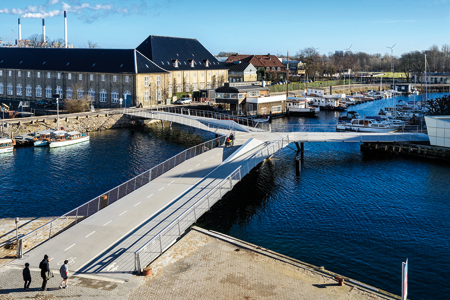
The Butterfly Bridge connects three parts of Copenhagen's Inner Harbour
The Butterfly Bridge was designed by Dietmar Feichtinger Architects and WTM Engineers and is so-called due to the fact that when both its opening spans are raised, they resemble butterfly wings. In plan, the structure connects three sides of the harbour, using three spans that meet at a central node. Two of these are opening spans, crossing Christianshavns Kanal and Transgraven, and the third is fixed. The bridge was built by HSM Industri, which took over the construction in April 2014 after contractor Pihl & Son went bankrupt in 2013.
In high season, approximately 400 boats, kayaks and canal cruisers are expected to sail under or through the bridge daily. Its navigation clearance of 2.3m will allow canal cruisers and small motor boats to sail through, while around a quarter of the passing boats will require the bridge to be opened.
The main structure of the steel bridge is formed of single-web, continuous T-beams. The web, which extends across the entire bridge, is built of a trapezoidal hollow section which is hermetically welded for corrosion protection, while the deck is an orthogonal, anisotropic plate construction.
The movable superstructure is formed of two individual bridge leafs without counterweights; they each have a clear opening width of 15m, and the length from the pivot point to the tip of the leaf is 23.3m. The width of the bridge cross-section is 7.9m and its cross-sectional height varies from 500mm to 1.7m at the junction of the cylinder with the superstructure.
The longitudinal beam widens from the axis of rotation starting at a width of 400mm upwards in order to achieve the structural effective height of 1.7m above the attachment point of the hydraulic cylinder. Towards the tip the construction height decreases again back to the standard cross-section.
The anchor point of the hydraulic cylinder is about 5m from the axis of rotation. The axis of rotation and its support are part of the central pedestal. The hydraulic cylinders are located within the pile cap of the central landing point, and when the decks are closed, the tip rests on the opposite shore-side bridge.
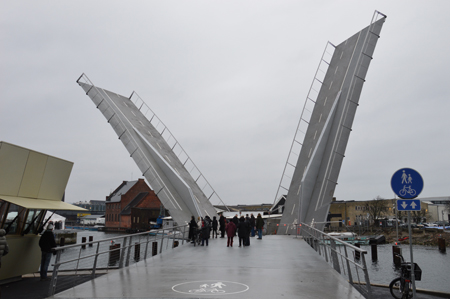
With both spans raised the name takes on more meaning (Dietmar Feichtinger Architects)
When the deck is down, its structural system corresponds to a single-span beam with a supportive structure which is restrained on the bridge side and pinned on the shore side. In its open state the bridge flap corresponds to a clamped cantilever.
The hollow box is peripherally braced with an orthogonal system, consisting of longitudinal ribs of 150mm — 200mm high plates with a spacing of 400mm and transverse beams of uninterrupted plates with a cross-sectional height varying from 500mm in the centre to 150mm at the section edge.
At the respective ends of the movable bridge superstructure and at the column locations of the onshore connection ramp a rectangular hollow box is designed as an end cross-beam.
The bridge is supported by elastomeric bearings and is brought into the correct position by a centring element in the middle in the process of movement. When closing the bridge two Oleo buffers are provided in addition to the elastomeric bearings. The bearings, the centring member and the buffers are mounted on a cantilever on the fixed part of the bridge.
The entire onshore connection is realised as a very light and removable design, so that in the event of a general overhaul of the existing shore walls and an envisaged widening of the road on the embankment beside the north abutment, the ramp can easily be removed and modified. The bridge was inaugurated by the owner, the Copenhagen Municipality in January.
When all the new bridges in the inner harbour are complete, pedestrians and cyclists will have much easier access between the city centre, Christianshavn, Holmen and Amager. The bridges are also integrated with the new Christianshavn Route a cycling and walking trail that which runs through Arsenaløen, Christiania and Kløvermarken.
Two to follow
Two other bridges currently under construction are also due to be completed this year. The Circle Bridge has been designed by artist Olafur Eliasson with structural engineer Ramboll, and is funded by the Nordea Foundation as a gift to the City of Copenhagen.
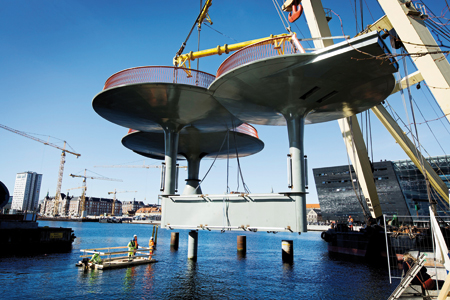
The main decks of the Circle Bridge being lowered into position
The artist used the sailing ship as a visual starting point for the bridge concept; the structure consists of five staggered circular platforms of various sizes, each with a mast, and it will connect Christiansbro with Appleby’s Square. The circle provides an alternative to a direct route straight across the water. It encourages walkers and cyclists to slow down and offers a vantage point where people can take a short break, thus creating a new space between two urban areas rather than simply the fastest route across the 32m-wide Christianshavn Canal.
The series of platforms will have 2.25m vertical clearance above the water when closed. The bridge operates as a swing bridge, and will open to provide a 9m-wide channel.
Construction began in March 2012 and much of it has been done offsite, with foundation work carried out from pontoons on the water. Steel contractor KSM Industry fabricated the platforms at its works and shipped them to the site for installation. Erection of the masts began at the end of last month (April) and the bridge is scheduled for completion this year.
The third movable bridge, which was designed by Flint & Neill, Studio Bednarski and Hardesty & Hanover, is a retractile bridge nicknamed the Kissing Bridge. The bridge functions on a sliding mechanism with an opening that spans 50m, and a total length of 180m. The deck is 7m wide and it has a low structural profile in order to minimise obstruction to views along and across the harbour. Another significant feature of the bridge is the inclusion of viewing platforms at the edge of the navigation channel. The platforms provide a safe position for pedestrians and cyclists to view the bridge movement and be in close proximity to the passing ships and boats.
The bridge has a slightly sinuous alignment which extends the bridge and maximises the length of the adjoining ramps. This geometry permitted the ramp grades to be limited to 4%. This grade balances the needs of the pedestrians and cyclists with the desire to limit the intrusion of the ramps onto the harbour sides.
The bridge superstructure consists of the two main cantilevered moving sections which have smooth soffits reminiscent of a boat hull. The sculptural form of the moving spans can be highlighted in a number of ways through the use of lighting or surface finishes without being obtrusive to the users or the surrounding environment. The approach ramps consist of clean box girder elements that provide an efficient structure that is elegant yet low maintenance.