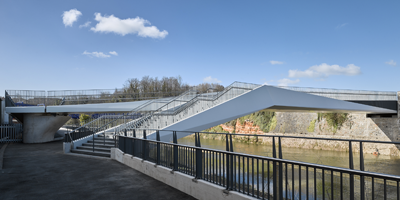
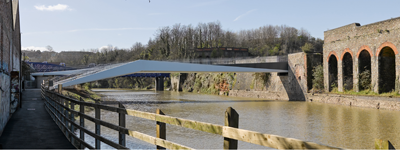
View of the bridge from the River Avon Path (photograph: Lance McNulty)
Bristol’s newest footbridge carries an innovative steel beam with a forked geometry that maximises functionality in a constrained area. The recently completed St Philips pedestrian and cycle bridge is one of the two new pieces of infrastructure, together with Brock´s Bridge, built in Bristol to improve accessibility to Temple Island, an area behind Bristol Temple Meads railway station which has been restricted to rail-related uses for more than 150 years. The River Avon, the Bath Road and the Great Western Railway tracks define the boundaries of this previously isolated plot, which is expected to be developed into a new cityscape in the coming years.
The footbridge was designed by Knight Architects and Jacobs for Bristol City Council and was built by Andrew Scott, with SH Structures as steel fabricator.
The 50m-span bridge crosses the River Avon, connecting Temple Island with a riverside pedestrian and cycle path on the east bank. The two banks are very different from a topographic and formal standpoint. While the west one stands on a beautiful and prominent 19th century stone wall with relieving arches (a reminder of the railway heritage in the area), the east bank is a green slope, partially muddy in low tide, keeping the natural appearance that characterises the River Avon in the surroundings. A difference of around 5m in elevation between the two banks makes it impossible to directly connect them with a straight line and an accessible gradient.
From an architectural point of view, the bridge will link an area that will be soon transformed into a new district at the west bank, on Temple Island, with an industrial area at the east bank that is likely to turn into a public space in the longer term, in St Philips Marsh.
(Lance McNulty)
The design is required to respond successfully to three very different scenarios: when it is the only object that meets the architectural quality expected for the area in the future, when just one of the banks has been developed and, eventually, when developments on both banks have been completed.
The footbridge is flanked by two existing truss bridges. Until recent times, the only structure spanning this river stretch was a railway viaduct that opened 120m upstream of the new crossing, in 1892, part of the Bristol Temple Meads Avoiding Line. Its design is very representative of its time and consists of a sequence of three isostatic through trusses with a curved top chord, with a main span over the river of 50m. Approximately 170m downstream of the new footbridge is the other structure, built in 2015 to improve the plot’s accessibility. It is also an isostatic variable-depth through truss, with a single 63m span. The design of the new footbridge is intended to co-exist harmoniously with these nearby characterful bridges, whose highly visible, prominent and colourful geometries will overlap in some views.
The east bank is formed by especially soft ground and has limited access; to the south there is a 4m-wide path with headroom restricted by the railway viaduct, and to the north the path is less than 2m wide. These were significant constraints for the design and the selection of erection methods because, for example, additional loads on the bank both during construction and in the permanent condition needed to be avoided, as well as cyclical lateral loads or deflections on the foundation imposed by the bridge. The west bank, on the contrary, provided easy access via the existing road bridge and enough space for bridge assembly and crane placement. Also, the better ground condition allowed the team to use the west abutment to provide a lateral restraint to the structure, ensuring global stability.
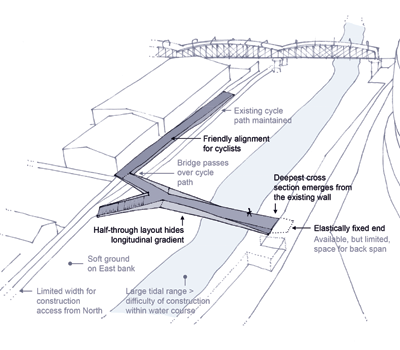
Some key points of the design (text in black) and constraints (text in grey)
The bridge is designed to respond to such a constrained crossing via an innovative steel beam with a forked geometry. It hosts a ramp for disabled users and cyclists and a staircase as part of its own structure to maximise functionality in a very limited space. The footbridge‘s ends have a very different approach both from the geometrical and structural point of view.
Some characteristics of the Temple Island end include: sufficient space out of the bridge to channel pedestrian and cyclist flows; the bridge ending on a solid and prominent stone wall; and the structure being well above the water level. For these reasons the bridge has a constant width at that end; the deck has maximum inertia as it is elastically-fixed thanks to a hidden 4.5m short back span; and the structural depth is fully placed below the walking surface. In contrast, on the east bank the landing area is much more restricted and the structure can be affected by floods. For these reasons, the structure splits into two before reaching the bank, the structural depth is minimised with simply supported ends, and a U-shaped cross section is used. The forked geometry naturally guides people along the desired line without forcing them to reach the industrial buildings prior to selecting the direction of travel and, in addition it, doesn’t restrict potential future connections when the current industrial area is redeveloped.
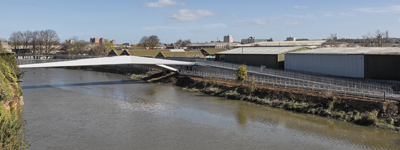
Bridge view from Temple Island (Lance McNulty)
This cross section variation in depth, width and arrangement from a rectangular to U-shaped girder, defines the character of the footbridge from the architectural point of view. It also creates a shape that is reasonably adapted to the bending moment diagram of the structural layout under uniformly distributed loads. Depth varies from 2.3m to 0.5m, matching the height of the top cyclist railing at the deepest point.
The width varies from 4m to 9m, being the distance between the outer edges of the branches circa 17m. The constant longitudinal gradient of the bridge is partially masked thanks to the depth variation, which makes the soffit almost horizontal for most of its length. Thanks to this, the design isn’t perceived as the continuous ramp it is, and it doesn’t appear as an inclined object that was originally designed to be horizontal, which is a common problem amongst bridges with significant longitudinal gradient.
Two of the three abutments were designed to be almost invisible, with one hosting the hidden back span, while the third is an unavoidably visible 60m-long concrete access ramp. This element was designed to be understated and elegant, and as narrow as possible to maximise visibility along the River Avon Path. The top slab is read as an extension of the bridge thanks to its side cantilevers, whilst its main bulk and corbel for support of the structure appear be part of the ground.
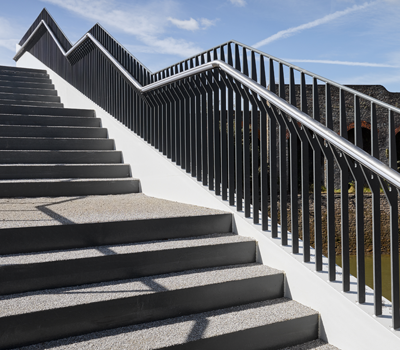
Detail of staircase, steelwork and parapet (Lance McNulty)
The railings, made up by a sequence of slender vertical plates acting simultaneously as posts and infill, have a simple design which is very transparent in elevation, helping to highlight the bold shapes of the structure. A bolted stainless steel handrail hosts linear LED luminaries, and a top solid bar acts as a cyclist protection element.
The choice of steel, an externally painted S355J2W grade, was an early design decision taken mainly based on architectural and buildability reasons. As well as the visual coherence of having a steel structure between two other steel bridges in what is nowadays mostly an industrial environment, the material will pay tribute, when the new townscape is developed, to the area’s railway heritage. Also, a steel bridge would naturally fit in the global family of bridges in Bristol, most of them made from that same material.
Bridge supports within the river and the tidal zone were discarded early in the design process to minimise the impact in an environmentally sensitive area. This led to a bridge with an approximately 53m main span that should make use of Temple Island for assembly and installation due to the access restrictions and poor ground condition on the opposite bank.
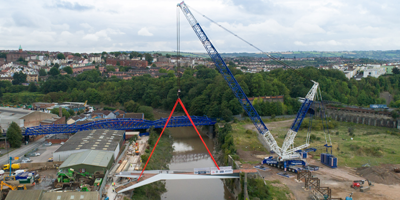
The footbridge was installed from the west bank due to access restrictions at the opposite bank (Andrew Scott)
Steel was the perfect material to realise the relatively large, complex and sculptural multi-faceted geometry, combined with enough lightness – at around 160t – for installation in a single piece using a crane on just one of the banks. The parapet is directly welded to the main steelwork in different arrangements, depending on the area, becoming an indissoluble part of the global object, even to the point of extending it in some parts to seamlessly create textures on some surfaces.
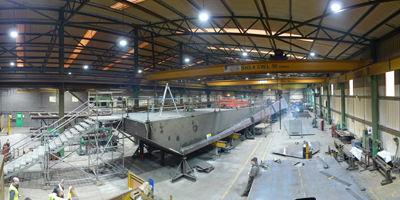
Part of the steelwork for the 160t-heavy structure at the fabricator’s workshop
The design, fabrication and assembly of such an atypical steel box girder was extraordinarily challenging due to the number and variability in geometry of the internal stiffness and diaphragms required, some of them carrying significant load as invisible extensions of the main structure.
Part of this challenge was to make compatible the existence of this dense internal stiffening with the aspiration for a light structure, with optimised plate thickness and the subtle geometric language of the bridge. To avoid compromising the legibility of the object, external assembly welds and local deformation caused by internal welds should not compete with the edges of the origami. The result was hugely satisfying thanks to the rationalisation of weld finishes – ground flush in the most visually sensitive areas – and the skills and experience of the steel fabricator and the contractor.
As a result of the holistic architectural, functional and structural approach, the design is compact, apparently simple and elegant. The bridge is clearly legible for both its users and the users of the River Avon Path, even in the views overlapping with the two existing bridges.
Its solid but slender geometry makes it a quiet addition to an eclectic townscape, bringing visual order to the composition. The architectural quality of both overall shape and details may temporarily seem overly ambitious for the current context. However, this is precisely one of the roles that bridges should play when they are the first pieces of large transformation projects: to set the quality benchmark for future regeneration and development in the area. The St Philips Bridge is expected to open in May.
Héctor Beade-Pereda is associate bridge designer at Knight Architects, John McElhinney is associate bridge engineer at Jacobs