Demolition of the Westchester end of the span (image: New York State Thruway Authority)
Removal of the former Tappan Zee Bridge forms part of the contract being delivered by Tappan Zee Constructors, the joint venture which was responsible for the design and build of the new bridge.
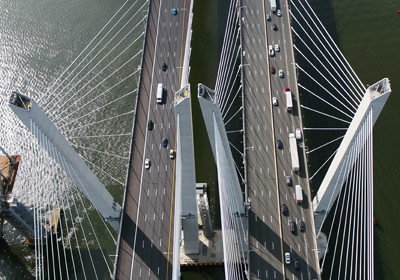
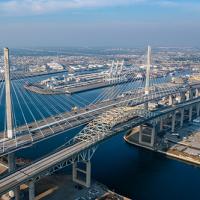
The new Governor Mario M Cuomo Bridge (image: New York State Thruway Authority)
The new 5km-long twin-span cable-stayed bridge carries the New York State Thruway Authority across the Hudson River between Rockland and Westchester counties, some 32km north of New York city. Costing US$3.98 billion, it represents the largest single design-build contract for a transportation project in the United States and it will be the largest bridge in New York State history. Crews are currently working on dismantling the remaining sections of the old Tappan Zee east and west anchor spans and salvaging items from the river, as well as removing the substructure foundations in the water.

The former Tappan Zee Bridge had a main span of 736m (image: New York State Thruway Authority)
It is now more than 18 months since the work to dismantle and remove the existing structure began, kicking off in October 2017 after the first span of the new bridge was opened to traffic. Operations started at the landings on each side of the old bridge, where sections of steel truss and concrete deck were cut into manageable pieces and lifted onto barges by floating cranes.
The steel trusses once formed the base for the old bridge’s concrete deck on the approach spans; to remove them, TZC disconnected the structural steel from the concrete piers and cut them into manageable sections, measuring up to 76m long. The concrete deck panels were removed from the trusses and placed on floating barges to be prepared for transport and recycling offsite.
Most of the concrete material and the steel trusses are being repurposed or recyled. The New York State Thruway Authority has redistributed 135 concrete deck panel units, each approximately 4m wide by 15m long, to state and local municipalities to be repurposed for other bridges and highways. In total the demolition process involves removal of approximately 274,000t of concrete, 42,450t of steel, 13,192 timber foundation piles, and more than 2,000 precast deck panels.
There are 196 piers, 30 circular caissons of solid concrete, 20 steel truss sections, and eight rectangular hollow concrete box caissons to be demolished. This process continued until June last year, when TZC removed the final steel truss section with its huge floating crane, known as ‘I Lift NY’.
In addition to the steel, many concrete materials are also being recycled. Nearly 816t tons of material from the old bridge are being used in the state’s largest artificial reef expansion initiative. State agencies will continue the reef programme by deploying an additional 33 barges of Tappan Zee Bridge recycled materials and 30 cleaned vessels to six reef sites.
Work on the 736m-long main span is still under way – the span has been divided into five sections for removal, with a range of different procedures being used. In May last year, the first part of the main span, the 162m-long centre section, was cut out and lowered down using strand jacks.
The 27-hour operation involved the use of eight hydraulic strand jacks to lower the 4,310t suspended span onto a barge once it had been cut free of the main structure. TZC transported the main span section south of the bridge for further disassembly. Preparation for the operation involved strengthening the structure and adding temporary structural members to accommodate the change in load path that the bridge would experience once the central section was removed. Additional members were also needed to accommodate the forces from the strand jacks. As the operation began, the strand jacks were engaged up to approximately 105% of the anticipated load to allow the vertical hangers to be cut free. Once this was accomplished, the strand jacks lowered the steel structure around 36m to the barge below.
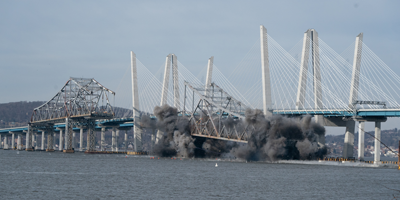
But methods for removing the other four sections had to be reconsidered, when it became clear that the east anchor span was damaged and although stable, some of the key components were highly stressed. Close monitoring of the structure led engineers to propose that the safest way to remove the Westchester end of the span was to bring it down by controlled demolition.
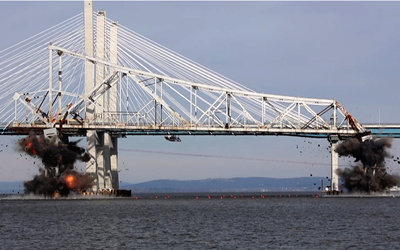
Explosive charges were used to deliberately fail the vertical members supporting the span (New York State Thruway Authority)
TZC hired demolition and salvage experts to plan and carry out the operation, which took place in January this year. Explosive charges were used to deliberately fail vertical members supporting the span, allowing it to be brought down towards the east, away from the main navigation channel. Marine salvage experts then removed the material from the river over subsequent weeks. Chains were laid on the river bed before the demolition started, and these were used to assist with recovery of the steel. The chains supported the salvaged structure in the river, enabling TZC to place the material on barges for removal from the project site.
Work is currently under way to dismantle the 4,137t cantilevered section of the truss over the pier on the Rockland end of the span, and this is being done using barge-based cranes. The final section of truss will be removed with the assistance of strand jacks.
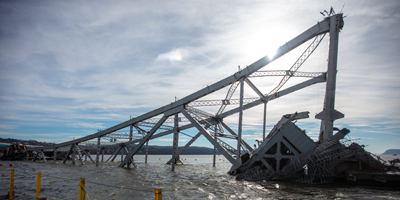
Nearly 816t of materials are being used in an artificial reef expansion initiative (New York State Thruway Authority)