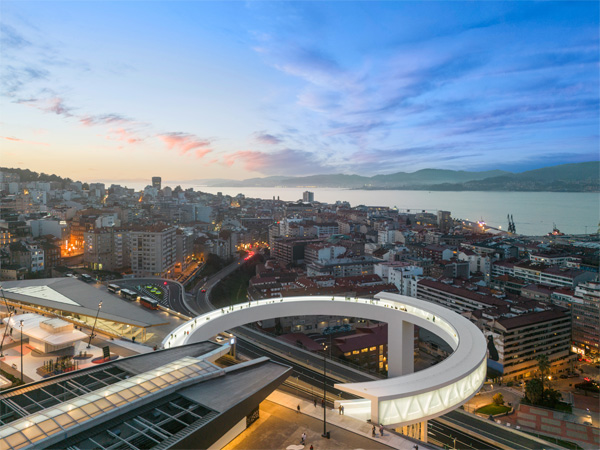
The Halo opened in February 2024 (photo: João Morgado)
Vigo is full of hills and level differences and in recent times many vertical connectivity and mobility solutions have been developed as part of the Vertical Vigo city-wide programme. Halo is the largest and most ambitious of these connectivity solutions, and its opening has been a success story that will enhance sustainable mobility in the city centre for decades to come.
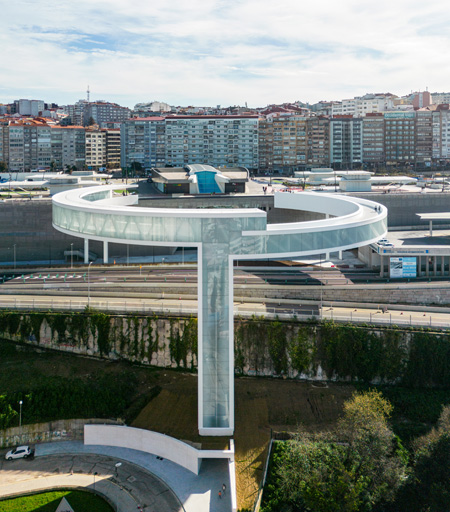
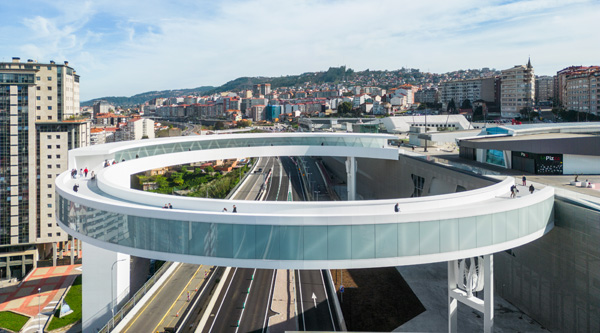
The new Halo mobility solution consists of a two-elevator tower that bridges the 40m difference in height between the lower and higher sections of the city. It also features a striking 84m-diameter circular footbridge whose two curving 80m-long arms span over a busy six-lane highway below. The new structure lands on a public plaza located on the rooftop of a new multimodal train station and commercial building, linking with the streets in this area. The complex includes a train and bus station as well as a large shopping centre.
(Photo: João Morgado)
Engineered with two cabins that are each capable of accommodating 17 passengers, the elevator part of the Halo facilitates efficient vertical mobility across Vigo’s varied topography. The footbridge’s design is notable for its minimalistic support strategy, relying on just three points of contact, one of which is the elevator tower itself. In addition, it has no connection to the train station building, just a gap and expansion joint between both elements.
This design (Bd&e issue 109) was the result of an international competition held in 2021 by the Vigo Municipality and won by the team formed by Spanish bridge designers Arenas & Asociados in collaboration with local architects AM2 and Noarq of Porto, Portugal. The team carried out the detailed design and site supervision while construction was executed by contractors Ferrovial and Oreco Balgón.
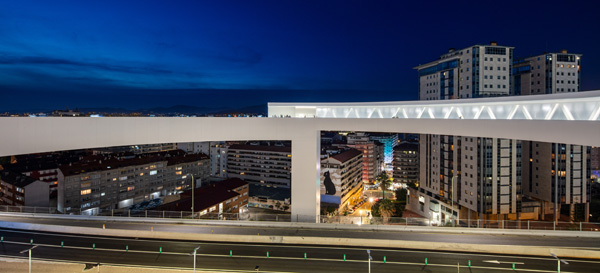
The Halo is a collaborative integrated effort to merge architecture and structure into a single sculptural object. The circular footbridge aims to be not only a crossing or connection over an obstacle, but also a promenade and a viewing platform over the city and the estuary. The design includes a 4.5m-wide pathway supported by a broader 6.5m-wide structure. To cater to diverse user needs, one side of the footbridge is equipped with a roof for weather protection, while the opposite side remains open, inviting unobstructed views.
(Photo: João Morgado)
From a structural perspective, the footbridge is a spatial truss. The covered part of the footbridge is an asymmetrical cross-section through which the users pass. The main external truss plane is along the outer edge and takes advantage of the coupled performance of torsion and longitudinal bending of the curved structure: open views to the inside of the ring are provided for pedestrians on this section. In contrast, the open footbridge section is a symmetrical truss girder that positions pedestrians atop the structural element. The covered truss section has a structural height of 5.9m while the open truss is 4.8m high. The steel structure is made from 800t of S355-grade steel with anticorrosion protection C5 for marine environment, underscoring the project’s commitment to durability and resilience.
Both to allow panoramic views from within the elevators and to enhance the aesthetic and functional appeal of the vertical transport experience, the elevator tower is formed by a concrete C-shaped section with vertical prestressing bars. The two elevator cabins allow faster passenger transfers as well as facilitate emergency evacuation from one to the other in case of breakdown. Internal maintenance stairs are also included inside the tower. The lower part of the tower emerges directly from the hill, and access to the elevators is via a small tunnel.
The aesthetic dimension of Halo is further enriched by the choice of white Krion for the façade. A material made from acrylic resin and mineral dust, Krion adapts to the Halo’s curved surface with a minimum number of joints, and also ensures good durability with low maintenance.
The external faces of the footbridges and elevator tower are glazed with panels up to 5m in height and 2.4m in width that have no intermediate carpentry or supports, and which are only supported along two edges. The curved and tempered structural laminated panels are 12 plus 12.2mm thick and the total glazed surface is 1,320m2.
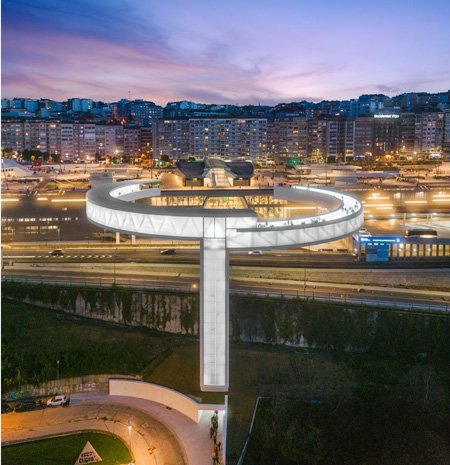
The glass features a subtle ceramic white serigraphy that accommodates the enjoyment of views from the inside of the structure while conveying a milky exterior. During the night, the lighting illuminates the glass façade like a beacon over the city. The part of the truss that is covered carries an additional internal glazed wall which slides laterally for maintenance access. Depending on the hour of the day, the glazing allows the structure to be either seen with various degrees of clarity or to reflect the light and the sky views.
Lighting plays a crucial role in the Halo’s design, with LED lines integrated into the footbridge railings and scenic projectors illuminating the glass façades. The scenic lighting allows for RGBW colours and DMX control to turn the façades into dynamic color animations for special occasions and celebrations. The LEDs enable light intensity regulation and variable effects of white light to enhance the character of the Halo in its new role as city point of reference during the day or night. The scenic lighting is provided by 220 lamps, each with 40 LEDs.
(Photo: João Morgado)
The two secondary piers are simple slender steel supports that house two vertical wind turbines generating electric power for the elevators. Each of the aerogenerators has a 4kW capacity and measures 5m in height and 3.1m in diameter.
Construction of the Halo truss modules was carried out using temporary intermediate towers every 25m in plan. The structure was divided in nine modules ranging from 45t to 140t in weight, the heaviest serving as the connection between the footbridge and elevator tower. The steel structure was fabricated in the workshop and each module transported in four pieces, welded together on adjacent fabrication areas and erected using a large 500t crane with additional counterweight. The crane, which was fixed near the center of the circular footbridge, lifted the modules with a radius ranging from 40m to 50m. All nine modules were installed at night during eight-hour highway closures. The highway remained open to traffic during the day for the duration of construction. The assembly of the steel modules and their erection were executed on site by fabricators Horta Coslada over the course of just two months.
The façade and glazing elements were largely installed during the night and the glass panels – up to 800kg in weight – were lifted using special suction cups. The existing station building was adapted to receive the new footbridge, and a new glass railing was installed in the façade facing the Halo.
Halo’s name is abstract and evocative and as such is a good fit for a new structure that is neither a footbridge, nor an elevator, nor a sculptural piece of architecture, but that at the same time is also ‘most’ of these three things.
(Photo: João Morgado)
Even before its construction was completed, the Halo’s sound and bold design received several awards, such as the Loop design award for unbuilt architecture and the Sems award for sustainable mobility in Spain.
The Halo opened on 16 February 2024 after only 18 months of construction work and is estimated to have attracted over 25,000 users within days of opening.
Miguel Sacristán Montesinos, office director at Arenas & Asociados, was Halo project director as well as design co-author. Alexandre Mouriño Fernández, director at AM2 Arquitectos, was responsible for Halo’s urban and architectural design. Jose Carlos Nunes Oliveira is director at Noarq Arquitetos and was responsible for Halo’s architectural design.
Client: Municipality of Vigo
Contractor: Ferrovial, Oreco Balgón
Detailed engineering: Arenas & Asociados
Urban and architectural design: AM2 Arquitectos
Architectural design: Noarq Arquitetos