The restoration of Dunlap Creek Bridge in the city of Brownsville is now entering the final phase of a multi-year programme shaped by a succession of engineering surprises and an unusual depth of insight into early cast-iron bridge construction.
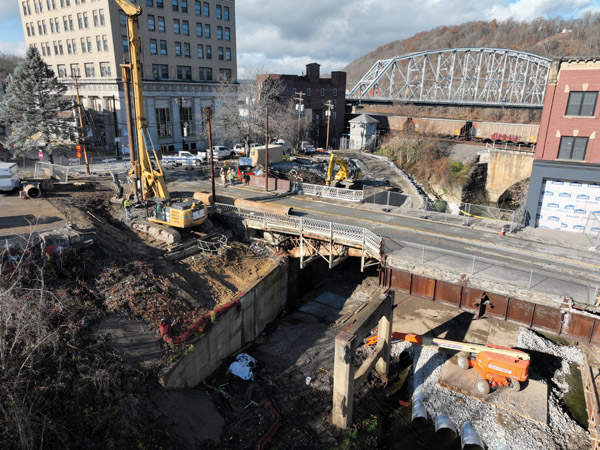
Site preparation ahead of Dunlap Creek Bridge disassembly (PennDOT)
Conveniently positioned along the country’s first federally funded highway, around 60km south of Pittsburgh on the Monongahela River, Brownsville was a thriving river town during America’s westward expansion in the early to mid-19th century. After earlier timber crossings carrying the town’s main artery over Dunlap Creek had failed, the town needed a reliable solution to support heavy trade and travel. In 1839, under the direction of Captain Richard Delafield of the US Army Corps of Engineers, the Dunlap Creek Bridge became the first cast-iron arch bridge in the United States. It also marked a turning point in American engineering, introducing standardised, interchangeable parts to bridge construction. Today, it is listed on the National Register of Historic Places and recognised by the American Society of Civil Engineers as a National Historic Civil Engineering Landmark.
The structure consists of a single cast-iron arch spanning a modest 24m, assembled from five identical tubular iron ribs whose cylindrical form echo the shape of engine components from the steamboat era. These support a lattice cross-section and a layer of cast-iron plates, elements that remained untouched until the early 20th century. The bridge underwent modification in 1922, when sidewalks and metal railings were added, as well as a reinforced concrete deck.
In 2016, PennDOT began planning a sensitive restoration project to preserve the bridge’s historic character while addressing long-term performance. The project also set out to return the structure as closely as possible to its 19th century profile, which included removing the 1922 additions that had obscured the original arch. In place of the sidewalks, a new footbridge would be constructed around 3m away that would also create a vantage point from which to view the restored structure. The work was put out to bid in mid-2024, with construction work currently under way.
The scope of the restoration is as ambitious as the bridge is rare. “We are not restoring it as a museum piece – it’s still an in-service bridge and, in Pennsylvania, 200 years is pretty old for a bridge,” says assistant district executive of design Jeremy M Hughes, who carried out the original scope and helped define the rehabilitation programme. He highlights that structural capacity was not an area of concern during the planning stage, because refined analysis carried out on the main load-carrying members had shown that the bridge was still good for legal loads.
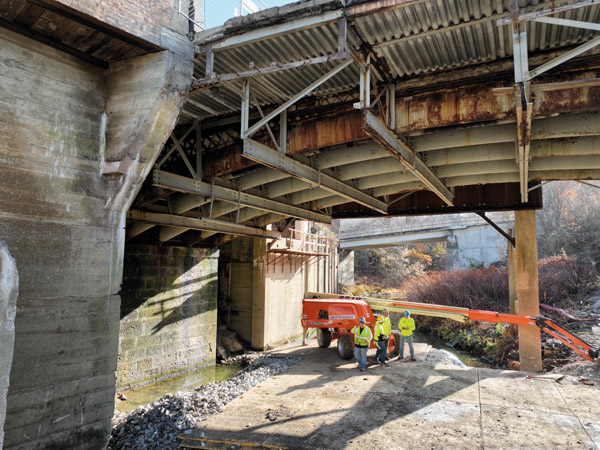
The five original cast-iron ribs and the later 1922 addition of sidewalk steelwork (PennDOT)
PennDOT concluded that a conventional in-situ rehabilitation would not have allowed the historic cast-iron fabric to be properly inspected or conserved. Given the bridge’s age, the brittleness of early cast iron and the extent of later modifications, full disassembly offered the only practical way to assess each component and carry out repairs under controlled conditions. Discounting the masonry abutments, the bridge is therefore being taken apart, with every cast-iron element carefully removed and transported first to Pittsburgh for stripping, inspection and coating, and then – where required – to Michigan for specialist repair.
However, before site works could begin, a number of interrelated issues had to be resolved at planning stage, many of them arising from the bridge’s unusually tight integration with its immediate surroundings.
The crossing is located in a part of Brownsville that has been in continuous use as an industrial zone since the link opened, and over time the fabric of the city had quite literally merged with the bridge itself. At one time, says Hughes, there had been three buildings on the creek embankments that had direct access onto the bridge deck, with one even remaining today – known as Building A, which is currently being redeveloped as a brewery.
Building A was originally planned to be demolished as part of the project, clearing the space around the bridge abutments to the south. However, during the Section 106 review process required for federally funded projects involving historic resources, stakeholders pushed to save the building. “We had to take a step back,” remembers Gary Ferrari, project manager of PennDOT District?12 and in charge of design at the time: “We had to evaluate how the bridge and the [embankment-side] sidewalk in front of it would hold up with the building remaining in place. A lot of geotechnical and design work had to be carried out to make the sidewalk in front of this building stand up independently of the bridge.” The issue, explains Hughes, was that the building’s foundations were connected to the bridge, and needed removal, with some sections even supported by the bridge.
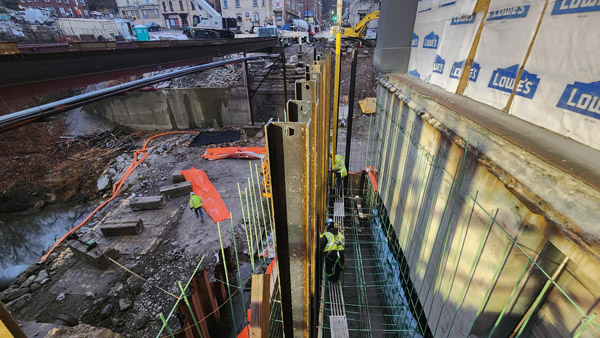
Part of the foundations of Building A (on the right) had to be removed: they were connected to the bridge and supported a sidewalk to its deck (PennDOT)
As a result, access to the building from the walkway on the embankments is presently being reconstructed with a combination of micropiles and mass concrete pours: “We have two-thirds yet to pour to get to the top to connect the front face of the building to where the proposed bridge is going to be,” explains PennDOT assistant construction engineer Scott E Faieta, adding that also complicating matters on site is the presence of a utility duct, currently temporarily supported on a system of beams, cross bracing and strapping.
In line with the bridge’s historical status, another area of focus during planning was the method of restoration for the masonry abutments. Initially, the project had envisaged renewing the appearance of any damaged rectangular masonry by extracting individual pieces, rotating them and reseating them in alternative locations. However, site inspections revealed that this approach would be highly impractical due to the variation in dimensions: “This stone might be 5 feet wide, this one 2 feet,” says Faieta: “But the thing is, the depth that they go back all varies – one might be 2 feet back into the abutment, another 6 feet. And they are all interlocked like a Jenga puzzle.” Consequently, to keep within budget and programme constraints, the team had to settle on a less invasive approach: where faces are chipped or weathered, contractors will remove the damaged surface and secure a new stone veneer that matches the original texture as closely as possible. Once repairs are complete, the abutments will be blasted clean and stained so old and new masonry blend seamlessly.
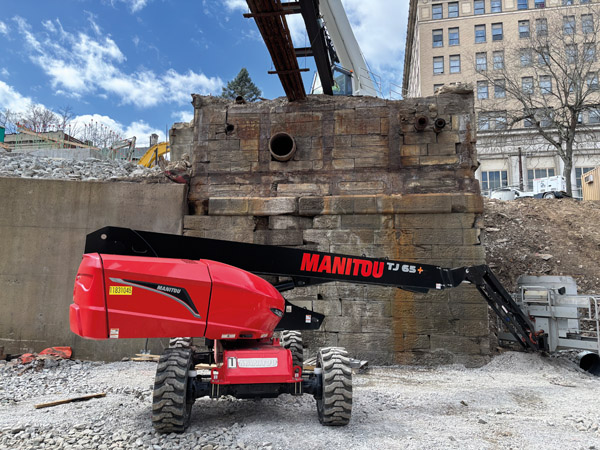
The masonry abutments were found to comprise blocks of varying sizes, requiring a change of approach (PennDOT)
The team also had to work out how to reinstate a distinctive feature from the original 1839 design: the cast-iron plate, positioned above the lattice ribs. While no longer serving a structural role, the plate was historically integral to supporting the riding surface between the lattice members. For the rehabilitation, these plates are being reintroduced as an aesthetic element to preserve the bridge’s authentic appearance. Adjustments were required to accommodate the slightly wider new deck: they will be flush on the side visible from the pedestrian bridge for visual continuity, with a minor overhang on the opposite side.
The most striking visible change, however, will be the removal of the added sidewalk steelwork, which consisted of a web of cross members and light steel channels attached to the original cast-iron ribs. It was a solution that obscured the historic structure and proved a constant maintenance headache. “We’re really lucky that that wasn’t considered to be a contributing attribute of the bridge to its historical significance,” says Ferrari. In its place, the rehabilitated bridge will feature a crash-worthy Type 10M barrier on the traffic side to meet modern standards, with a decorative railing fabricated to mirror the original design on the outer edges. The adjacent new pedestrian crossing will comprise a simple two-girder system of steel plate girders topped with a reinforced concrete deck.
Another major driver for the extended planning period was that Dunlap Creek Bridge’s closure involved a carefully orchestrated rerouting plan that included interventions on two additional crossings nearby.
PennDOT policy prohibits using local streets for official detours, so the primary detour for vehicles had to follow state-maintained roads. While this added only a few minutes to travel time, it required strengthening the Brownsville Avenue Bridge, around 480m away from Dunlap Creek Bridge, which formed part of the emergency detour. The works were completed in October 2024 and involved installing a new composite deck, new parapets and sidewalks, which lifted the crossing’s former load restrictions and ensured it could safely handle emergency vehicles and diverted traffic.
To reroute pedestrians, the Charles Street Bridge located around 60m downstream from Dunlap Creek Bridge was similarly treated, with a brief closure in mid 2024 enabling rehabilitation of the sidewalk and guardrails.
When site works finally got under way in November 2024, the 200-year-old crossing began to challenge a number of long-held assumptions.
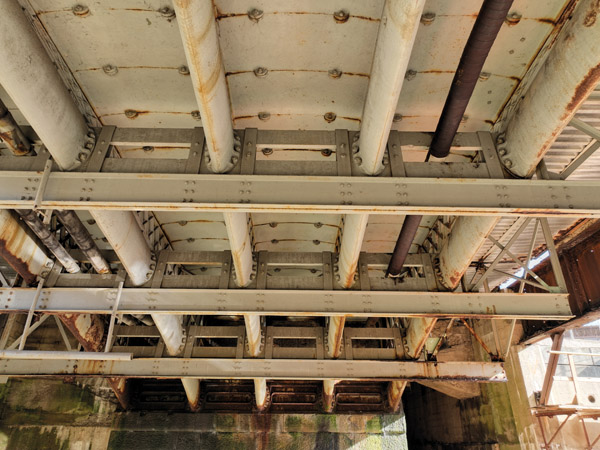
None of the cast-iron ribs will need replacement (PennDOT)
With no original engineering plans – only drawings based on visual inspections – the team had to rely on assumptions that haven’t always held against reality. An inkling of what was to come started early, when removal of the concrete deck revealed that the floor plate sections were not all the same length, as originally thought, but varied from 0.5 to 1.5m. Further surprises emerged at the level of the five rows of ribs spanning about 24.4m. Each rib is assembled from nine cast-iron segments of nominally around 2.7m in length, and all the ribs are tied together by eight lines of cross plates: “We assumed that the cross-plates were just flat plate,” says Hughes. “But each protrudes into the ribs.”
That detail made dismantling far more complex because the plates had cast male ends that locked into female sockets in the ribs, meaning the crew couldn’t just unbolt the flanges and lift the pieces free. “We had to cut the male ends off to get the pieces out,” Faieta explains. “It was a big challenge and it set us back at least a month.” The discovery also raised questions about how the builders had assembled the structure originally, given the precision required to interlock these elements and the fact that each rib section weighs roughly 1,360kg. “How did they squeeze all the pieces in between the cross-plates with male ends? How did they do it?” wonders Faieta.
With the original male ends removed, engineers are exploring several options for the reassembly of the supporting structure: reattaching new tenons, inserting partial connectors, or using a sleeve system that passes through both the cross plate and adjoining ribs. “We’ve got a conceptual drawing we’re sharing with the contractor,” says Hughes. “Since they’ll be the ones putting it back together, we’re asking for their input too. It’s a work in progress.”
Worthy of note is that the ribs themselves have held up remarkably well throughout their working life. None need replacing, and what appear to be flaws in places are not signs of age or fatigue but imperfections from the original casting. These inclusions and imperfections, says Hughes, were perhaps caused by wet sand during the casting process. “This isn’t deterioration over time, it is just casting,” he says.
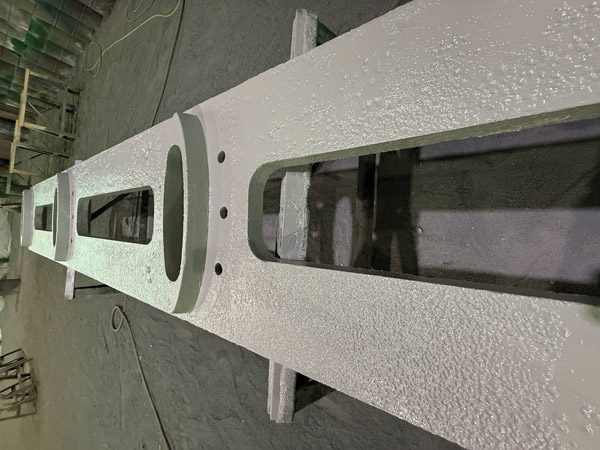
During dismantling the original cross-plates revealed male ends which fitted into the rib sections (PennDOT)
Another detail that came out during the disassembly is that each rib section connects to the lattice on top via small iron nubs, or saddles, that were cast integrally with the ribs. Many of these saddles snapped during disassembly, and the team is now working out how to replicate and fix them back in place. “We’re pretty familiar with how to work with cast iron from the 1880s, 1890s,” Hughes notes, “but this is a full generation older than that. We have less experience with how to work with that material.” Also to be established is a method to repair some sections of lattice but, by and large, they are in good condition and will likely only need repainting.
A lesser challenge will be replacing the historic square head bolts, which will be substituted with new bolts fabricated to modern standards but – in line with the sympathetic nature of the project – finished with replicated square heads to preserve the bridge’s original appearance.
According to the official schedule, the project should have been completed by the end of December 2025, but the finishing line is now looking like summer 2026. “We’ve had some delays with the disassembly, and with getting the welds approved at the shop to do some welding,” explains Faieta, adding: “We’ve stumbled across a couple of things with the painting where we’ve had some bleed through after they’ve been blasted and had primer on there. We’re doing some tests to see what we can do to prevent that rust bleed.”
In hindsight, the team admits that some early assumptions, particularly around preserving original stone masonry, proved unrealistic. “We probably should have been more aggressive in design,” says Ferrari. “We tiptoed around cultural resource requirements, thinking we could keep everything intact, but the reality was that some replacement was inevitable.”
Looking ahead, the team is eager to see whether the bridge will fit back together as planned. Before disassembly, the contractor captured a detailed as-built survey of critical points – the backplates where the cast-iron arch meets the stone masonry abutments, the corners of wing walls, and other irregular geometries. These measurements will guide reconstruction but, even with this meticulous approach, there’s an element of suspense around the next phase: “We’ll see if the bridge got longer or shorter,” says Faieta.
The historical significance of the rehabilitation and the opportunity it presents to secure the bridge’s future are not lost on the PennDOT team. Such is their respect for the project that no fewer than seven stakeholders made the time to speak with Bd&e about the Dunlap Creek Bridge, “Everybody’s excited about it, and we all want to learn from it,” says Faieta, “Chances are, most of us will never see this happen again.”
Lead agency: Pennsylvania Department of Transportation (District 12)
Federal partner: Federal Highway Administration
Historic oversight: Advisory Council on Historic Preservation
Contractor: Allison Park Contractors
Refurbishment: Envirosafe
Cast-iron works: Bach Steel