Salangaan (‘Swiftlet’) Footbridge is a design, build and maintenance project that started out in 2016 as a reference project by Zwarts & Jansma Architects (ZJA). Ney & Partners, as architect and structural engineer, developed the project in collaboration with general contractor Artes-Rogiers and electromechanical specialist contractor De Meyer.
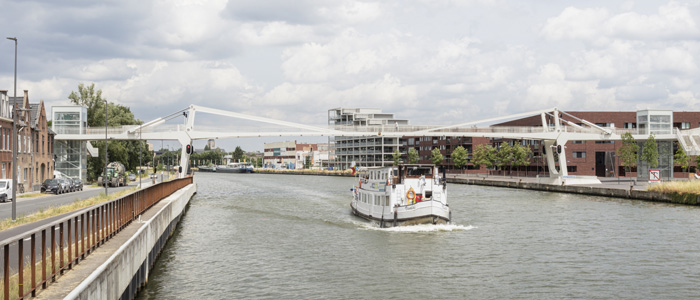
The 115m-long moveable bridge spans the Brussels-Scheldt Canal in central Vilvoorde, a city north-east of Brussels, connecting a new waterfront development with Drie Fonteinen Park.
(Image: Michiel De Cleene)
The essence of the design by ZJA offered a continuous connection across the stairs, balcony approches and movable decks, all of which offer a minimum 4m usable width. The new design by Ney & Partners developed the concept by enhancing the crossing’s integration with the landscape as well as reducing its maintenance and optimising costs.
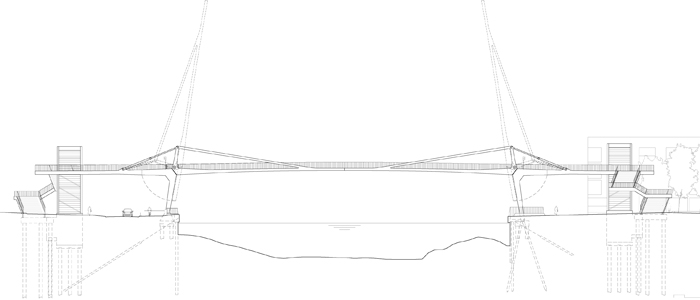
Some significant improvements were made to the reference design. In order to prevent works taking place in the canal itself, the main span was increased from 50m to 66m, which also provided the maximum clearance for canal traffic as well as retained the continuity of the quay walls on both banks of the canal. The main span, originally proposed as a double bascule bridge in the DBFM tender documents, became a double piston-stayed moveable bridge with two 30m-long lift spans. The pistons serve both as motion actuators and, in closed position, as structural backstays of the 33m-long cantilevers. The front tie is a closed steel box girder, as are the 3.75m-high masts. Each counterweight has a length of 6.5m behind the axis, hiding under the bridge deck between the main girders of the frame between columns and lift shaft. The pistons are located above the bridge and are highly visible, making them easy to inspect and to maintain.
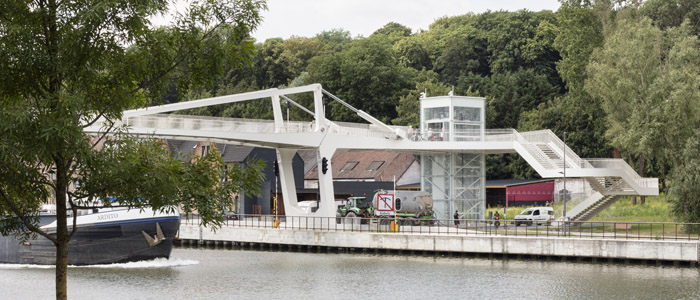
As there was a 10m clearance requirement above the canal and long ramps were not desired, lifts and wide staircases were integrated into the design for both sides of the bridge. The columns of the main span, together with the stairs and elevator shafts, have been reshaped to form an integrated structural frame. Extra secondary structures were avoided and the stairs became self-supported, without the need for extra intermediate columns, which added a visually powerful effect.
(Image: Michiel De Cleene)
We lowered the path level of the footbridge by 1.5m through geometric and structural optimisation. The deck is 65cm deep on the balcony approaches, reaching a maximum of 1.42m on the columns below the hinges and a minimum of 47cm at the middle of the bridge, at the joint between the two moveable parts.
The complete superstructure is made of closed steel box girders for the main beams, stiffened plates for the deck, and structural steel profiles for the elevator shafts. From the total 520t of steel, each moveable part accounts for 135t, of which 50t act as a counterweight. The main beams of the fixed parts of the balconies, the columns, and the moveable bridge section all form one continuous shape. The hinges on the main axis are therefore completely integrated inside the outer geometry of these main beams. The edge plates of the balconies become the main beams for the stairs. The result is an elegant, slender and efficient structure.
(Image: Ney & Partners)
Each moveable section has two hydraulic pistons with a capacity of 2.5t. The hydraulic groups are stationed in the basement, underground, next to the elevator shaft. The integration of all hydraulic, mechanical and electronical parts – including hydraulics, axis, closing mechanism, sensors, cameras, lights -–inside the optimised structure was a particular challenge. It demanded the competences of all parties involved, especially because some elements required a proper separation, such as the lift mechanism. At the joint between the moveable bridge deck and the balconies, the railing is partially used as a gate to prevent users accessing the moving deck. At the joint between the two moveable parts, each main beam is equipped with an electric locking system that keeps the two aligned vertically. A contact wheel is used to provide lateral alignment.
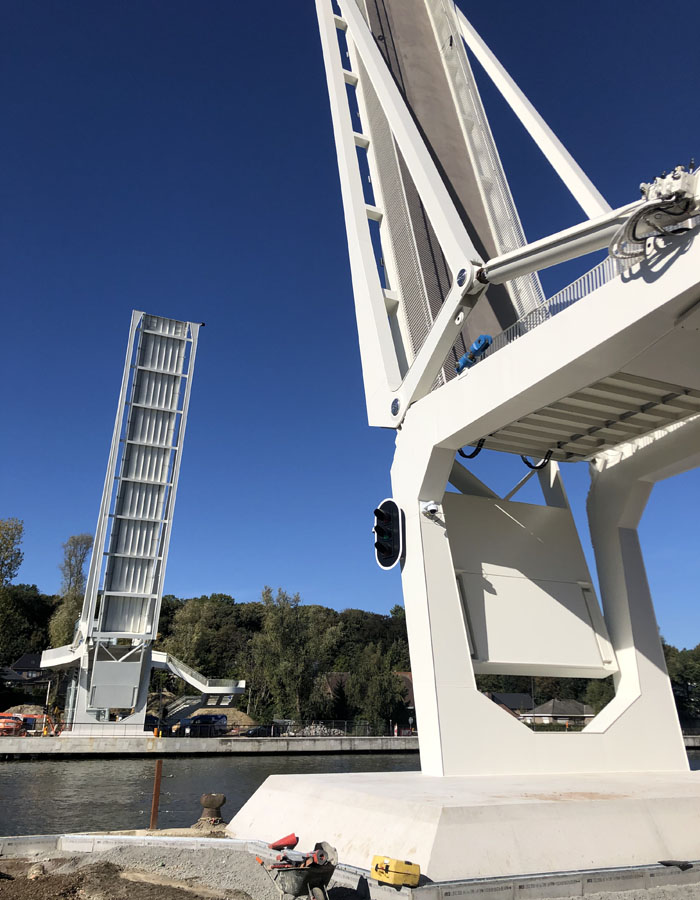
(Image: Michiel De Cleene)
After a three-year construction period, the US$10.75-million bridge opened to the public on 17 February 2023 in the presence of many local residents. Following a public competition, the new footbridge was named Salangaan Bridge, after the surrounding swiftlet birds and in memory of Frederik Vanclooster, a local student who drowned in the canal at the beginning of the year and whose scout name was Salangaan.
The bridge is now an important part of the bicycle and pedestrian network in Vilvoorde but also the canal network to/from Brussels.
Bart Bols is project engineer at Ney & Partners