There may not yet be much to see, but work has in fact already started on Canada’s US$4.2 billion New Champlain Bridge Corridor Project in Montréal. Construction crews are working on a dyke in the middle of the Saint Lawrence River, boring and concreting test piles as well as preparing to build a 240,000m3 construction berm that will serve as a working platform for the prefabrication of the bridge piers, and the assembly of the deck sections.
Later this summer, construction of a second berm will facilitate the building of the main tower adjacent to the Seaway. Through the summer and autumn of 2015, preparatory works in the river will continue, and the main construction work is scheduled to start at the beginning of the 2016 season as soon as Montréal’s legendary winter weather loosens its grip.
.jpg)
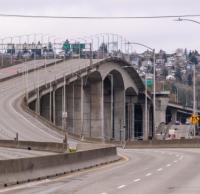
In fact the harsh climate and extensive use of deicing salts are major factors behind the deterioration of the existing Champlain Bridge, which the new bridge will replace. Opened in 1964, the existing crossing is a steel truss cantilever bridge and approach spans of prestressed concrete beams which supporting a prestressed concrete deck paved with asphalt. It is one of the busiest bridges in Canada, carrying between 40 and 50 million vehicles per year and it plays a vital role in Canada’s trade partnership with the United States. More than US$20 billion in cross-border goods cross it every year. Maintaining a viable transport link is vital to the economy of the region and in 2011 the decision was taken to go ahead with a bridge replacement project.
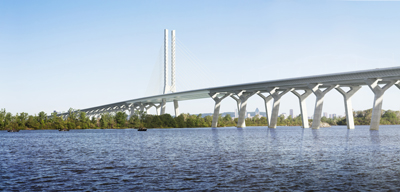
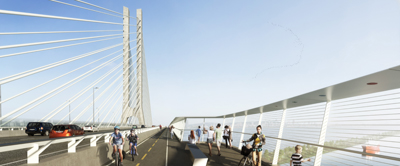
The new Champlain Bridge will be the centrepiece of the 7km-long corridor project, which also encompasses highway widening and replacement of 15 other structures. Among these is a 468m long, low-level bridge connecting Ile-des-Soeurs to the island of Montréal. This is a major bridge structure in its own right, yet the 3.4km-long bridge over the main stretch of the river steals the limelight. This bridge will sweep across the river in a graceful curve; the high point of its profile being a 240m main span cable-stayed bridge across the St Lawrence Seaway, the international shipping channel that connects the Great Lakes to the Atlantic Ocean. The new bridge carries three separate transportation corridors, each supported on its own steel box-girder superstructure. The north and south corridors are three-lane highways with inner and outer shoulders. The north corridor also includes a 3.5m-wide shared-use path to provide a new route across the river for pedestrians and cyclists. The central transit corridor will initially provide dedicated bus lanes but the bridge will be built to allow it to be converted to a light rail system in the future as Montréal’s transit system expands.
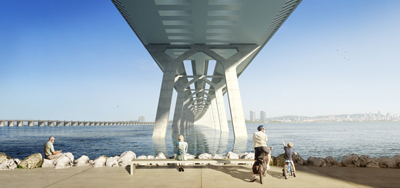
In the vicinity of Montréal, the Seaway runs along the south side of the river. A dyke was constructed in 1954 to allow the water level in the Seaway to be controlled by a series of locks, and has become a very popular bicycle path, effectively in the middle of the river with water on both sides. More than 200,000 cyclists a year use this route, which is connected to the urban areas of Montréal in several locations including via an existing ice control structure, or estaçade, immediately upstream of the existing bridge. The main tower of the bridge is designed to be on a berm, immediately adjacent to the dyke, and this berm was originally planned only as a temporary construction measure. It is now intended to be maintained as a permanent feature, both to facilitate inspection and maintenance of the bridge and to provide a rest-area and viewing platform for cyclists so that they can access dramatic viewing-points underneath and up-close to the bridge.
Despite the major scale of construction needed for the project, the time allowed to do it is short. Structural condition surveys in 2013 revealed the existing Champlain Bridge to be in worse condition than originally thought. Since then the schedule for the replacement bridge has been pressing. After studying the available procurement options, the Government of Canada accelerated the project timeline and committed to getting traffic onto the new bridge before the end of 2018, three years earlier than previously planned. The business case developed for the project was based on a public-private partnership model but with only five years now available to procure a private partner and build the bridge instead of the eight originally planned, immediate action was needed and a team was quickly assembled to bring together experts in engineering, ITS and tolling, procurement, legal and financial.
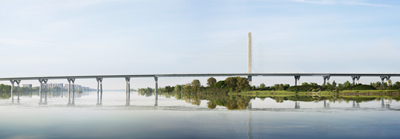
Consultant Arup supported by Groupe SM was appointed as technical advisor to the government, to develop the reference design, procurement documentation and technical specifications for the project. The scale and complexity of the project, and in particular the sensitivity of working in an existing urban highway corridor required significant planning to be completed before proposals could be invited.
“Probably the key to achieving the schedule for us was the close working relationship we have enjoyed with the owner and stakeholders throughout this project,” explains Arup project manager Doug Balmer. “We also recently worked on the other side of the fence as lead designer for Nouvelle Autoroute 30 who are the private partner on the A30 project. This helped our team enormously in terms of understanding the technical demands of construction in Montréal as well as what was going to be important in terms of putting together project requirements that would lead to a successful partnership agreement.”
The project attracted considerable interest, with six consortia vying for the contract. The request for proposals was issued to a shortlist of three in July 2014, less than a year after the decision was taken to accelerate the project. In February this year, three technical submissions were received, and evaluated against both mandatory criteria - largely relating to the aesthetic form of the bridge - and general criteria, prior to the receipt of financial submissions. The Government of Canada took steps to ensure the integrity of the procurement process, following a rigorous, open, fair and transparent process, with each step overseen by a fairness monitor. The preferred proponent announced in April was the Signature on the Saint-Lawrence Group, a consortium of SNC-Lavalin, ACS Infrastructure, Hochtief PPP Solutions, Dragados and Flatiron Construction with design services provided by TY Lin International and International Bridge Technologies and the MMM Group.
Despite the accelerated timeline, the project goals remained unchanged. Among these was a strong commitment to fulfilling local aspirations for a landmark structure that would serve as the gateway to the city of Montréal. During the summer of 2013 the Government of Canada, in conjunction with the city of Montréal, began to study options for ensuring that the architectural quality of the project would be of sufficiently high standard. At the time there were calls from some quarters for a design competition. But the time required to properly organise and run a design competition in order to elicit serious responses did not fit within the accelerated schedule. In any case, the procurement of the project meant that the final design would be carried out by the private partner.
Arup’s lead bridge engineer for the project, Matt Carter, offered a solution. “From our experience on the Queensferry Crossing in Scotland and the Øresund Bridge between Denmark and Sweden, we knew that the most effective means of ensuring a high-quality architectural design was to mandate the most important aspects of the geometry and form through a set of drawings known as a definition design. At the same time we would leave open structural solutions, construction methods, material types, foundations and other key areas where the private partner could bring innovative solutions,” says Carter. “We worked with Infrastructure Canada and the City of Montréal to develop what we called a roadmap to architectural quality. It set out the process that we would follow.” Arup went on to develop both reference and definition designs, in parallel with the development of the technical requirements. The reference design, a non-mandatory solution, helps to define the project’s technical requirements and inform the cost and schedule estimates. The mandatory definition design communicates the owner’s aesthetics requirements to the bidders, ensuring that technical and visual aspects of the design are considered simultaneously, and provides a plan for safeguarding architectural integrity through the final stages of the project.
While it is common to prepare a reference design in a PPP project, it is typical not to focus much effort on it as the final design will almost certainly be very different. In this case, Arup developed a reference design to demonstrate there was a technically-viable solution that respected the project schedule, was architecturally pleasing and would be cost effective. “Understanding the project constraints such as the restrictions for building over the Seaway while it remains in operation, and Quebec’s desire to convert the central transit corridor over the bridge to a light rail system in the future were key to the development of the reference design,” explains Balmer. “It was essential that an holistic approach was taken to find a solution that fulfilled all stakeholder requirements, rather than considering each element in isolation.” The reference design was used to prepare a definition design, which includes a set of drawings showing the requirements for configuration, geometry, and form for the final bridge.
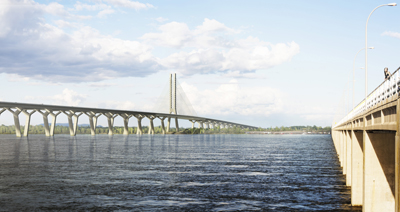
Architect Poul Ove Jensen of Dissing & Weitling was appointed by Arup to assist with the bridge design, together with Claude Provencher from the Montréal architectural firm Provencher & Roy. The design was developed through a close collaboration between engineering and architectural disciplines with regular review and input from an architectural quality panel representing city of Montréal, Ordre des ingénieurs du Québec, Ordre des architectes du Québec, Mission Design and Héritage Montréal. “The design that evolved is a unique and instantly recognisable structure with the visual appeal to become a new icon for the St Lawrence River, the city of Montréal, and Canada as a whole,” says Carter. One of the defining aspects of the design is the piers that support the approach spans. The team recognised the approach bridge substructure as both the biggest architectural challenge and at the same time the biggest architectural opportunity. Shunning traditional solutions such as a ‘forest’ of columns or heavy portal frames, the team developed a W-shaped pier. “The design of the bridge is to a great extent based on analyses and logic, but at a certain point the analyses no longer give the answer,” explains Jensen. “Sometimes you have to trust intuition and make subjective choices. This is when it gets exciting, because these choices make the difference between a decent bridge and an outstanding bridge.”
One of the key benefits of the definition design approach was that the Government of Canada was able to release images of the new bridge in the summer of 2014, prior to the procurement, confident that upon selection of a consortium to complete the design and construction, the bridge would indeed respect the design intent.
With the existing bridge lasting only a little over fifty years it was equally important to the project team that the new bridge would be much more durable in order to maximise the public benefit of the investment. This is a common trend for bridge replacement projects in North America, and in this case a design life of 125 years has been specified for the main bridges, well in excess of the 75 years mandated by the Canadian bridge design code. Such a long design life is a challenge in any location, but for a river crossing in Montréal there are particular problems due to the extreme temperature range, copious use of deicing salts on the deck and piers which are subjected to being frozen into ice-sheets and exposed to impacts from ice floes. Achieving an extended design life requires an holistic approach that integrates material selection, design detailing, construction quality control and long term maintenance.
The approach that was taken is a combination of performance specifications, including probabilistic time-to-corrosion modelling, and prescriptive requirements. “The problem with a fully performance-based approach is that it’s statistical and frankly requires a great deal of engineering judgment, balancing risk and cost. That can be a little problematic if the party that could achieve savings due to reduced quality isn’t carrying the long-term risk,” says Peter Matusewitch, Arup’s durability expert for the project. “We wanted to ensure that there were some things that were mandatory in the project requirements so that we could eliminate the most significant durability risks. A good example is the use of stainless steel reinforcement in the deck slabs. The use of a definition design also helped here since we could be fairly sure that the durability assessments that were carried out to develop the prescriptive requirements would still be appropriate for the final design.”
So far the team has hit every schedule milestone. Achieving financial close with Signature on the Saint-Lawrence in June this year, just fifteen months after releasing the RFQ, has been a tremendous milestone and a major validation of the commitment made by the Government of Canada. With just 42 months to construct the bridge, including three winter seasons, a lot of activity is going to take place in a short time. The St Lawrence River looks set to be a place for bridge enthusiasts to keep an eye on for the next few years.