Perhaps the most iconic of American cities, Washington DC is nevertheless atypical in the sense that its built environment has evolved physically and philosophically at a relatively glacial pace, with skyline and street pattern fiercely protected by powerful conservative sensibilities. The new Frederick Douglass Memorial Bridge (FDMB) is therefore, in many ways, a mould-breaking initiative in terms of planning, process and delivery. Most significantly, perhaps, has been the resolve to deliver major infrastructure as progressive civic architecture – a concept that while not new, has in this case rebooted the idea in testament to the ambitions of the District Department of Transportation (DDOT).
(Icons DC)
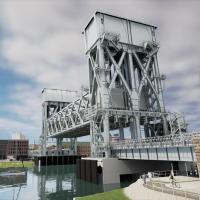
The historical significance of the location for the new Frederick Douglass Memorial Bridge in South Capitol Street can be traced back to Major Pierre L’Enfant’s 1791 Plan of Washington DC which developed South, East and North Capitol streets so that they extended from the US Capitol and became prominent gateways to the city’s monumental core. The replacement of the existing crossing with a new structure transforms the South Capitol Street Corridor with an iconic entry to the capital city. The US$442-million project is the largest in DDOT’s history.
The overarching goal was to improve connectivity, traffic mobility, safety and operational characteristics in the corridor while ensuring compliance with all environmental requirements. As part of the overall Anacostia Waterfront Initiative, the FDMB project is a key component for the DDOT’s strategy to support neighbourhood revitalisation and economic development on both sides of the river.
AECOM is lead designer for South Capitol Bridgebuilders (SCB), a joint venture team of Archer Western Construction and Granite Construction Company. The SCB team is assisted by industry experts which include BEAM (formerly Brownlie Ernst and Marks) as bridge architect, Engineering Consulting Services for geotechnical design, McNary Bergeron & Associates for erection engineering, Veritas Steel for arch/deck fabrication, and Randy Burkett Lighting Design for aesthetic lighting.
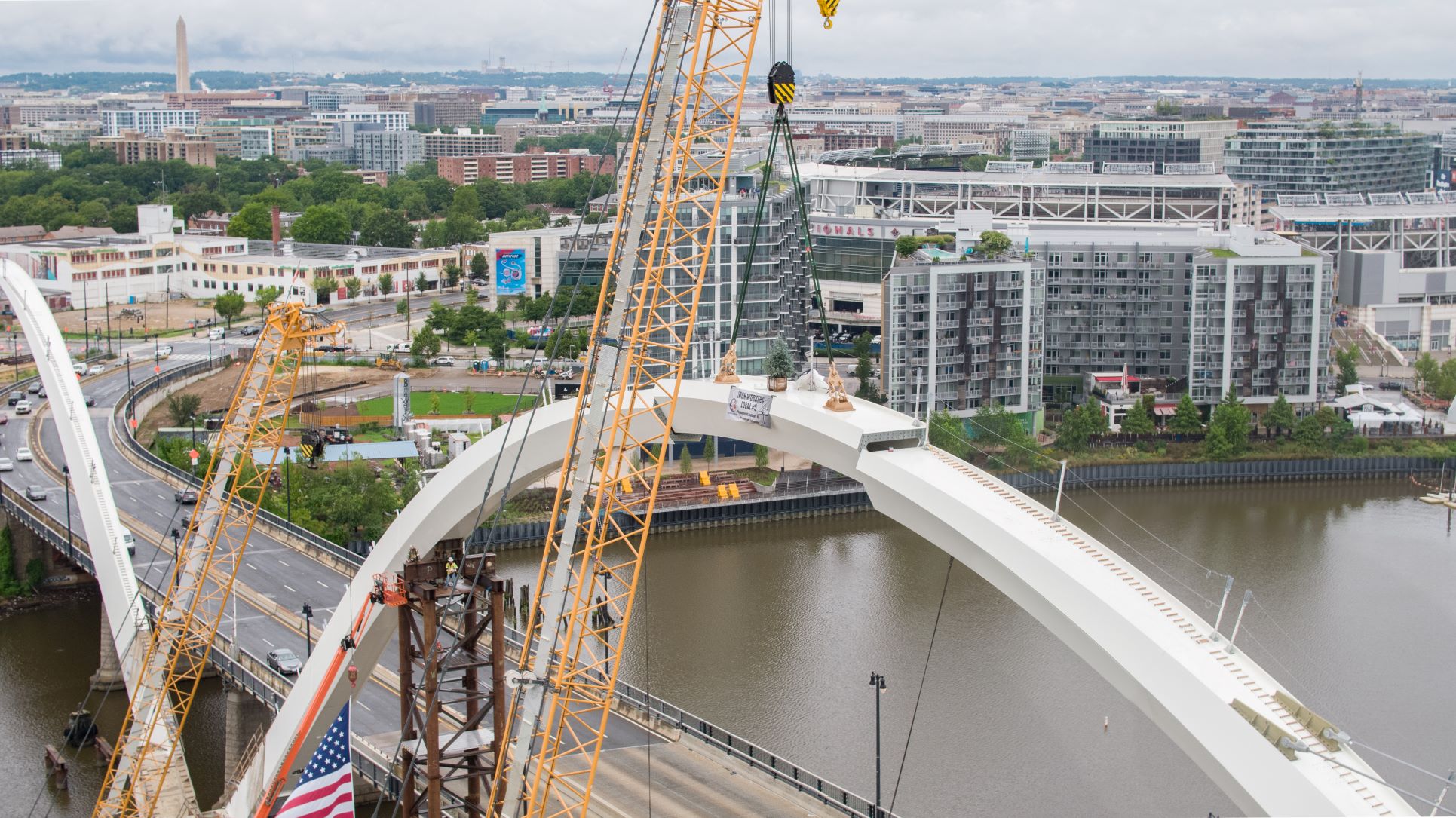 Placement of the final hexagonal steel arch keystone (AECOM/SCB)
For the project to be successful, DDOT’s procurement strategy had to be meticulously thought out. Delivering any project in Washington DC can be challenging, but creating an iconic bridge with a grand urban boulevard offered unique challenges. From the early stages of the environmental impact review, DDOT focused on how to reduce risk for the design-build teams by taking on preliminary design, permitting, and community outreach activities. At the outset, DDOT had to determine what needed to be done in advance of the design-build procurement in order to strike the right balance between budget, schedule and the desire for a signature bridge – within the oversight of the US Commission of Fine Arts and the National Capital Planning Commission.
Perhaps the most important initial challenge that DDOT overcame was securing the US Coast Guard’s (USCG’s) acceptance to change the existing structure from a moveable swing-span to a fixed-span bridge. To attain this, DDOT liaised with the river users and the US Navy in developing a study that justified the change. As part of the USCG permitting process, DDOT coordinated the relocation of the USS Barry, a decommissioned naval military display ship that would have been landlocked upstream at the Navy Yard as a result of the new bridge configuration. DDOT spent several years developing the preliminary engineering as well as a comprehensive set of reference information documents that could be provided to the design-build teams to aid their understanding of the project and to assist their bidding.
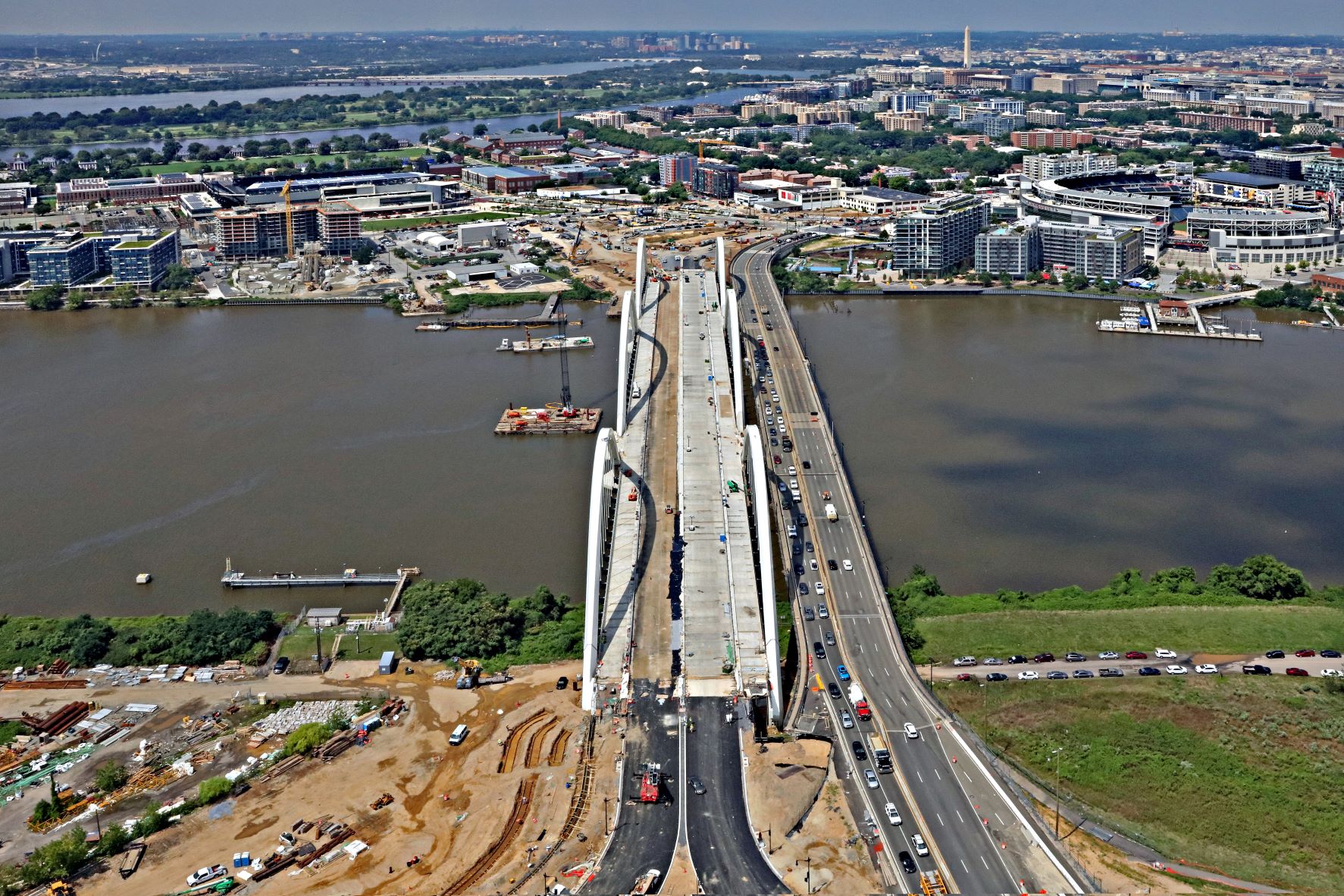 The FDMB is a unique above-deck arch design that captures the essence of Washington DC both historically and in consideration of future context (AECOM/SCB)
In addition to the base engineering information, a comprehensive request for proposal was developed that included project-specific technical provisions and specifications. In tandem with the technical requirements for the project, DDOT outlined visual quality requirements and goals. These included replacing the existing FDMB with a new iconic structure that reflected the traditions of great civic design in the district, as well as incorporating throughout the corridor aesthetically pleasing and sustainable materials and elements that reflected the natural and historic resources of the area.
To ensure the design appearance goals were met by the design-build teams, a visual quality concept process was devised. This allowed DDOT the opportunity to review the design-builder’s visual concepts and clarify, by addendum, any misinterpretations or ambiguities in the request for proposal before the submittal of technical proposals. Two mandatory visual quality concept submissions were required in conjunction with two one-on-one meetings. Optional third and fourth submissions as well as one-on-one meetings were also offered. Also established was an aesthetic review committee (ARC) that consisted of representatives from DDOT, the US Commission of Fine Arts, the National Capital Planning Commission, and the State Historic Preservation Office.
The committee was tasked with reviewing each visual quality concept and providing comments indicating whether each design appearance goal had been addressed. All the visual goals had to be accepted by the ARC for a proposal to be compliant. The pass/fail criteria were intended to provide assurance that the design-build teams were committed to delivering an elegant and iconic bridge. Visual quality was one of the components evaluated within the technical proposal, representing a significant proportion of the total score.
SCB’s approach throughout the bidding phase was to develop a design that truly reflected DDOT’s requirements for an iconic bridge and grand boulevard for the South Capitol Street Corridor, all the while staying within the overall budget and schedule. SCB’s goal during the proposal phase was to exceed all requirements for each of the design appearance goals. In response to comments from the ARC on its visual quality concept, SCB adjusted its design significantly from first submission to the second, and made even further refinements before the third. By the end of the procurement process, the SCB team had produced a design proposal which exceeded all the project design appearance goals.
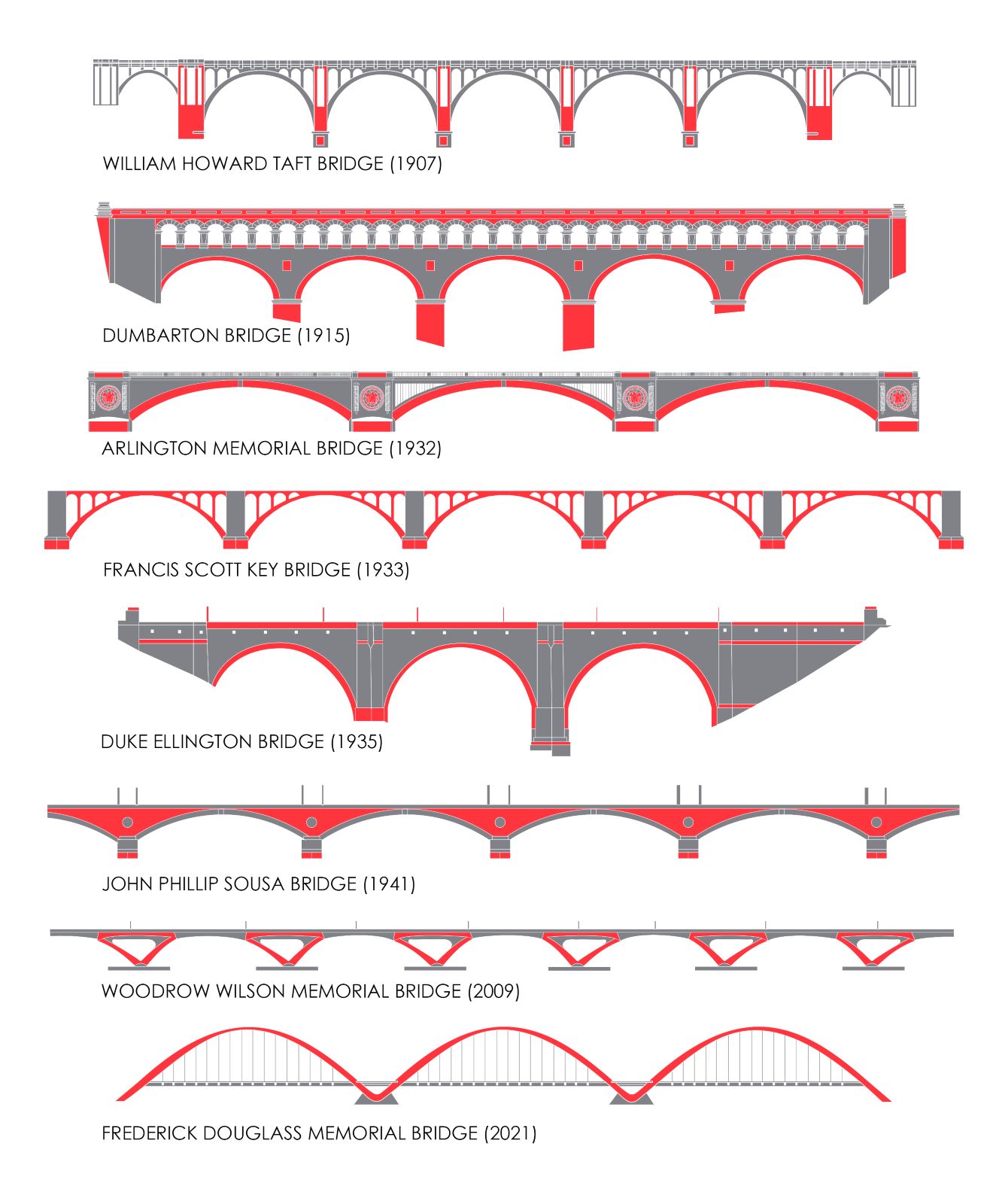
The FDMB is a unique above-deck arch design that captures the essence of Washington DC both historically and in consideration of future context. It uses the ancient structural form of an arch and marries it to modern technology through a design that has evolved from the context of the multi-arch forms present in many of the city’s major crossings. Above deck level, the new design breaks away from Washington’s historic arch bridges to demonstrate a distinct evolutionary progression.
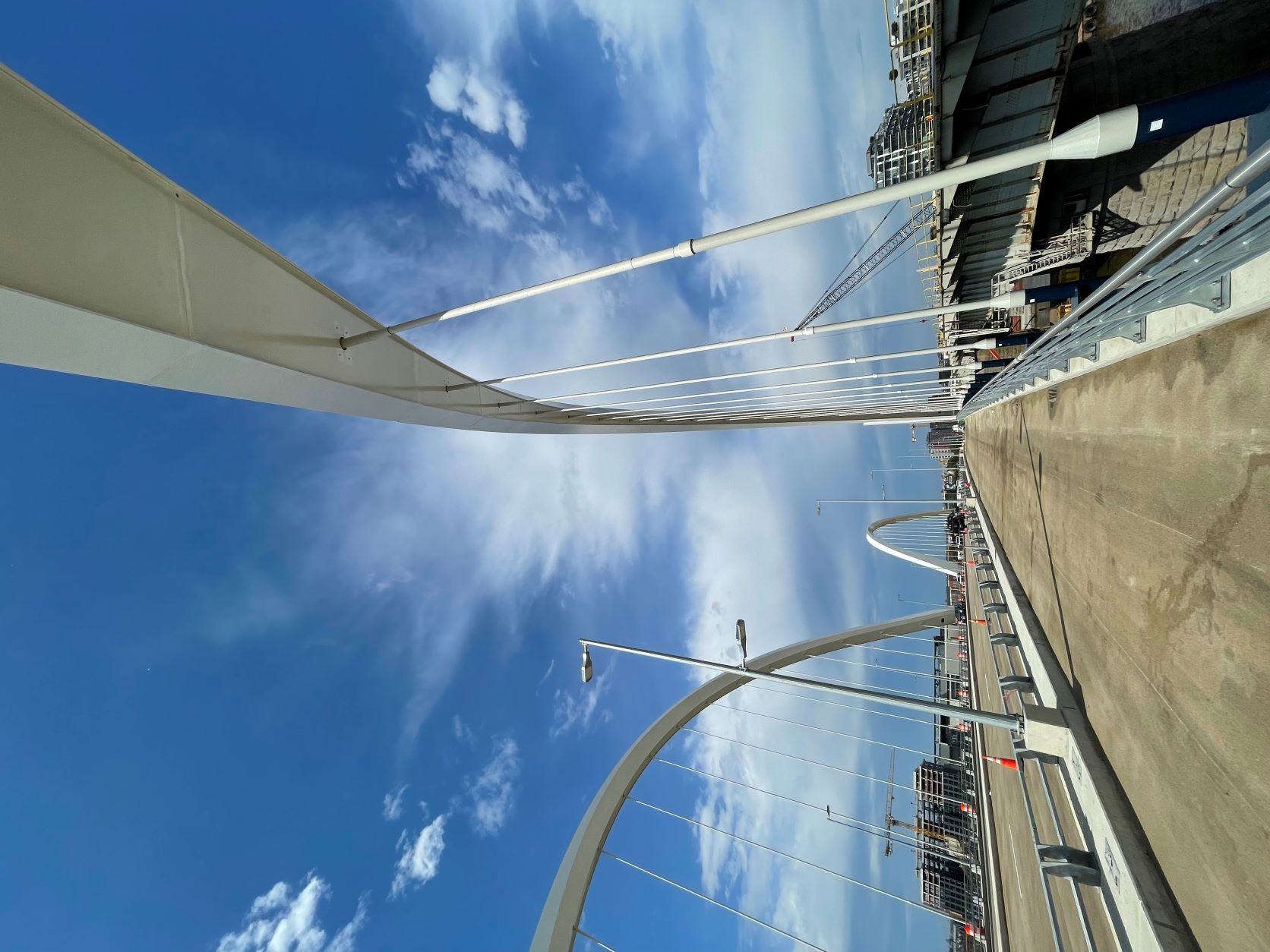 Unlike conventional arch bridges, the three-arch system is designed to allow the superstructure to freely move through the arches with water-tight expansion joints located at the beginning and end of the structure ((AECOM/SCB))
The design integrates engineering and architecture using aesthetics and symbolism as key drivers. The three-span arches result in only two V-piers in the river, and these are designed to appear as if they spring out of the water, creating a visual effect of continuity and flow from deck to water. The arches rise high above deck level to enhance the visual impact for drivers entering or exiting the nation’s capital. The central arch span significantly exceeds the required horizontal navigational clearance envelope, providing a dramatically different footprint from the existing conditions. It widens the navigational channel by reducing the number of piers in the river and thus the need for a pier protection system.
In addition to aesthetic challenges, the project team also faced technical complexities. Unlike conventional arch bridges, the three-arch system is designed to allow the superstructure to freely move through the arches with water-tight expansion joints located at the beginning and end of the structure. Minimising the number of joints on the bridge was critical to the overall corrosion protection plan.
The new FDMB is a three-span bridge with the deck suspended on vertical hangers from high-spanning steel arches and supported by bearings at the V-piers and abutments. The bridge has a total length of 440m, with a main span length of 165m centred with the existing federal navigation channel. The heights of the arches are set in proportion to the spans at 45m – 51m – 45m above mean sea level, with the height of the centre arches at the maximum allowable amount in Washington DC.
The concrete V-piers and steel arch ribs make up the two primary components of the arches. The two arch lines and hangers are in a vertical plane centred outside the deck edge, with no lateral bracing or part of the structure extending out over the traffic lanes or split-use pedestrian pathways. The absence of bridge elements directly above the deck reduces the potential for falling ice that would pose a safety hazard to motorists and pedestrians, but also eliminates the need for any inspection and maintenance operations directly over traffic.
The arch ribs consist of a hexagonal steel box section with a constant width that tapers in depth from the base connection to the crown. Each steel arch rib is made of multiple sections that are spliced together internally using field-bolted, butt-splice connections that are milled to bear in accordance with American Welding Society requirements. The use of internal bolted connections between field sections eliminated the need for field-welded joints or unsightly external splice plate connections. The V-piers and abutments are constructed of high-strength, low-permeability concrete and are post-tensioned to inhibit cracking. V-pier and abutment arch bases seamlessly continue the geometry of the arch ribs and are constructed composite with pile-supported footings. Concrete ‘strongbacks’ (V-shaped elements) built integrally and adjacently with the V-piers support the deck on bearings. The V-piers are supported on sculpted waterline in-river footings. Stay-cable technology was chosen for the hanger system due to its ease of replacement and durability.
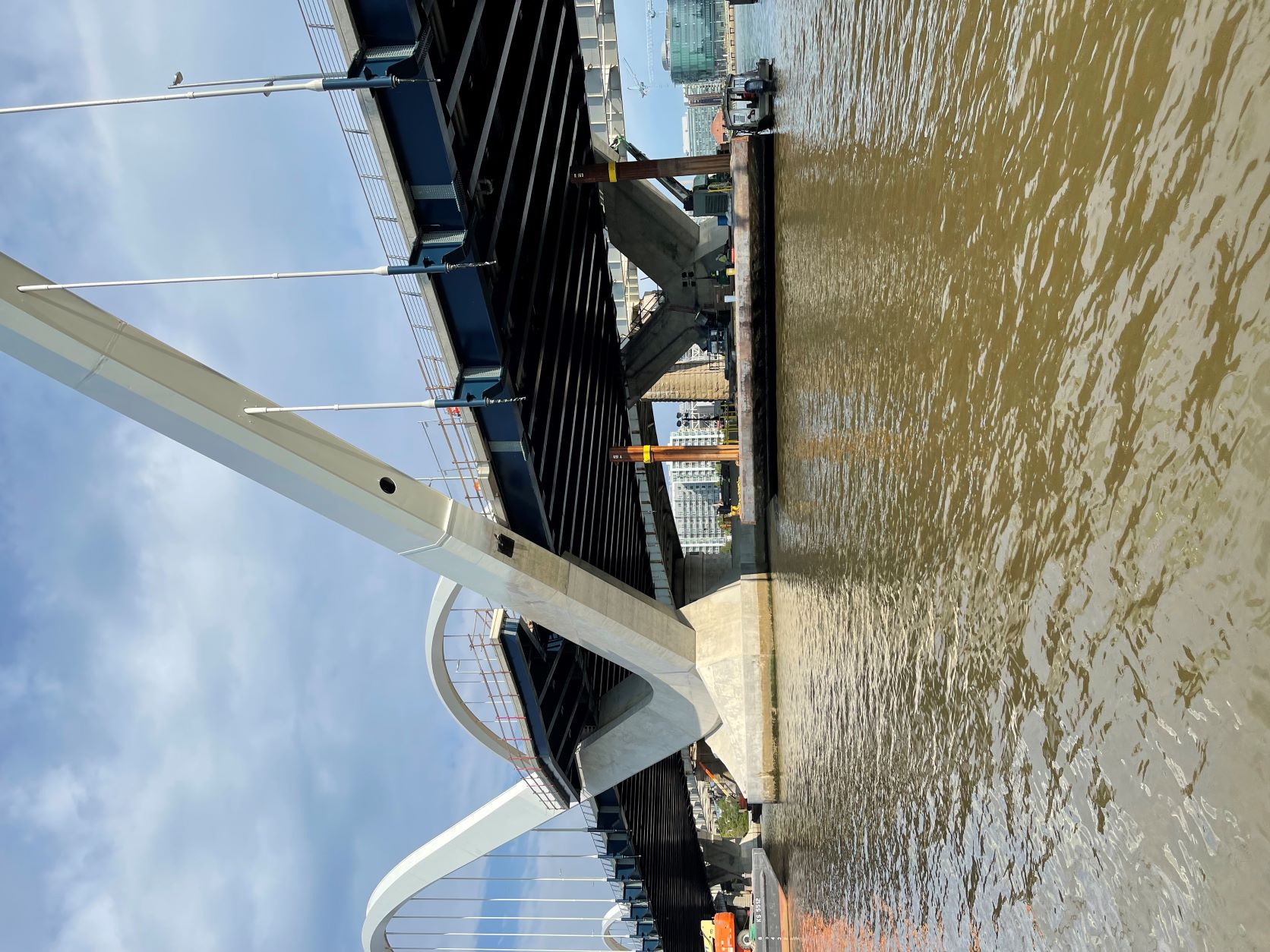 The concrete V-piers and steel arch ribs make up the two primary components of the arches (AECOM/SCB)
The typical out-to-out width of the deck is 37.3m, accommodating three 3.4m-wide traffic lanes in each direction; two 5.5m-wide split-use pedestrian paths; and the required medians and shoulder widths. The design of the superstructure relies on the composite action of a steel deck grillage system and the precast concrete deck. To enhance durability and meet the service life requirement for the bridge, the deck is reinforced with a combination of epoxy-coated and stainless-steel reinforcement, and topped with polyester polymer concrete overlay.
As part of the technical requirements, a detailed corrosion protection plan was developed to demonstrate that design details and proposed materials for non-replaceable components of the new bridge could meet the 100-year minimum service life. The plan provides the corrosion protection design with detailed strategy and technical specifications, work methods and quality control procedures. With respect to durability planning of reinforced concrete elements, the corrosion protection plan modelling was based on the fib Model for Concrete Structures and the methodology presented in fib Bulletin 34 and 76.
Due to the unusual shape of the arch and overall geometry of the bridge deck, Rowan Williams Davies & Irwin was tasked with performing the wind evaluation and buffeting analysis for design and construction. As part of evaluation, sectional model tests were conducted to ensure aerodynamic stability of the transverse cross section. Pedestrian comfort and cable vibration assessment were also performed in support of the overall wind evaluation. Various stages of arch erection were tested in the wind tunnel to assess stability of the arch sections during construction. The tests identified potential vortex induced oscillation issues with the centre arch span. This required wind speed restrictions during erection as well as a temporary damping system in case of emergency.
After DDOT had secured the relevant permits and right-of-way acquisitions, construction began in September 2018 with the erection of two temporary steel trestles extending outwards from either side of the river towards the temporary navigational channel. The opposing trestles were designed to support the large cranes which were used to drive foundation piles, place the concrete footings, and ultimately erect the arches and bridge superstructure. With land access available on both sides of the river, construction teams could work concurrently starting at both ends of the bridge. Once the construction of the bridge substructure was complete, lower sections of the arch ribs were erected in a progressive manner working from the abutment or V-pier towards the drop-in keystone section. Temporary shoring towers were used to provide stability of the arch cantilever during erection.
The most challenging aspect of the erection sequence was maintaining a 46m-wide temporary navigation channel during construction. Due to the lower arch section weights and the distance across the trestle opening at the channel, two cranes working on opposite sides of the opening were required to place the lower sections of the eastern centre arch span. In addition, upper and lower temporary stays were installed to prop the eastern portion of the span over the channel, using the completed eastern side arch as tie-back support. Final erection of the arch spans was completed in August 2020.
As the final keystone arch section was being placed, pier table deck erection began at the eastern V-pier near the temporary navigation channel. Deck construction progressed sequentially in both directions from this V-pier working towards the east and west abutments. Each step of the process included erecting 15-18m-long steel deck field sections, setting precast deck panels and constructing the cast-in-place concrete closure pours over the floor beams and edge girders. Each section of the floor system was supported with the permanent hangers or on permanent bearings as deck construction progressed through the centre and side arch spans. Although this erection plan facilitated the contractor’s preferred construction sequence, several design issues had to be resolved. The contractor wanted to use the temporary trestle to construct the entire bridge, but also wanted the ability to remove the trestle as construction moved east and west from the navigational channel. Therefore, deck construction had to start over the river and move towards the banks of the river. However, arch deck erection is ideally performed in a symmetric fashion either from the centre of the arch span or from the ends inwards in order to control load distribution and mimic the true behaviour of the arches in the final condition. The asymmetric deck erection sequence used for the FDMB required special techniques to control loads and stresses in the steel arches as well as the post-tensioned V-piers and abutments.
Due to this asymmetrical loading condition, the arches experience wave-like stress reversals ahead of the deck erection which are typically opposite of the final design stresses for the completed bridge. In order to mitigate and control the magnitude of this stress reversal in the centre arches and V-piers, the upper and lower temporary stays which were used to support the eastern portion of the centre arch during erection were again used to counteract the out-of-balance forces. Staged post-tensioning in the concrete arch base at the abutments was also required to control the stress levels as deck erection progressed through east and west side arch spans.
The bridge opened to traffic one month ahead of schedule on 10 September, 2021. On 7 September, DC Mayor Muriel Bowser joined federal partners and members of Frederick Douglass’ family for a ribbon cutting ceremony, commenting that the new crossing represented the best of Washington’s past and future. Also present was Frederick Douglass’ great-great-great grandson, who said, “We are thrilled that this magnificent bridge will serve to educate the public about his legacy, connect DC to the neighbourhoods where he worked and lived, and inspire future generations to agitate for change”.
Demolition of the existing bridge and landside work on the traffic ovals and approach roadway will continue into 2022
Nathan M Porter is lead bridge engineer and Kenneth V Butler is chief bridge engineer, complex bridge practice, at AECOM. Keith Brownlie is international lead bridge architect, BEAM Architects