
Designers in Columbus are attempting to capture the city's vision for a landmark structure; Steve Hague and James Siebert explain how
As the new century dawned over Columbus, Ohio, civic leaders faced a difficult transportation challenge. Time, weather and traffic had taken their toll on one of the city's primary arteries, a multiple-span, open-spandrel concrete deck arch bridge built in 1937, degrading it to such an extent that it had to be closed. Its deteriorated condition meant that the Main Street Bridge needed replacing - and with a structure that suited the city's unique heritage and bright future.
The initial concept was designed by Dr Spiro Pollalis, professor of design technology and management at the Harvard University Graduate School of Design. He was appointed by the city authorities who had seen other bridges designed by him. After a remarkably public decision-making process, the leaders and citizens of Columbus chose the final design for the new Main Street Bridge, which is owned by the Ohio Department of Transportation and managed by the City of Columbus. Leading the design process are two companies with local roots and experience: DLZ Ohio, a Columbus-based architectural, engineering and environmental services company holds overall project management responsibility for the Main Street Bridge design team. DLZ designed the bridge's substructure and is handling traffic management, railing design, geotechnical engineering and approach roadway work.
DLZ selected HNTB as a partner based on its work on large, complex bridges and other successful projects in Ohio. HNTB is the lead structural design firm, carrying out structural analysis and structural design of the Main Street Bridge, and designing the superstructure.
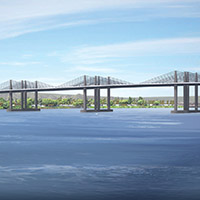
The US$42 million Main Street Bridge project will be an iconic structure, and is intended to contribute to the revitalisation of the city by linking parks and communities in Franklinton, the oldest part of the city, with the downtown core on the east side of the Scioto River. An inclined single-rib tied arch bridge - believed to be the first of its kind in the United States, and one of only a few in the world - will carry vehicle and pedestrian traffic and is intended to revolutionise the skyline.
Recognising that rehabilitating the existing bridge would cost nearly as much as building a new one, leaders in Columbus determined early in the process that the city deserved a signature replacement bridge. With neighbouring arch bridges and an art deco heritage of arches throughout the city, clean, classical lines were considered an important design element of the new structure. The bridge needed to add value to urban and regional development plans - not just provide a way to cross the river - and create desirable public spaces. The bridge would also need to serve both vehicular and pedestrian traffic, a decision that helped drive the project's progressive visual elements.
The basic requirements were that the structure should have a 100-year lifespan, a clear entrance and exit, and be pedestrian-friendly. The design criteria were established by the stakeholders, including state and federal transportation officials, city leaders, the state historic preservation office, the Franklin County engineer, developers of a high-rise residential complex near the bridge, the Greater Columbus Arts Council and the downtown association, among others.
The structure was to be compatible with the neighbouring Broad Street Bridge, which has recently been renovated and is the primary artery into the downtown area. It was intended to embody the architectural character of the civic centre historic district and provide motorists and pedestrians an unobstructed view of the water and skyline.
The bridge was also required to incorporate high-performance materials whose durability would help achieve the 100 year life span of the bridge. Other requirements were that it should accommodate contemporary and future vehicular, bicycle and pedestrian traffic needs for the expected addition of 400,000 residents during the next 20 years, and that it should provide a link to the Riverwalk, another civic project currently under design.
In addition the structure was required to accommodate several public festivals held annually during the summer and to offer relatively maintenance-free service.
The design teams held a two-day charrette to develop concepts, generating about 50 initial ideas which were narrowed down to six designs to be presented to the mayor and city officials. They selected three designs on which the public were invited to vote.
The design team developed an architecturally-significant bridge designed to provide a number of key elements. A single-rib tied steel arch inclined at a 10-degree angle from vertical, and an asymmetrical cross-section emphasising the role of pedestrians and bicyclists.
The structure has three vehicle lanes to accommodate eastbound traffic across the Scioto River, a 2m-wide pedestrian walkway on the south side of the bridge, and a 6m-wide pedestrian deck that sweeps horizontally and vertically away from the road to provide an unobstructed view of the city.
The bridge has a steel box girder roadway and a concrete pedestrian path, and was designed with piers that complement the superstructure design. The simple, yet sculptural, design that emerged starts as a single, unified section from both ends, gradually rising as it separates into three lanes for vehicle traffic and a fourth lane for bicycle and pedestrian traffic.
Because the city wanted a structure that would also be an architectural feature, aesthetics and attention to detail were critical to the design. Elegant roadway and pedestrian lighting, splice plates placed inside the bridge to give a smoother outside appearance and post spacing that matches other bridge elements help to meet these goals.
The designers were also careful to choose individual elements that are aesthetically pleasing. For example, the steel arch will emerge through the bridge deck and steel hangers will come down from the arch. The hangers have both an engineering and an aesthetic purpose, enhancing the lines of the structure while supporting the members below the deck.
Because of the budget, steel, rather than concrete, played a significant role in the bridge design. A concrete bridge would have exceeded the budget, but steel will make it possible to build the inclined arch design, and also to achieve a quicker construction process. Steel elements will make it quicker to erect the structure, minimising the time the temporary supports will be exposed to potential flooding.
Design drove other materials considerations as well. For example, the handrail has an aluminium finish that will not corrode or require maintenance, and concrete on the bridge is coloured for aesthetic reasons. The team chose steel boxes to support the road deck which reduced the bridge load.
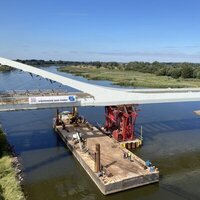
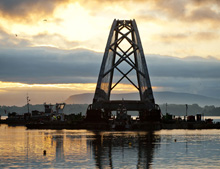
Removal of the old bridge took place in the autumn of last year, after which the contractor Kokosing Construction Company ordered the steel for the bridge, which will take about a year to fabricate by subcontractor PDM Bridge. In the meantime, foundation and substructure construction is under way. Four temporary falsework towers will be erected along the length of the roadway box girder to support the vehicular steel box, along with two taller falsework towers to support the arch's construction. Jansen & Spaans is the construction engineer.
After building the steel box and arch, the contractor will install floor beams to support the pedestrian deck on the north side and the permanent struts and hangers for the arch. This will allow construction of the pedestrian and bri