Juan Arenas is tired. Last night he slept badly, he tells me, from worrying about a conversation he had to have today with the editor of El Mundo, one of Spain's most popular national papers. In its Sunday supplement magazine, the paper carried a story about the architecture of wine cellars; alongside designs by Frank Gehry and Santiago Calatrava was a photograph of the Otazu wine cellar, designed by Arenas and opened three years ago. In a scenario which will sadly be familiar to many engineers, two architects and even the owner of the cellar were mentioned, but there was no reference to Arenas himself.
At the end of my visit, he regrets that the incident seems to have dominated my stay and urges me not to dwell on it too much, but the theme is so universal and the frustration so recognisable that I cannot help reflecting on it.
The last 12 months has marked a significant period for Arenas. After a distinguished academic career, and eleven years building the consultancy Apia XXI in Santander, he finally broke away from his business partner to set up his own structural engineering practice at an age when most engineers are thinking about retirement. But it is hard to imagine Arenas ever retiring - his energy and enthusiasm could match that of any of his young team of employees, and the ideas just keep on coming.

“It’s difficult to say why I first became an engineer,” he reflects. As a child born at the end of the Spanish Civil War and the beginning of the Second World War, he remembers seeing the destruction these conflicts inflicted on his homeland. “Spain was a poor and devestated country,” Arenas recalls.
His uncle had been exiled from Spain and was living in France; at the age of eight, Arenas visited the neighbouring country. “I was impressed by the culture, the language and the difference between the two countries, he says. “I thought that as an engineer I would be able to contribute to the civilisation of Spain,” he goes on. He was attracted by the great projects he saw, particularly dams. although the bridges that existed in Spain at the time were not at all inspirational. His interest in bridges came later.
Arenas began his studies at the only place in Spain that taught civil engineering - a school in Madrid that was established for the purpose of training government engineers. He started there at the age of 19, several years younger than most entrants, and by 21 was already demonstrating his enthusiasm for his studies by taking part-time work in the design office of a local building company.
“It was absolutely thrilling!” Arenas remembers. “I had the chance to design footings and so on, and to go to site and see them being built. It was a really special feeling.”
His confidence got a great boost when the boss of the firm asked him if he wanted to do the calculations for a 14-storey building being built in Madrid by a famous architect. Accepting the challenge, Arenas found himself carrying out calculations for wind loading and other concepts that were unfamiliar to him. The work was checked by the building director, and construction began. However, when the architect discovered that Arenas was not yet a qualified engineer, he demanded to see Arenas and his boss.
The meeting was fraught, he recalls, with his boss trying desperately to smooth things over and placate the angry architect. In the end, the architect demanded that Arenas’ calculations should be checked by a professor. “The design was approved,” he says simply, a fact which obviously gave him great pleasure at the time and still does now.
One thing which is plain about his time at university is that he worked extremely hard - a commitment which has stayed with him throughout his professional career and which he believes is fundamental to the creation of good engineers. Too many students fail to appreciate the importance of hard work, he says - they do not realise the amount of individual study and effort that is required, especially after leaving college.
Two structural engineers inspired him at a young age - the work of Spanish designer Eduardo Torroja interested him, particularly the shell roof structure designed for the Zaruela Hippodrome in Madrid in 1935.
Although Torroja died while Arenas was in university, his work was fresh and modern, and he was a very important influence on the young student.
But Arenas stumbled on the work of Robert Maillart quite by accident - his name had not been mentioned by any of the professors and it was only when Arenas found a book about him in the university library that he discovered the master’s work. “Two weeks later I saw the same book in the window of a bookshop,” he says. When he went inside, he discovered that it was the last copy in the shop, so despite its cost, he bought it. “It was expensive,” Arenas admits, “particularly for a student, but it was the best investment I made in my life. I was in the first year of university, I couldn't even understand the behaviour of an arch, but that book taught me the value of structures beyond engineering. It taught me the importance of their culture, their beauty, that they had a value which was much higher than just that of pure engineering.”
His admiration for Maillart's famous Salginatobel Bridge is clear – its design, its setting, its structural form and especially the experience of crossing the structure are all a delight to him.
The link between engineering and culture is a very real one to Arenas. It is rare in conversations about structural engineering for the names of artists or sculptors to be mentioned, but he sees a definite connection between the two disciplines. During the last six months of his studies, when he was working in another design office, Arenas learnt what he says was a very important lesson - the beauty of reinforcement plans.
“They are so carefully ordered, so carefully detailed,” he explains, “like a (Wassily) Kandinsky or a (Piet) Mondrian painting.” The significance of order and detail translate directly to his designs, and both figure prominently in his design philosophy.
When Arenas graduated from university in 1963, he made what he admits was a ‘very strange manoeuvre’. Although he had the offer to continue in the design office in Madrid, working with Eduardo Torroja’s son, he decided to take a job in his home town of Huesca, in the Pyrenees, working in a factory which made precast concrete floor beams.
His colleagues and friends thought that he was foolish to make the move, but he says that he was driven not only by the romantic notion of contributing something to his home town, but also by the desire to be himself. In a small organisation, rather than a large design office, he believed this would be possible.
So he began working in the factory, making not only floor beams, but also small bridges of up to 20m span. For some of the designs Arenas had to teach himself new methods of calculation, and on the larger spans, had the opportunity to try his hand at post-tensioning. The factory made the precast segments, they were taken to the site some 150km away, and were erected using a gantry designed and built by Arenas. The structure attracted a lot of attention in the region, he recalls, even from France - a French engineer showed interest in buying precast units from the factory for a similar use, although the scheme fell through in the end because of the difficulties with transport and customs.
After a short stint in Zaragoza, where Arenas designed his first ‘proper’ bridge - a 30m structure over the river Ebro - he returned to Madrid in 1967.
He remembers his first eight months there as ‘the worst period in my life’ - so bad, in fact, that he does not want to name the company he was working for. “They just wanted me as a calculator of bending moments and so on, not as a designer,” he says in disgust. This experience led him to decide on a solo career for good, and although his colleagues warned him that he would starve to death, he took the offer of office space from a friend and set himself up as a designer.
It was in the early seventies that Arenas developed his computer program Pontex for design of continuous beams. He had already written simple programs on an Olivetti calculator, but when he bought his first computer from Hewlett Packard he was able to produce this ‘marvellous’ Pontex program.
This program was the subject of Arenas’ first public lecture, and it has since spawned many imitations. He has always been keen to share his knowledge with other engineers, believing that it is more important for designers to learn from one another in the pursuit of good practice than to keep this knowledge secret in the hope of maintaining a commercial advantage. Although he sees his designs being copied, he makes sure that he is always one step ahead, working on a new idea or refining one of his previous designs.
By this stage in his career, Arenas was working as a lecturer in prestressed concrete at the Madrid Polytechnic University. In 1976, two chairs in bridge design were created - one in Madrid and one in Santander. Although he was reluctant at first, Arenas eventually let himself be persuaded to apply. “I was appointed to Santander,” he recalls, “and although at the time I regarded it as the second prize, now I see that I actually got the first prize.”
After two years of travelling between Madrid and Santander, in 1978 he took the plunge and relocated his family and professional life to the Cantabrian coastal town, where he still lives now. After more than a decade as the professor of bridge design at Cantabria University, Arenas decided to return to the professional life of a designer. He set up an office with some of his ex-students and they produced a number of bridge designs, mostly pedestrian structures in the neighbouring Basque region. “It was the beginning of the new democracy in Spain,” Arenas recalls. “Good designs were well-received and the govenment was keen to show people that democracy was a good thing.
In 1988, Arenas established the Apia XXI design practice with Marcos Pantaleon, and the company’s first big scoop was winning the competition to design the Barqueta Bridge in Seville, for Expo 92. “Steel was not really used for bridges in the post-war period,” he says, “and the tradition was mainly for reinforced concrete.” This design, with its unusual structural form and its strong impression of being a gateway won ‘because it’s a marvellous bridge’, Arenas claims. The triangular form at each end of the arch is significant, not only in terms of creating the gateway effect, but also because it has lots of structural benefits, in particular offering security against lateral buckling. The steel arch cross-section has grooves, an idea lifted from designs of reinforced concrete, but this design means that no additional internal stiffening is required.
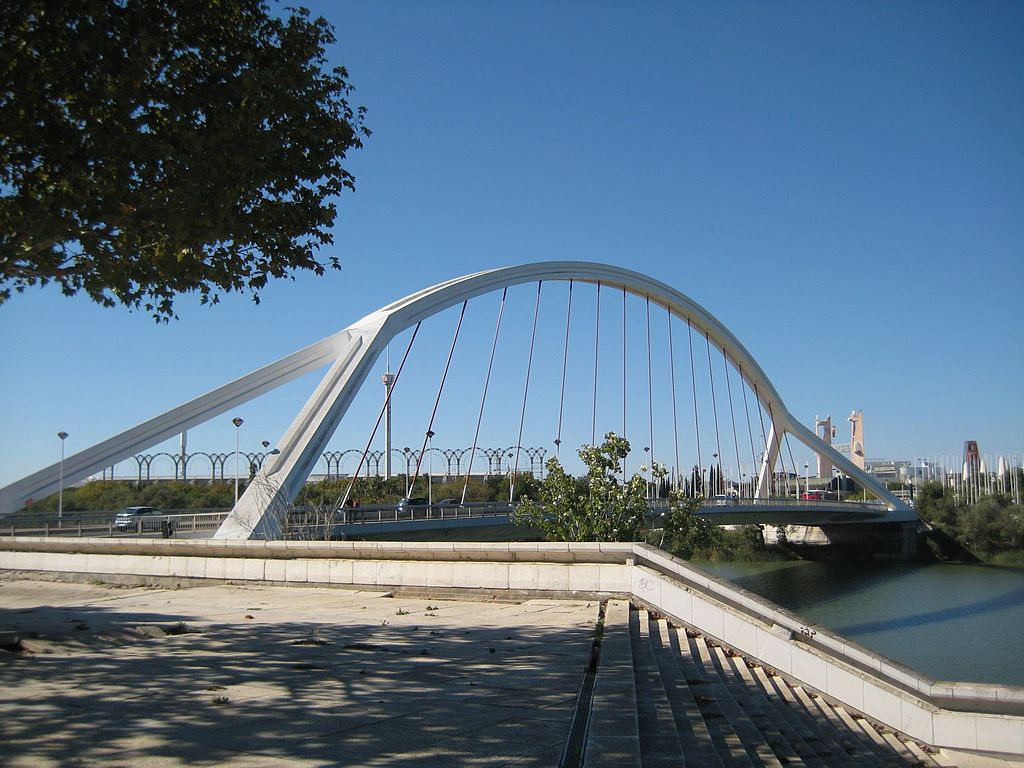
Barqueta Bridge; by Araucaria at English Wikipedia, CC BY-SA 3.0, https://commons.wikimedia.org/w/index.php?curid=7564865
“I have tried lots of other designs for arches since,” says Arenas, “but I still think that Barqueta is the best concept.” It may have been more difficult to design and build, but it is the best structurally, he says.
In the competition for the Barqueta Bridge, the span was fixed, as was the height of the structure over the water. Arenas had been invited to lunch with two contractors to discuss the bridge competition - one of them was from a steel manufacturer which was keen to build a big steel structure.
Throughout the lunch, Arenas recalls, his mind was working as two halves; one concentrating on participating in the discussion, the other feverishly thinking about the design of the bridge. “When I left the restaurant,” he says, “I already had the idea of the arch and the 'gates' in my mind.”
After 11 years working with Pantaleon in Apia XXI, Arenas decided it was time to split from his partner and set up on his own. The business had begun to diversify from the original concept of pure structural design into other sectors of civil engineering, and Arenas wanted to get back to basicx. His new company Arenas & Asociadas was formed last November; some engineers joined the firm from Apia XXI and others have been recruited from elsewhere, even as far away as Switzerland. The Barqueta concept has been used as the base for the design of the company's first major project - a new bridge over the Ebro River in Zaragoza. Other work includes a fish market currently being built in
Santander, which has a dramatic roof design formed of concrete shells.
Despite having designed such a variety and number of structures, Arenas cannot name a favourite – probably, he admits, because he is something of a perfectionist. “Every human work has weak points,” he says sadly, and starts to name the problems on some of his most well-known projects. “It makes me suffer as I am a perfectionist; I worry about durability even though I know that a bridge can’t last for an eternity.”
One of Arenas’ greatest living heroes is Jorg Schlaich, whom he admires 'profoundly' both as an engineer for the quality of his designs, and also as a person for his social conscience. But once he starts to talk about his contemporaries, he worries that he might miss one of them out and cause hurt. He mentions Christian Menn, Jiri Strasky, Michel Virlogeux and Enzo Siviero before going on to explain that most European countries seem to be changing their minds on bridge design. “They seem to realise that bridges are more than just elements of transport infrastructure,” he says, “and they are all producing good structural designs, rather than structures that are used as bridges.”
If engineers are properly educated – and here Arenas is talking about a much broader range of issues than just structural engineering, he includes history and culture for example, then there should be no need for architects to be involved in bridge design. “Bridge design is a question of loads and the transfer of these loads, so the process must be directed by the flow of forces. But solving the flow of forces is not enough,” Arenas admits, “the engineer must be able to design a solution that is perfect structurally and in terms of durability, safety, aesthetics, its role in the landscape and so on.” He believes that the involvement of an architect will only result in the introduction of unnecessary decoration.
One of his recent projects. a moveable bridge in Barcelona Harbour, shows the results that a structural engineer can achieve with careful thought. He is very proud of the design of top of the approach bridge piers which have some decorative detail, although this is kept to a minimum. “I look at the design, and wonder whether an architect could have done it better,” he muses. The secret of this type of detailing is to keep it in proportion with the structural function of the bridge.
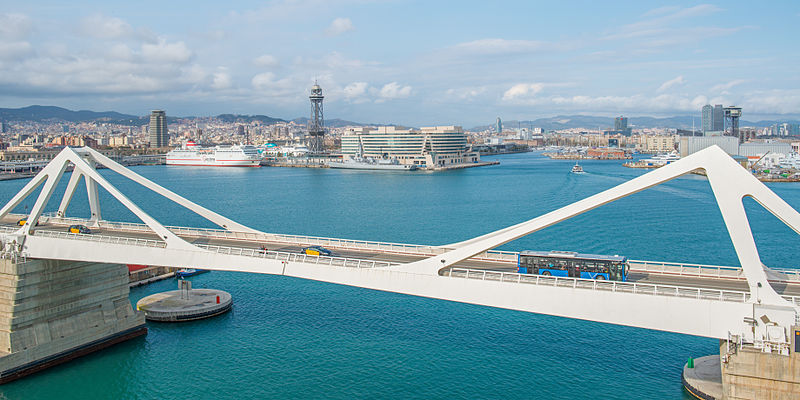
Porta d'Europa in Barcelona (Bengt Nyman)
For his inspiration, Arenas needs to look no further than the materials that he uses. “It's the materials' resistance, the way they behave and perform,” he says, and explains that this is something that has to be learnt.
There is a certain amount of intuition involved, but it is only as a summary of an engineer's experience and education. He admits that he is constantly thinking of new solutions, and hence has a large collection of 'back of the envelope' sketches. While he denies being preoccupied by bridges to the extent that he thinks about them all the time, Arenas agrees that it must be a large percentage of the day.
One major ambition that still remains to be fulfilled is his desire to set up a school to produce new leaders for the structural engineering profession in the future. This plan has developed from a desire to pass on his knowledge and a frustration at the limitations of the structural engineering courses taught today. “Engineering schools need to change
deeply,” he says, explaining that the problem is that they cannot accept that culture is an essential ingredient to producing a good engineer. “It's not enough just to produce mathematicians,” he goes on, “they should be educated to take decisions. The schools need to widen their scope to make engineers think about the future of the planet, to see the problem as a larger one not just a structural one.”
Arenas' plan is for a school which will take well-educated engineers who have a cultural awareness and groom them to become good designers of bridges and landmark buildings. “They should design the concept rather than do the calculations,” he says. His establishment has a working title of 'European Centre for the Development of Structural Art', although he is aware that this title is perhaps too grand and pretentious for what he really wants to achieve. His ambition is to educate engineers to have an architectural appreciation of design; of space, volumes and light. They should be able to apply a sense of proportion, detail, scale, light and shadow, and proportion at any level - whether on a spectacular building or a bridge abutment. With this knowledge, he believes that more engineers will be able to design fine structures - as engineers such as Pier Luigi Nervi and Eduardo Torroja showed was possible in the past.
He is also hopeful that this initiative will help to raise the profile of engineers, and possibly reduce the frequency with which their skills and contribution are overlooked. “The media are always aware of architects,” Arenas concludes sadly, “but not of engineers”.
Read our article about the Almonte River Bridge here.
Download the pdf from here