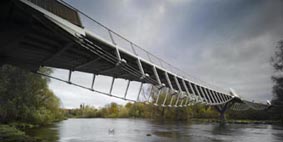
The design of the Easo Footbridge aimed to provide a unified and natural response to urban integration, functionality, user safety and durability through a structural form consisting of rigid frames and circular cross-sections.
A 4.2km-long city-centre underground rail line is currently under construction by Basque Railways in the coastal city of San Sebastián. When completed, the rapid transit line will connect the city’s central areas with lines E2 and E5 of the regional commuter rail network that runs as far as the French town of Hendaye 25km away.
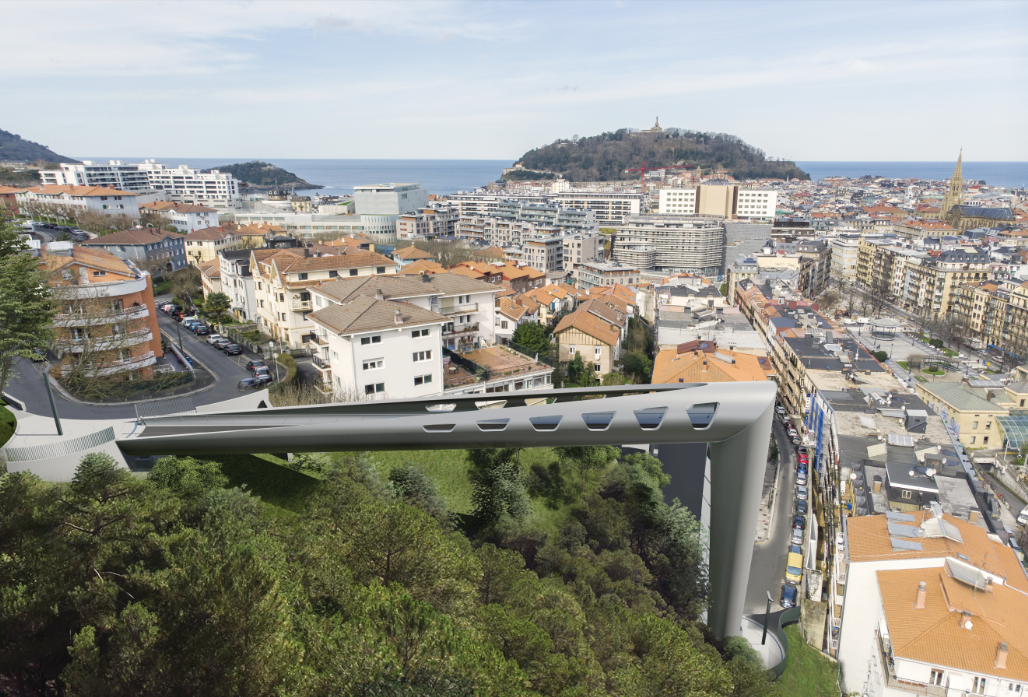 Easo Footbridge will connect residents to a new underground rail line
As part of the project, a number of new underground stations are being built and historical rail infrastructure remodelled, including Easo Railway Station (also known as Amara-Donostia), where a new underground station is being constructed. Adjacent to the new Easo Station at La Salud Street is a steep slope that rises 30m to the Aiete residential area, with no direct access for would-be metro users. Consequently, it was decided a 60m-long footbridge with an integrated elevator was required.
The design that has been proposed for Easo Footbridge presents a circular steel hollow box form with elongated arch-shape cut-outs that spring from the entry/exit points of the bridge. It carries a variable cross-section that is dimensionally greatest where deck and pier meet, and smallest at the abutment and pier base. The seemingly simple, well-proportioned design solution answers the project’s challenges in a global manner, as outlined below, with a structure that accommodates functional and resistive requirements.
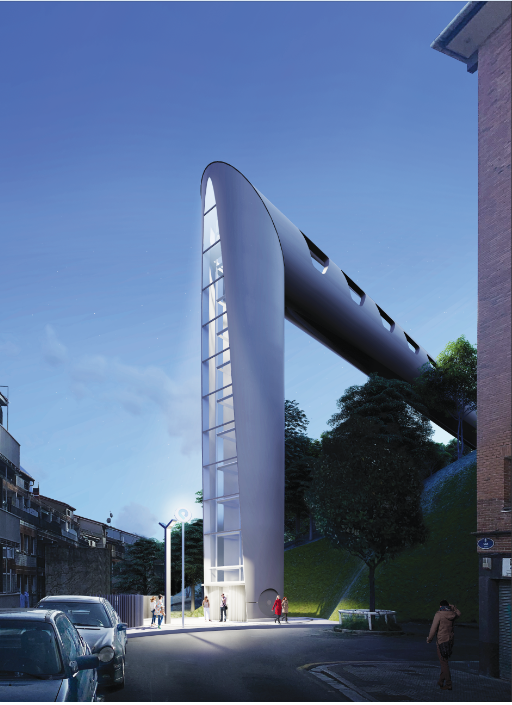 Pier and deck are designed with the same variable cross-section
Located in a heavily built-up area, the structure was required to address a 30m difference in height and a span of 60m. It also had to be functional, durable, and within the set budget. The pier had to accommodate an elevator within the 3m-diameter footprint of the excavated connection with the underground metro. A vertical clearance of at least 3.6m was stipulated at the elevator’s upper access. In addition, the upper access to the elevator had to offer protection from the elements, both to facilitate mechanical/electrical maintenance works as well as to shelter the waiting users. Also to be considered were surrounding residential buildings, whose upper levels are at the same height as the bridge. Blind-spots were to be avoided so that footbridge users would remain visible from the exterior of the structure, for safety reasons.
These considerations are presented in a unified, circular cross-section design that can be easily interpreted by the user while avoiding the addition of visual clutter to the densely built-up urban area. The bridge adopts design parameters based on the simple expressiveness of the structure, with soft contours that aim to integrate the bridge in its environs.
The structural scheme corresponds to two steel rigid-frames (ie pier and superstructure) that are thematically twinned by the use of steel cross girders at 2.5m intervals. The pier and deck both carry the same linearly variable cross-section, corresponding with two circular concentric sections joined by the box section sides. The guiding principle for the sides was found by sectioning a cylinder in plane, which created the elliptical line used for the upper and lower sides of the deck structure, and exterior and interior sides of the pier.
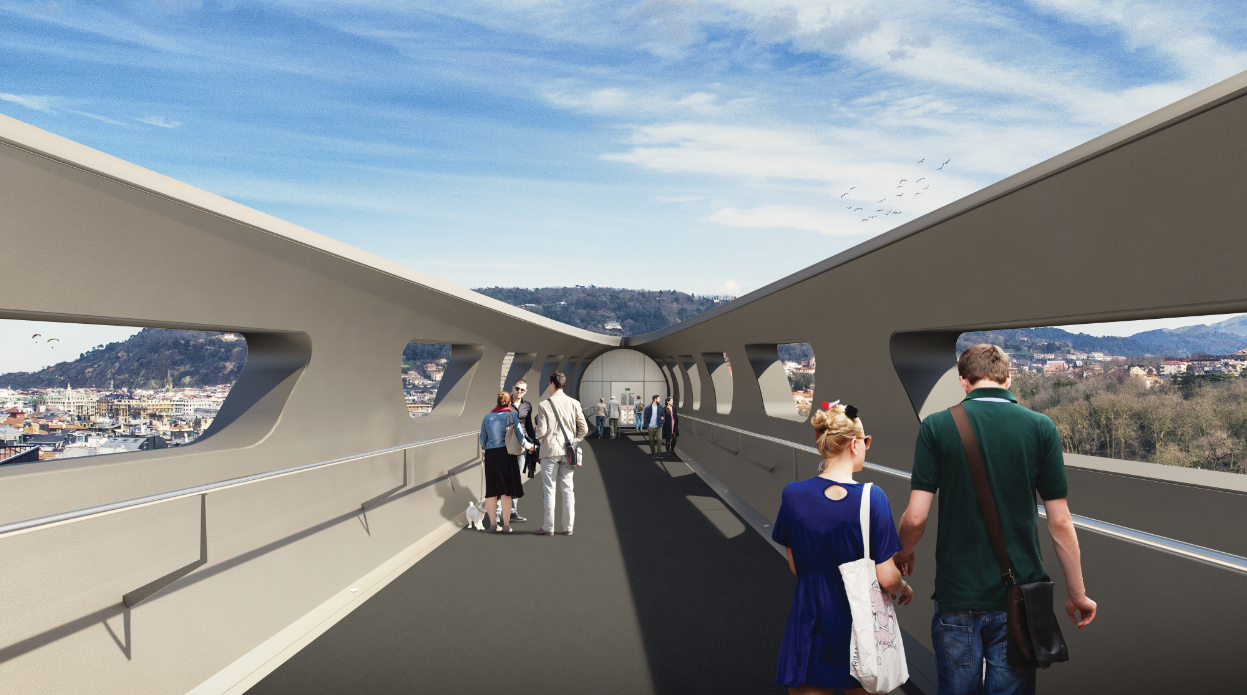 Parapet height gradually increases until forming an enclosed circular section
In terms of functionality, the design has taken cost into consideration by minimising the number of elements in the structure. Durability was considered, as well as future maintenance without the need for large-scale intervention. The structure does not present any requirements for special access because its appearance is its structure, and as such that is where budget and design efforts were concentrated. The minimum number of bridge elements were chosen on the basis of robustness and durability. The emphatic design that was proposed meant that unnecessary ostentatious detailing could be discarded.
The structure includes many aspects designed for improved user experience. The area where the pier and deck come together serves to provide shelter to pedestrians, whilst concealing the elevator’s operational equipment. The compactness of the box section provides a sense of safety for the crossing, given the high elevation. The structure itself acts as a parapet of variable height. At the abutment, where the ground is only around 2m away from the deck, the parapet is 80cm high. As the user proceeds towards the pier end, the parapet’s height increases as the slope below falls away. At the same time, incrementally larger openings in the box girder enable panoramic views to be enjoyed as the pier-end approaches.
The requirement for users to remain visible is fulfilled by the use of glazing on two sides of the elevator’s trajectory. Similarly, users remain visible as they cross the deck until the elevator is reached.
The superstructure is formed by two lateral hollow box segments, each box consisting of two concentric circular sections joined by radial webs. The height of the box gradually increases as it approaches the elevator end, at which point the ends of the box segments join to form a complete circular section with a 6m exterior and 5m interior diameter.
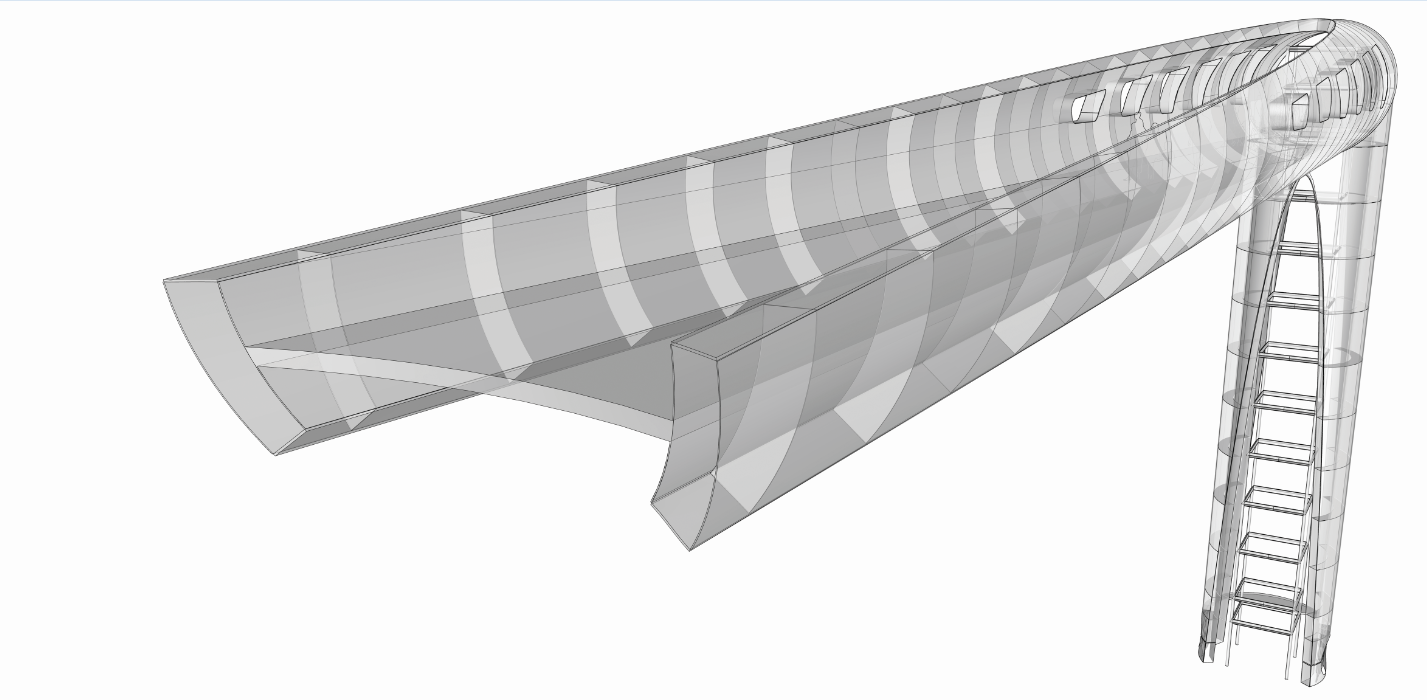 The steel boxes are internally stiffened every 2.5m with simple curving steel plate sections, similar in appearance to the ribs of a ship, to prevent transversal instability. The hollow boxes are joined together using transversal steel girders at the axis of the stiffening steel plate. At the meeting point between the deck and the pier, where the stiffening steel plate of both structures intersect, an elliptically shaped hollow box is placed.
The deck superstructure provides five openings that are chamfered and trapezoidal in shape, a geometry determined by the need to prevent bending at ‘window’ edges.
As a rigid frame, the structure transmits horizontal and vertical reactions to the foundations via articulations. The articulation at the base of the pier is significant, but its open exposure – as a reflection of its structural behaviour – also facilitates ease of access for future maintenance.
Due to the circular geometry of the resisting section and the presence of structural openings, extensive FEM was carried out to confirm the absence of a concentration of high forces at the key areas.
The footbridge is planned for construction in 2022.
Mario Guisasola is founder and managing director of Anta Ingeniería Civil