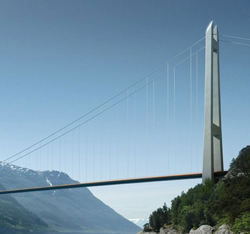
The Hardanger Bridge has a main span of 1,310m and the crossing’s total length is only 70m more. It connects the mountains on either side of Hardanger Fjord, cutting journey times between Bergen and Oslo.
Photos: MT Højgaard
Client for the US$389m scheme is Statens Vegvesen. MT Højgaard was responsible for the steelwork and assembly, with the concrete work done by Veidekke and the approach roads built by AF Gruppen.
Approximately 15,000t of steel have been assembled for the bridge; the two suspension cables alone weigh 6,400t. They were installed using a wheeled cable track, which rolled back and forth across the fjord at a height of 200m. Each cable has a diameter of 600mm and contains 10,000 wires.
The pylons are 202.5m tall and the clearance between the deck and the water is 55m.
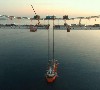
The traffic lanes comprise 23 steel sections each weighing 400t. They were shipped in under the bridge and hoisted up by means of a specially constructed crane, after which they were welded together.
MT Højgaard divisional director Henning Schultz said that the shape of the bridge resembles several others that the company has built over the years. It refined some earlier techniques for use on the project as well as developing special equipment that it expects to make use of again in future.