The health of bridges in the USA continues to be a subject that attracts much attention in the ongoing debate about infrastructure safety. One of the most important aspects of the process of assessing and managing structural safety of bridges is carrying out regular and thorough inspections of bridges so that their structural health is fully understood.
The health and safety of US bridges has been under the microscope for some years, and was recently the focus of increased attention following the release of the American Society of Civil Engineering 2013 National Infrastructure Report Card. This rated the country’s bridges as a C+ overall, although Maryland’s 5,294 bridges were rated higher than the national average, at B-.
The Maryland Transportation Authority is doing its best to set an example for the rest of the nation, and as part of this effort, recently implemented a more rigorous inspection plan. Under the new plan, the number of inspections of the lower-rated components on the authority’s critical bridges is nearly doubled in comparison to the federally-mandated inspection level.
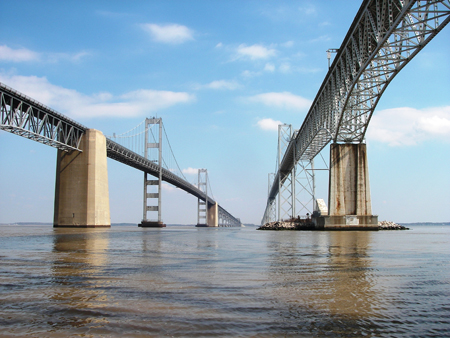
Maryland’s Chesapeake Bay Bridge, which is officially known as the William Preston Lane Jr Memorial Bridge, serves as a critical link over Chesapeake Bay between the Baltimore-Washington, DC corridor and Maryland’s eastern shore. It has two multi-span crossings featuring suspension and truss bridge spans; the original bridge, which now carries eastbound traffic, opened in 1952 and at the time was the world’s longest continuous over-water steel structure.
A parallel bridge, now carrying westbound traffic, was added in 1973, and today there is ongoing discussion about the possibility of a third crossing, due to the increased traffic levels in the region. A detailed inspection of the 975m-long eastbound bridge is currently under way.
As part of a joint venture with RK&K Engineers, Modjeski & Masters is conducting an inspection of the floor system, superstructure, railing, roadway deck and light poles of the through-truss spans of the eastbound bridge.
In addition, Modjeski & Masters has been commissioned to carry out the ultrasonic inspection of a percentage of the suspended span hanger pins of the through truss and deck truss spans, and the railing retrofit anchor bolts of the multi-girder spans on the same bridge.
Ultrasonic pin testing has been around since the late 1970s, but was rarely used until the early 1990s and the process remains a relatively under-used technique throughout the USA. The procedure requires a high frequency sound that is induced by a flaw detection machine into a bridge pin. When the sound reaches a reflector, such as a geometric change or internal discontinuity, some of the sound is bounced or reflected back. The intensity of the return signal received by the UT flaw detector is then interpreted by the technician who decides if a particular reflector indicates that there might be a problem.
Using this technology, UT inspectors can identify cracks, corrosion-induced section loss, wear grooves or manufacturing flaws that might cause internal stress concentrations and potentially lead to pin failure. Perhaps one of the most well-known failures was on the Mianus Creek Bridge in Greenwich, Connecticut in 1983, where pin failure led to the collapse of a 30m-long suspended span of the northbound section of the bridge.
Bridge pins, which are often found in the connections between suspended spans, cantilever girder spans or connecting trusses, are classified by the National Bridge Inspection Standards as ‘fracture-critical, non-redundant’ bridge members whose failure would be likely to cause a portion of the bridge to collapse. Investigating the structural integrity of a bridge pin can best be done using ultrasound technology, and is essential in monitoring for wear and the investigating the presence of potential problems.
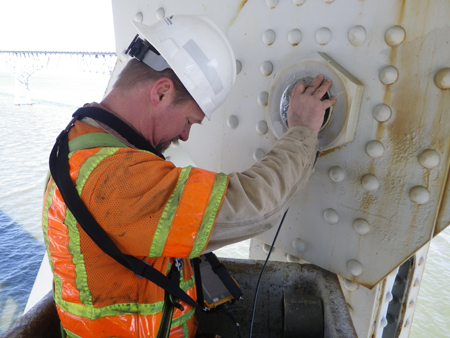
Ultimately, ultrasonic inspections are completed to preserve the health of the bridge and ensure the safety of the travelling public. Although the pins of the eastbound bridge have been ultrasonically inspected in previous years, this inspection marks the first year of a new, eight-year cycle that will see the thorough examination of each of the span’s 48 hanger pins.
Starting with this inspection cycle, Maryland Transportation Authority is implementing a regularly scheduled cycle such that during each biennial inspection, a team certified in ultrasound technology will inspect 12 of the bridge’s hanger pins until the eight-year rotation is complete. Physically accessing each pin can present a challenge for UT inspectors.
The location of pins varies – from beneath the deck to locations near the top of the highest through-trusses. On the Chesapeake Bay Bridge’s eastbound structure, all pins identified for this year’s inspection can be accessed using a man-lift or an under-bridge inspection vehicle. In instances where pins are less accessible due to traffic safety concerns or because of reach issues, alternative methods of access may be needed, such as those employed by Modjeski & Masters staff under the technical and rope access programme.
In such a programme, engineers are trained in both ultrasonic bridge pin inspection techniques and industrial rope access techniques that enable them to reach even the most inaccessible bridge members without impacting traffic. This results in a more thorough inspection of those difficult-to-reach bridge parts, access to which might otherwise be restricted.
In instances where ultrasonic indications are severe, the UT inspector may recommend that the pin be replaced. The level of priority depends on the nature of the findings, the pin loads, and whether or not there is a back-up retrofit catch system in place. Following the partial collapse of the Mianus Creek Bridge, some bridges had a supplementary support system retrofitted, providing redundancy for the most critical pins. If a pin is removed, the inspector will often recommend that it is subjected to both destructive and non-destructive testing.
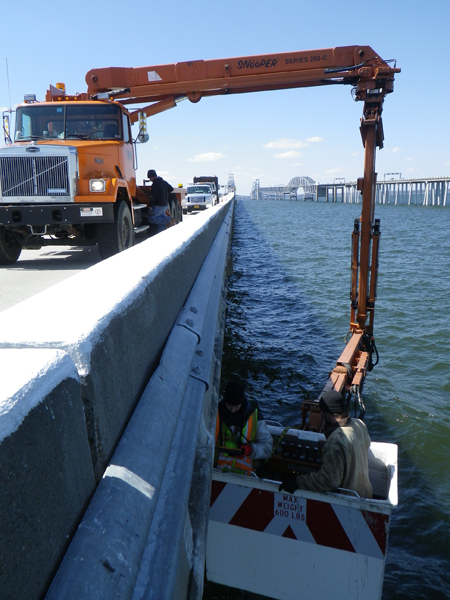
This is recommended so that ultrasonic findings can be verified, and the results will allow engineers to better understand the behaviour that lies behind the cause of the critical findings in that particular pin. It will also aid in the interpretation of ultrasonic inspection results in the remaining pins of the same bridge. Throughout the entire eastbound bridge inspection, one definitive requirement by the Maryland Transportation Authority is to maintain continuous traffic flow across the bridge.
Inspection vehicles and equipment are limited to a single lane of traffic, enabling travellers to use the other lane. So as to not impact commuter traffic during the peak of rush hour, inspections can only take place between 9.30am and 2pm. Furthermore, to ensure the safety of bridge inspectors and bridge travellers alike, the inspection is postponed if environmental conditions such as high wind or rain, or heavy traffic conditions create the risk of reducing safety.
In such conditions it is critical that the inspectors fully understand how ultrasonic techniques are best applied to b