
A major bridge crossing in Canada's remote Northwest Territories is set to move ahead again after being halted for an extensive and rapid redesign. Prabhjeet Raj Singh and Matthias Schueller report.
Long after the first settlers arrived in Yellowknife in the 1930s, people still travelled either by horses in summer, or dogsleds in winter due to the absence of a proper road connecting the region to the highway system of Canada. A 530km-long all-weather road from the Alberta border north to Yellowknife was completed in 1968 and has been steadily upgraded over the past 25 years. This route is known as Yellowknife Highway; it offers connections to winter roads that service the gold and diamond mines of the north and is used by more than half the population of the province. Construction of the highway reduced travel times significantly, but the Mackenzie River remained as a major obstacle.
The river at Fort Providence is approximately 220km north of the Alberta border and is crossed by ferry from late spring to early winter and by an ice bridge during some of the winter months. Since 1987, the ferry has operated into January or February through a channel cut in the ice, until the ice bridge is strong enough for heavy vehicles. Ice bridges are susceptible to collapse and cause environmental harm; even when operating normally, they can add 30 minutes to the trip. But the link is totally broken for an average of five weeks during spring while the ice breaks up and for up to three weeks in the autumn due to low water levels and while the ice forms sufficiently to cut the ferry channel. During these periods of isolation, there is no road connection between the region and southern Canada so people can only travel by air. Freight traffic to the region is also interrupted; some is trucked to the river, transferred to slings and shuttled by helicopter across the river to trucks on the other side.
As well as creating a permanent road connection, the bridge crossing would be expected to provide considerable economic stimulus and offer direct cost savings to industries, businesses, government and consumers in the region.
The route to construction of the new bridge has been anything but smooth, although with detailed design now complete, construction of the superstructure is finally expected to start later this year.
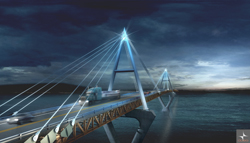
Back in 2007, the Government of the Northwest Territories entered into a public-private partnership with the Deh Cho Bridge Corporation for the design and construction of a new bridge consisting of a 1,045m-long composite steel truss bridge with a cable-assisted main span of 190m. The two-lane bridge has nine spans; the main span is flanked on both sides by three spans of 112.5m length and one of 90m. The superstructure is formed of two 4.5m-deep Warren trusses spaced 7.3m apart. Two A-shaped towers at each end of the main span support two planes of cables, each of which consists of six cables connected to the main truss via an outrigger system. The US$160 million bridge will be tolled, and the government will also contribute the same amount as it currently pays to operate the ferry, which will be discontinued when the bridge opens.
The P3 proposal called for accelerated construction of the bridge, and as is typical with this sort of fast-track project, construction of the foundations and substructure started before the superstructure design was finalised. But an independent review of the original superstructure design by TY Lin International on behalf of the government identified numerous deficiencies and deemed it unbuildable. The lack of a feasible erection procedure and the inclusion of several details that would be difficult to fabricate and assemble were some of the shortcomings identified. They could have had a direct impact on the project schedule with potentially significant cost implications for the partnership.
Pressure was put on the P3 team to mitigate the schedule delay by resolving these design issues effectively and economically. The original designer resigned from the project and Infinity Engineering Group was appointed by the Deh Cho Bridge Corporation to propose solutions. As well as presenting options to eliminate the deficiencies of the original design, Infinity developed a redesign option and carried out a value engineering exercise which revealed that it would offer significant savings in cost and schedule while simultaneously improving safety, durability, and constructability. The owner and concessionaire opted for the redesign option.
The value engineering process led to several features that were different to the original design. Applying the principles of lightweight design, a conventional truss system was developed where the member profiles respected the selected construction method. The articulation scheme chosen allows a continuous and jointless deck for the entire bridge length; this 235mm-thick deck will be built from precast concrete panels with cast-in-place stitches. A waterproofing membrane with two layers of asphalt will be applied to the surface for sealing purposes, and compact locked-coil cables are proposed for the stay system with the locations of the anchor points in the main span being modified for improved structural and aesthetic quality. These cables have the benefit of simple, fully-approved anchorages that can easily be inspected and maintained.
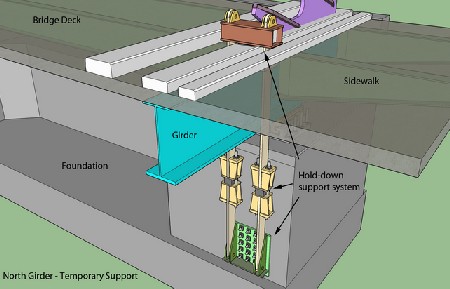
The design also included the consideration of a feasible and verified erection scheme; this involves launching the approach trusses, a one-step simultaneous stressing procedure for all the cables and a heavy barge lift of the main span. The scope included ensuring compatibility of the redesigned superstructure with the existing substructures which were already under construction. At the time the redesign started, foundations for all of the bridge piers had been installed, and the substructure for four of these piers had been completed.
The process of ensuring compatability meant that the design team had to be closely involved with the construction of the substructures and had to address site issues at the same time as they were carrying out the redesign work.
The challenge was not limited to solving technical problems under an accelerated schedule of five months; the problems encountered on the original design had sparked a greatly-increased level of scrutiny from the owner, lender and the concessionaire. The owner and its technical advisory team 'BP Tech and TY Lin International' were primarily interested in the technical adequacy of the design. Meanwhile the lender and its representative CH2M Hill were mostly concerned with progress and adherence to the schedule, while the concessionaire and its prime consultant Sargent & Associates focussed on auditing the quality aspects.
Understandably, a certain level of confidence had to be established between the P3 teams and the new designer. With the involvement of several teams, Infinity took the lead in steering progress meetings by developing agendas on behalf of the prime consultant, presenting the progress of the work and addressing comments. To instill confidence the designer chose to work transparently with all teams being given open access to drawings, calculations and progress reports.
Upon the award of the redesign, Infinity and Sargent & Associates developed a project-specific quality management system that included a quality control plan and a quality assurance plan. The merit of a design depends on the knowledge and experience of the design team and a well-structured and rigorously followed quality system ensures a product of the highest qualit