There is a timeless adage: "Man shall not live by bread alone." In the vernacular of civil engineering, “bread" represents structural function – safety, mechanics, and utility. The "spirit" is aesthetics – the landscape, cultural identity, and the emotional resonance that a structure creates with its environment.
For decades, the construction industry has implicitly prioritised the bread while treating the spirit as a discretionary luxury. Bridges were viewed primarily as functional assets governed by the laws of physics, a perspective that left little room for protecting intellectual property related to the pursuit of sculptural beauty. However, on 4 December 2025, the Supreme Court of Korea shattered this paradigm. By ruling that the aesthetic creativity in a bridge's sculptural design qualifies as a protected architectural work, the Court declared that even in large-scale infrastructure, a designer's unique expression must be respected. This decision is not merely a legal victory for EDI; I hope it will serve as a pivotal turning point that redefines the professional obligations of the bridge industry.
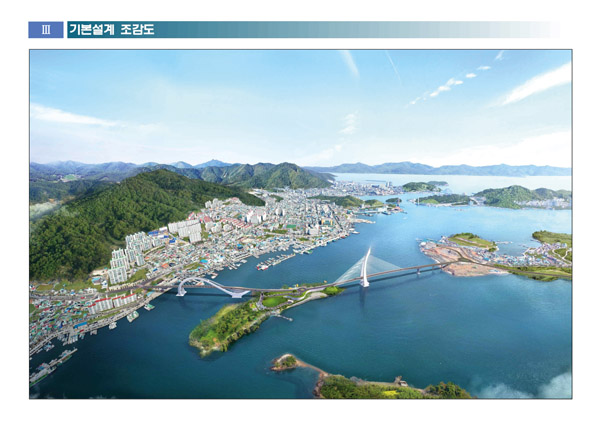
Bird’s-eye view render of the winning proposal for Gyeongdo Area Access Road Construction project (GFEZ website)
The legal battle centred on the sculptural designs for the Gyeongdo Area Access Road (Coastal Bridge) Construction project, commissioned by the Gwangyang Bay Area Free Economic Zone Authority (GFEZ) to connect the southern coast of Korea to Gyeongdo Island. Between 2011 and 2013, EDI had developed unique sculptural concept designs specifically for cable-stayed and arch bridges for other projects. However, during the turnkey tender for the Gyeongdo project in 2021, a winning proposal emerged featuring forms strikingly similar to EDI’s earlier works. This infringement was not a coincidence; it occurred because a former EDI employee moved to the firm and utilised its proprietary sculptural designs in the new bid.
The litigation was not pursued for mere financial redress. Instead, it was conducted with the purpose of creating an opportunity to change the mindset regarding sculptural design theft and the systemic inertia within the Korean bridge industry – issues I have been raising for the past decade.
During the first trial, and in direct contradiction to the appraisal results requested from the Korea Copyright Commission, the court adhered to the traditional view that "engineering constraints make aesthetic similarities inevitable" – essentially denying design copyright to civil structures.
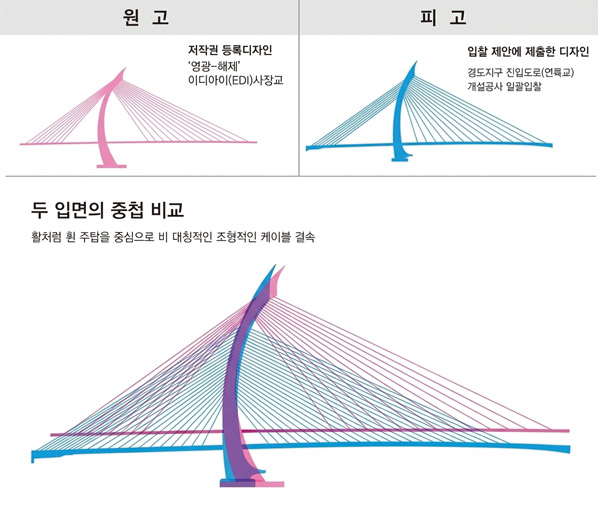
Visual comparison at the same scale, plaintiff design in pink, defendant design in blue (Korea Copyright Commission appraisal report)
However, the appellate court and the Supreme Court overturned this, establishing a precise legal standard. The Court ruled that architectural works, even those restricted by functional requirements, are protected by copyright if they exhibit "creative individuality." The judiciary affirmed that a creator's specific selection, arrangement, and combination of functional elements – if they manifest a distinct aesthetic thought rather than merely following standard engineering inevitability – constitute a valid "architectural work."
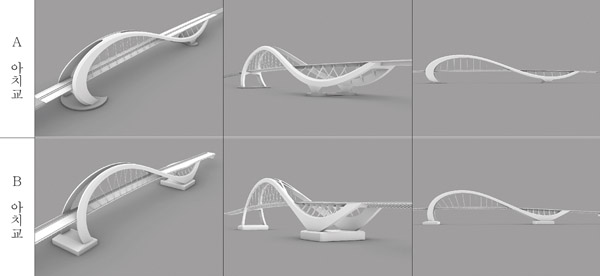
3D modeling data from the same viewpoint, plaintiff design in top rows and defendant’s below (Korea Copyright Commission appraisal submission)
There is a saying that design covers everything "from a needle to a spaceship." This implies that design plays a role in every object created by man. A spaceship may be 99% engineering. But what about a car? Or a shoe? Bridges also exist somewhere on this spectrum. While differences exist depending on the specific bridge, even in technically demanding long-span bridges, the aesthetic component is never zero. To abandon this crucial percentage of "art" simply because it is a massive civil engineering structure is to build a mere means of transportation, not a landmark.
Regrettably, commissioning authorities often suffer from a paradox of ambition. Responding to the demands of the public and the times, clients and public agencies demand landmarks that garner global attention. This goal encompasses technical feats – such as span length – as well as aesthetic values, such as originality and harmony with the environment. However, the existing mindset and systems do not align with this goal. Regarding aesthetics specifically: while even items for sculptural design and landscape exist in the evaluation criteria for selecting design proposals, they are rarely judged by relevant experts. Furthermore, even in this era where intellectual property rights are valued, when issues of sculptural design plagiarism are raised, they are often dismissed with the attitude, "Why does that matter in a bridge structure?" Consequently, the client fails to obtain the unique result they originally sought, or ends up with a distorted, low-quality outcome.
I understand that some professionals may view this ruling with apprehension, fearing it restricts the freedom of engineering solutions. However, I argue the opposite. This ruling does not restrict the laws of physics or standard structural types. Instead, it compels us to uphold a higher standard of aesthetic creativity and beauty.
Accepting copyright for sculptural designs is a necessary growing pain for the industry’s advancement. Just as we respect patents for new construction methods, we must respect the intellectual labour of aesthetic creation. Ultimately, the recognition of the value of distinctive sculptural designs and fair compensation will foster a healthier ecosystem and drive greater innovation within the bridge industry.
Infrastructure is built to last for a century. A bridge defines the skyline and instils civic pride for generations. If we focus only on minimum cost and efficiency, we rob the future of cultural value.
With this Supreme Court ruling, the "functional necessity" defence is no longer a shield for plagiarism of sculptural design. It is now incumbent upon engineers, architects, and commissioning authorities to recognise that a bridge without a soul is merely a road in the air – whereas a bridge with a respected, distinctive sculptural design, is a legacy.
Seong-ryoul Um is chief design officer, EDI.