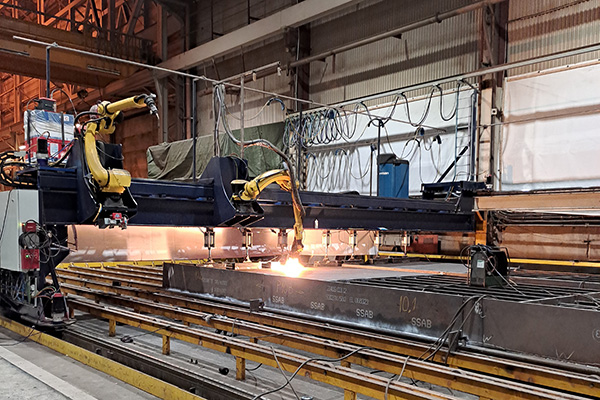
Robot welding in action at the Prodtex Fiskå facility
To observe the pioneering robot welding method that could transform steel bridge construction requires a scenic car ride as well as a ferry to reach Fiskå, a village along the coast of the Vanylvs Fjord, some 580km north of Oslo. It is a pleasant journey only interrupted by a deer enjoying the June sunshine in the middle of the road.
The destination is a repurposed shipbuilding facility whose high ceilings and enormous yard steel doors had been deemed a suitable location for housing robots as well as accessing the area’s rich tradition and knowledge of steel welding. Since 2020 the facility has been used by Prodtex to make steel elements for bridges, not ships, at the behest of the Norwegian Public Roads Administration.
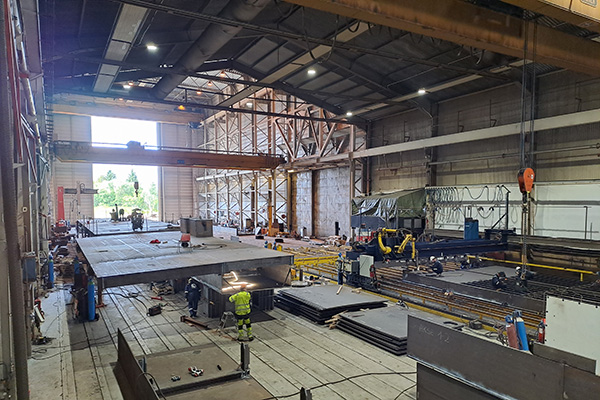
The spacious Fiskå facility houses Prodtex’s robot welding operation
At my journey’s end I join the NPRA engineers who are driving the project forward (Bd&e issue 111) and who are here to see the last of the steel elements being constructed for a third pilot crossing: Tore Askeland, project manager*, Cato Dorom, responsible for technology qualification, and Johannes Veie, design manager for bridge constructions. Host for the day is the director of business development at Prodtex, Tore Roppen.
The technology is under development by the NPRA in order to explore whether it could significantly reduce costs, time and emissions in bridge construction, while also delivering quality improvements in welding and fatigue performance. The origins of the pilot programme can be traced to the mid-2010s when the NPRA was challenged to cut costs for the construction of steel bridges as part of its efforts to deliver a ferry-free E39 coastal highway.
The E39 project looks to replace ferry crossings along the 1,100km-long coastal route running from Kristiansand in the south to Trondheim in the north via a combination of bridges and tunnels. These were predicted to halve the current travel time of 21 hours, but a number of the links were subsequently put on hold, awaiting funding.
Searching for ways forward, the NPRA began exploring whether bridges built with robots and laser welding could be the answer. One avenue of enquiry led to Prodtex – a specialist in automated manufacturing solutions that has been using laser welding for shipbuilding since 2012. It had also previously produced a sandwich bridge construction with good fatigue performance for a research project of Chalmers University of Technology, Sweden. When Prodtex suggested a method for programming welding robots from a digital twin 3D model, NPRA decided to investigate whether the methodology could be scaled up, as longer crossings would produce the most benefits.
The first pilot was the Frones Footbridge which opened in 2022 in Afjord, Trondelag County (Bd&e issue 99), a 65m-long and 3m-wide network arch pedestrian bridge with a steel ‘sandwich’ deck made of 10mm-thick rectangular steel plate sections.
The methodology was then applied on a road bridge in the second test project – the 48m-long single span steel girder Ya Bridge in Innlandet County, which opened in July 2023. Finally, the technology was scaled up for application on a larger vehicular crossing – the 110m-long, four-span steel girder Elverhoy Bridge on Road 70, More og Romsdal County, which is due to be assembled in autumn 2023.
The set-up is impressive and has remained the same for all three pilots: sensors monitor the welding as a quality control measure and the elements are formed using a combination of a laser-hybrid robot and an assembly robot. Special laser steel was used for the Frones Footbridge but, while the material was easy to cut, it was found to be hard to weld. Subsequently, the second and third test pilots are built with weathering steel, which proved easy to weld.
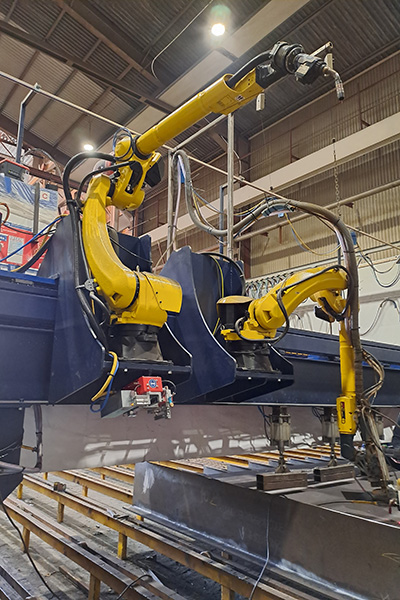
The robots are programmed from the digital twin of the bridge
The first test crossing had transversally welded girders while the girders for the following pilots were welded longitudinally, a design feature that can be accommodated without impacting the difficulty of the welding, explains Roppen. An important improvement that was introduced during the second test was the use of a ‘lap’ weld. This is achieved by positioning the main flange plate on top of a secondary stiffener plate, with the weld penetrating both. The traditional method is to weld on both sides to achieve the same result, explains Cato. Lap welding saves time and improves weld quality because it reduces the number of welds needed and uses a lower heat input.
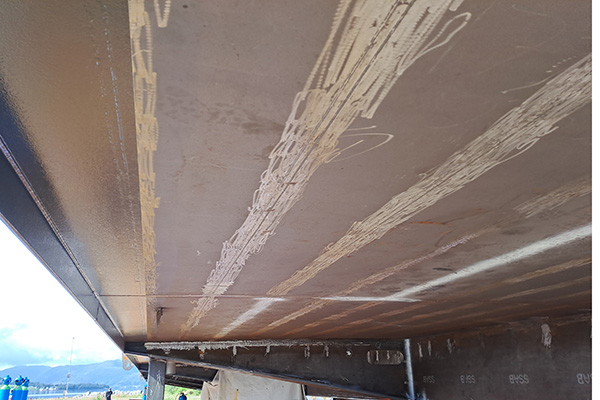
Elverhoy Bridge’s girders are welded longitudinally
During the visit I find out that the amount of heat and the number of welds used in segment manufacturing can impact the finished bridge, with extreme heating negatively affecting fatigue properties. A main advantage of laser welding compared to the manual method is that it works at a lower temperature, which reduces distortion in the welded segments. This, in turn, saves time later in the process, speeding up assembly and in-situ operations. Ya is considered to be the first bridge in the world where lap welding was used during construction.
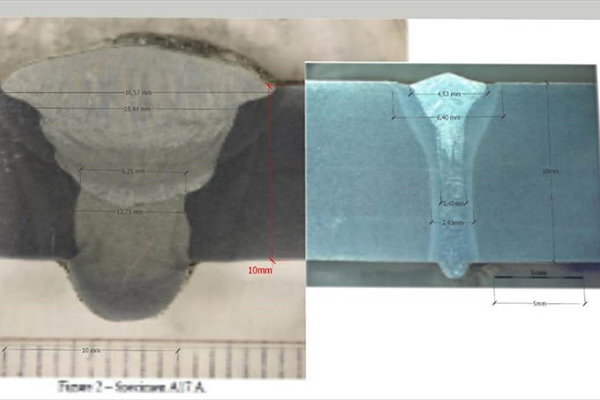
Side-by-side comparison of a high-heat manual weld (left) and (right) a lower-heat laser robot weld (Prodtex)
Observing the robots welding in action during the trip, we climb up on the segments and touch a half-minute-old weld with our bare hands. The weld is pleasantly warm, not scalding, so the hands-on test concludes without injuries.
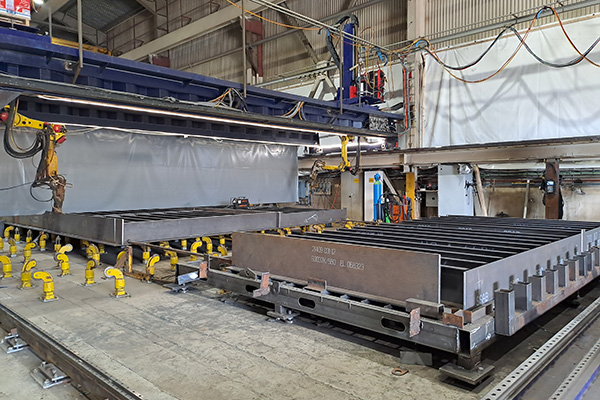
Prodtex uses programmable off-the-shelf robots
Using 3D models to programme the robots for specific projects is part of Prodtex’s standard process, which uses off-the-shelf programmable robots. To ensure a structure can be produced, a digital twin is created at the start of every project and is used to decide where the welds will be positioned and how they will be carried out, explains Roppen. The digital twin is crucial: it enables multiple robots to simultaneously assemble and weld in the same area and enables the welding to be carried out with a high degree of accuracy. The precise specifications provided by the 3D model optimise the amount of steel used and they dispense with the need for 2D drawings.
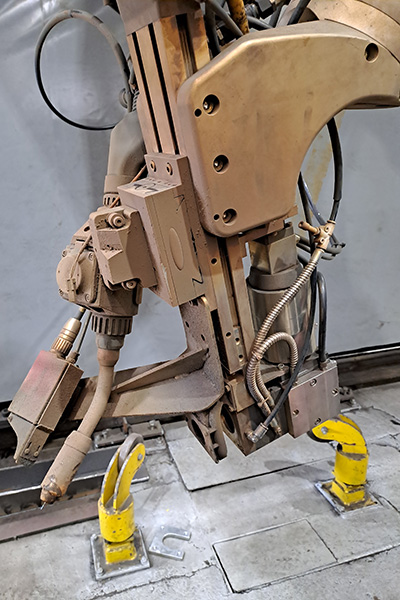
Multiple robots can weld and assemble simultaneously in the same area
Once the digital twin for a structure has been created, Prodtex estimates that construction can start three months later – this being the usual waiting period for material delivery. Once the elements have been constructed, the 3D model can be used as digital storage for all welding data for the entire project. If information on a specific weld is needed, either to replicate it or for inspection and refurbishment purposes, the digital twin can provide it.
The quality and safety data derived from the research project has delivered some impressive results. The NPRA conducted fatigue tests on small-scale specimens of the deck of Ya Bridge, and no weld failures were found. Independent research organisation Sintef designed and observed the test, while DNV, independent expert in assurance and risk management, carried out the actual process. No damage was located in the welding during testing, and any observed damage was in the base material. In summary, damage is dependant on what base material is used, so a project using high quality material could expect a correspondingly high welding performance with this methodology. “The result was so much better than what anyone expected,” says Roppen. Testing on more segments would be needed to statistically verify the results, but at the Fiskå factory both the NPRA and Prodtex are visibly excited and enthusiastic when discussing the initial results. These could change how steel bridges are designed, making it possible to reduce the amount of steel needed to construct new bridges or refurbish existing crossings to extend their lifetime and reducing the associated impact on the environment.
Another important finding of the tests was that fatigue started showing long before a breakdown occurred, explains Roppen, with more load cycles taking place pre-breakdown than initially expected. This demonstrates that a sandwich-constructed and laser-welded bridge would have higher resilience and be safer than a traditional concrete bridge or other types of crossings, which break down quickly after experiencing fatigue issues.
The technology could also significantly accelerate the construction of steel bridges because laser-welding carried out by robots is much faster than manual welding, says Roppen. The specific time savings depend on the welding capacity for a project but, at the time of the visit, Prodtex was welding an approximately 6m-by-7m sandwich deck element daily in the factory. Roppen estimates that this pace could be doubled with the existing equipment.
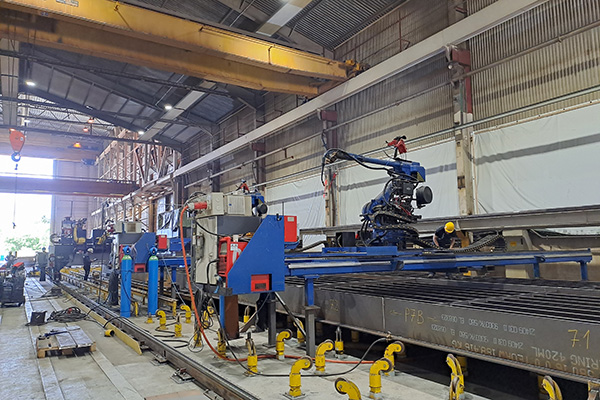
The hybrid-laser robots are more energy-efficient than manual welding
The robot laser and hybrid-laser welding technology also outperforms traditional manual welding on energy efficiency. Prodtex estimates that at least 15 welders would be needed to work simultaneously to replace certain robot welds. Fifteen units of the same energy source would need to be used compared to the single source for the robot, to complete the same task.
Manufacturing the segments for Eleverhoy Bridge has involved welding larger and longer sections than previously, with some elements measuring over 30m in length. At the time of the visit, their production was nearly complete and the sections were to remain in storage until installation. When the time comes, Prodtex will carry out the assembly work at location – again, with robots. The robots can be programmed remotely from Prodtex’s facility to operate wherever a project is located. “I expect that using robots instead of manual welders will be an advantage to all welding, wherever you are,” comments Roppen.
The major challenge for the wider application of this bridge construction method is spreading knowledge about the technology among industry stakeholders who often are non-experts on welding. Roppen explains that welding in Western Europe over the past three decades has largely been outsourced, so few engineers specialise in manual welding, and an even smaller number have experience in laser welding.
To encourage uptake of the technology, the NPRA is keen on presenting the innovative solution to the bridge industry. For lower cost, carbon and construction time, it would like to see the technology used on most – if not all – steel bridge projects in Norway. Naturally, it sees the technology having potential in other countries in the future. “I’m quite sure that some years from today, what Statens Vegvesen [NPRA] is doing now will be done in every country,” comments Roppen. He suggests that investment in modern production tools could help major construction companies increase their production capacities, remain competitive and reduce the reliance on outsourcing for welding.
With traffic volumes and loads rising across the world, laser and hybrid-laser welding via robots could be a solution for new bridges and other structures. Floating structures such as vessels, fish farms, and large pressure tanks also have high fatigue demands and indeed Roppen says that interest from these sectors has been noted.
Regarding future plans, Prodtex does not currently have another bridge project on its schedule and will focus on other types of construction over the next year. In the meantime, the NPRA will continue to brief the industry on the results of its research while also looking for more test projects. It is considering selecting as the next pilot a bridge that is past its design phase, which would test the application at a latter project stage, comments Veie.
While the organisation’s research and development budget has experienced recent cuts, interest in continuing the research work is unlikely to fade, however. Norway has a significant number of bridges built in the latter half of the 20th century that are approaching the end of their service life. Be it building new bridges, refurbishing existing ones or replacing old crossings – they could all be done faster and at lower cost with the robot and laser welding technology.
Departing Fiskå, the return trip includes two ferry stages that offer comfort and scenic views. But they also highlight the sheer convenience that a bridge brings, whether it be robot-welded or not.
*Since the time of writing, the project management of the E39 coastal highway has passed over to Cato Dorom.