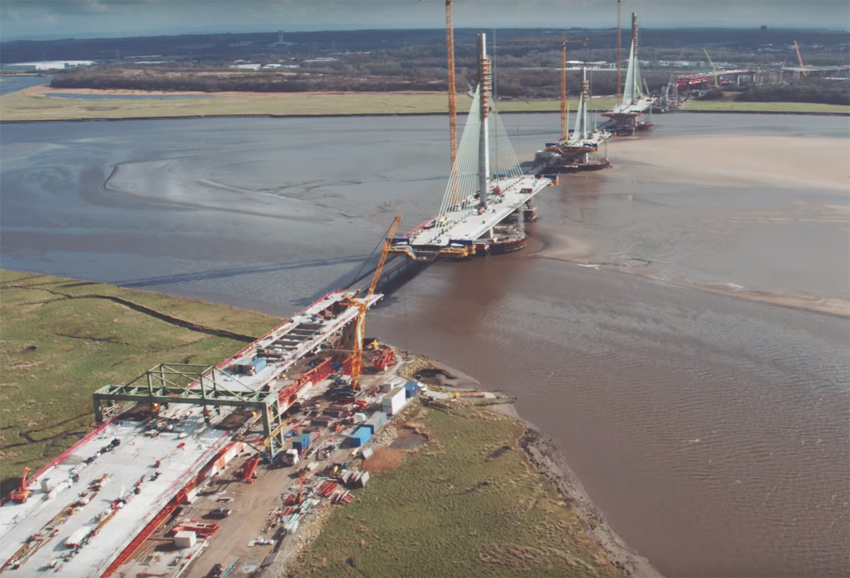

Ambitious plans for bridge building in the Gulf states range from the longest viaduct in the world to a major suspension bridge.
Skyscrapers and huge man-made islands are not the only infrastructure projects being planned for the Gulf region. As the states jostle for position with extensive leisure and business developments already under construction and new ones planned, proposals continue and plans are advanced for new transportation links, which range from mundane to spectacular.
Arguably the region's most ambitious and eye-catching project is the recently-revived plan to build a 23km-long road bridge over the Gulf of Aqaba, linking Saudi Arabia and Egypt. Incorporated in this sizeable link, which is being promoted by the Saudi and Egyptian governments, will be a 2.5km-long suspension bridge.
Tenders are expected to be invited soon for a feasibility study for the estimated US$3,000 million bridge which will be built across the Straits of Tiran, the entrance to the Gulf of Aqaba. Several regional banks, investors and contractors including Saudi Aramco, Saudi Binladin Group and Kuwait's Kharafi Group have already expressed an interest, and construction of the link is currently pencilled to start in 2007, with completion set for 2011. It is understood that a management team has been appointed to advise the two governments.
Tolls of approximately US$60-70 per user are expected to be levied on the crossing by the promoting consortium, as the scheme will probably be implemented on a BOT basis. A hefty slice of income will be raised from the estimated four million pilgrims who are expected to use the bridge each year, in addition to the usual commercial and tourist traffic.
The planned bridge will also support two 1m-diameter oil pipelines which will transport Saudi crude oil directly to the Mediterranean export terminal of Sidi Krier. Oil company Aramco, which is expected to take a majority shareholding in the project company, is likely to benefit from savings of up to US$1 million a day from reduced shipping fees and transit time by using the pipeline. A team of Japanese and Danish consultants has carried out the project's initial feasibility study, and the next step is the release of the 12-month full feasibility study tender. Once this study is complete, a design and build tender will be issued.
One of the major obstacles facing engineers will be the technical challenge of building at the site, where the sea is very deep. But the political issues of building a structure across an international waterway which is of strategic importance to Israel and Jordan as well as Egypt and Saudi Arabia could prove even more challenging. Some also question the economic merits of the scheme.
The project has already been on the drawing board for almost 20 years since a protocol agreement was signed between Riyadh and Cairo in 1988. However, the project has gained momentum following the Al-Salam 98 ferry disaster earlier this year, which killed more than 900 people.
Another major scheme which is gathering pace is the 40km-long Friendship Bridge, which is planned to connect Bahrain and Qatar. In June officials in Doha and Manama announced that they had agreed to establish a special purpose project company to build a link between them, seen as a significant moment in the development of the Gulf Cooperation Council. Although the Friendship Bridge will be the longest in the world once it is complete, the project is more than just another mega-project in a region awash with huge infrastructure schemes. One again, economic considerations are not the deciding factor in the planning of this scheme.
According to the pre-feasibility study for the Friendship Bridge, only 6,000 vehicles a day are expected to cross the bridge, a figure that is well below the estimated 10-15,000 a day that use the 25km-long King Fahd causeway between Saudi Arabia and Bahrain. The traffic figures are so low that it is close to not being feasible, but the significance of the project goes far beyond its role as a transport link. The agreement, which was signed on 11 June by Qatar's Crown Prince Shaikh Tamim bin Hamad al-Thani and his Bahraini counterpart Shaikh Salman bin Hamad al-Khalifa, was a clear public commitment by the Gulf's two smallest states of their intention to bring their economies closer together.
The two governments have also investigated whether to use the bridge as an energy corridor carrying electricity power lines and a gas pipeline alongside, to meet Bahrain's growing energy requirements. Sources close to the project in Doha also suggest that a number of artificial island developments could be built along the route of the causeway. Adding a pipeline would make it more viable, as would combining tourist and residential island developments with the project. But such projects are largely political, which is why this one is called the Friendship Bridge; its aim is to bind the two countries together.
The design is likely to be similar to the King Fahd causeway. Although the final details have yet to be released, a pre-feasibility design carried out by consultant Cowi, which also designed the Saudi-Bahraini crossing, developed a conceptual design with about half the crossing on embankment with the other half on a series of short bridges of about 50m spans. Initially it was intended that the project would be offered to contractors on a design-and-build basis but now it seems that the inter-governmental committee responsible for developing the project is considering a more conventional procurement route, with the detailed design being carried out by the client. The Bahrain-Qatar Causeway is just one of the major bridge projects being planned for the Middle East, particularly in the Gulf, as governments seek to develop their road and rail infrastructure to cope with the region's rapid economic expansion.
Information gathered by the Middle East Economic Digest and Meed Projects, about 20 major bridge schemes worth an estimated US$12,000 million are planned or under way in the region. Hundreds of smaller bridge structures such as rail bridges, highway interchanges, flyovers, and so on take the total value of regional bridge projects up to an estimated US$20,000 million.
But in common with many other sectors of construction, Dubai is the Middle East's capital for bridge building today. The emirate faces crippling traffic congestion which is at risk of seriously damaging its future economic prospects if nothing is done to address it. Hence the government is currently ploughing billions into upgrading its transport network.
The first aim in alleviating Dubai's congestion problem is to remove the traffic bottleneck over Dubai Creek. Currently, some 16,000 vehicles an hour cross the creek, but authorities estimate that by 2020 the figure will have risen to about 43,000 an hour. This volume will be far too high for the 19-lane capacity currently provided by the three existing crossings - the Garhoud and Maktoum bridges, and the Shindagha Tunnel.
With this in mind, the Dubai Roads & Transport Authority is pushing ahead with an estimated US$1,000 million bridge-building programme that will see six major new bridges built across the creek by 2010, and which will increase the number of lanes across the creek to 44 by 2008, and more than 90 by 2010.
By the end of next year, an additional 25 lanes of capacity will have been provided with the completion of the two, 520m-long bridges that will form the second Garhoud crossing and the Ras al Khor bridge, both of which are currently under construction.
Meanwhile plans to build a temporary floating bridge were recently announced, and on completion, this will add a further six lanes capacity, significantly reduc