The new girders are being developed under the umbrella of Sustainable infrastructure through increased use of stainless steel (SIFRA), a project founded by Sweden’s innovation agency (Vinnova), the Swedish Energy Agency and the Swedish Research Council (FORMAS). It aims to provide bridge owners and bridge engineers with the necessary competence and tools to use stainless steel in their infrastructure designs. Usage of this material is regarded as more sustainable than the traditional route because of its lower lifecycle costs (LCC) and it has led to a series of large-scale physical tests that began in November 2020 at the Research Institute of Sweden.
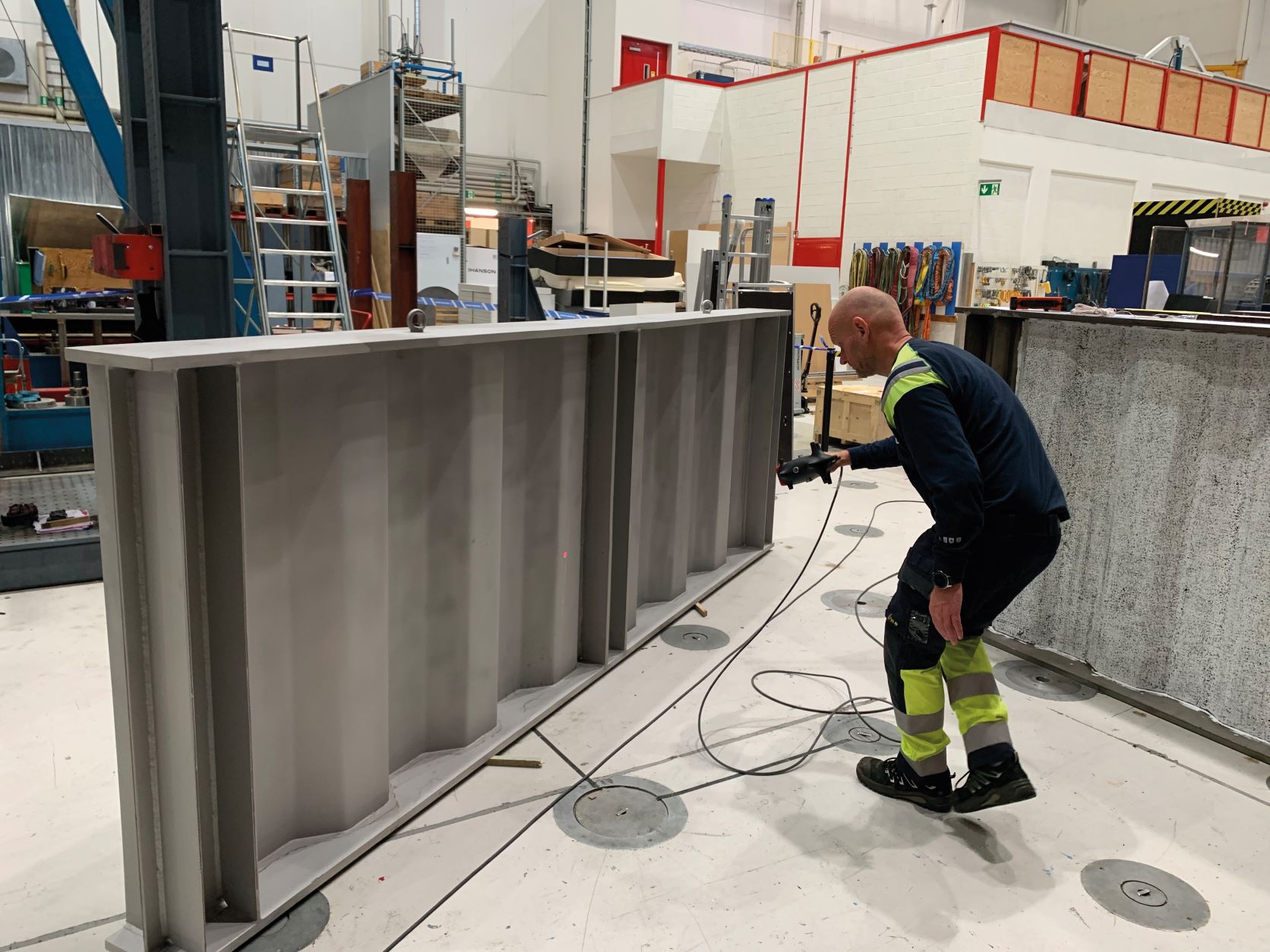 Laser scanning a 1.45m-deep corrugated web stainless steel girder produced for the Sunlight testing program
The groundwork for the testing was laid four years ago by the SIFRA WP1 report. It presented the findings of two case studies where new designs were produced and compared with the original designs of an existing highway bridge and an existing railway bridge, both in Sweden. These are a composite carbon steel-concrete bridge over E4 in Skulnäs with a single span of 32m, and a 24m-long simply supported rail bridge over Östra Klarälven in Ställdalen-Kil. The new designs used stainless steel alternatives both with – and without – design improvements. LCC analysis was carried out for all the designs.
For each bridge a design in duplex stainless steel grade EN 1.4162 was produced using existing Eurocode 3 rules for stainless steel structural design. In addition, for the road bridge, an innovative design was produced that used stainless steel girders with corrugated webs.
The new design for the rail bridge was produced with duplex stainless steel grade EN 1.4162 in accordance with EN 1993-1-4. Two additional optimised designs were produced where post-weld treatment was assumed in the welded joints, treatment that was required to enable the cross-section of the rail bridge design to be optimised while ensuring appropriate fatigue strength.
This resulted in a total of seven designs for comparison purposes, three for the road bridge – original, stainless steel, and stainless steel corrugated web – and four for the rail bridge – original, stainless steel, post-weld treatment (class 3) and post-weld treatment (class 4).
The results, which were interesting enough to warrant further large-scale testing, can be summarised as follows. As regards the road bridge, a weight reduction of 14% was achieved with a stainless steel flat web and 41% with a stainless steel corrugated web. In addition, the LCC calculation found that the original design in carbon steel had a higher total LCC than the other designs. In fact, the stainless steel corrugated web design held an LCC that was around 40% less than that of the existing bridge’s design, mainly due to the reduction in self-weight and non-requirement for coatings.
The rail bridge study was equally revealing. As the original design was governed by the fatigue limit state, the same cross section was obtained for the new design so there was no change in the girders’ weight. However, for the two optimised designs that had improved fatigue strength at the weld toes with high-frequency mechanical impact treatment, there were reductions of 33% and 39%, depending on their welding class. The LCC for the original rail bridge showed user costs accounting for a large portion of the total, mainly because of substantial costs associated with closing railway traffic. Even without taking these costs into consideration, the LCC cost of the two optimised designs was nevertheless lower than the original design, because of the latter’s requirement for repainting every 25 years.
It is in this context that the follow-on Sunlight research project was launched in 2019, which aimed to develop and verify the combination of stainless steel, stiff corrugated web plates and composite performance as a potential replacement for conventional stiffened steel girders.
An initial hurdle for the researchers was that no codified rules exist in the Eurocodes for such a combination, something that was overcome by developing design rules based on those related to flat web carbon steel girders. From these, multiple simulations using different angles, depths and height were carried out, resulting in an optimum with the highest shear buckling capacity in relation to material weight. “A couple of different corrugation shapes where chosen from the screening process, and their predicted capacity then verified with the full-scale testing,” comments Paul Janiak, research and development manager at project partner Outokumpu.
The testing, which focussed on local, global and interactive buckling modes in shear, was carried out on four EN 1.4162 stainless steel girders, which measured 4m by 1.45m with 4mm and 6mm corrugated web configurations. The focus on shear behaviour was due to the fact that the main benefit of this type of girder is high shear strength. Geometry and deformation of the web panel during loading was monitored and the applied load, maximum vertical deflection, and the strains were all measured, validating the FEM.
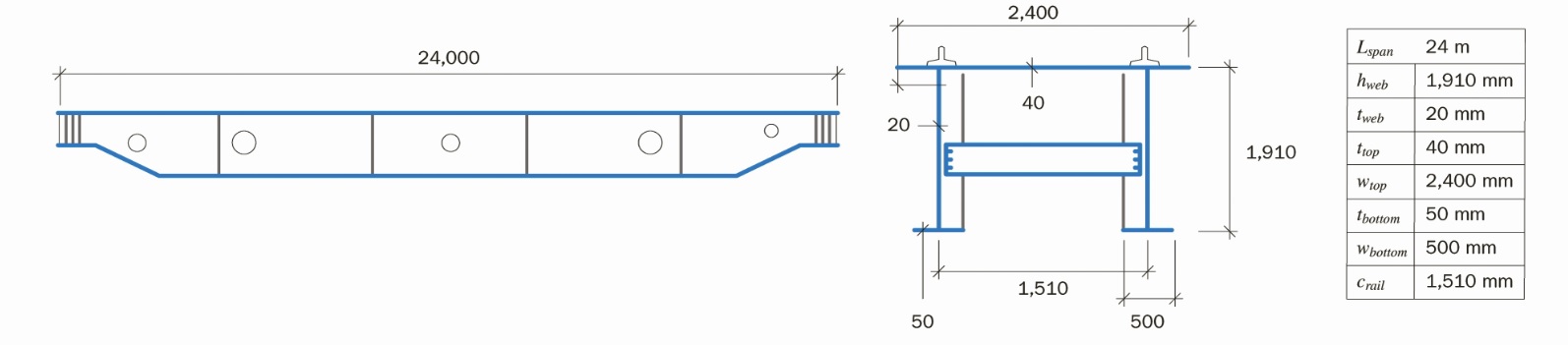 Original design of the Ställdalen railway bridge, in S355 steel
During the course of the investigation the researchers also redesigned three existing carbon steel twin I-girder composite bridges using the stainless steel corrugated web girders. The redesign of these bridges showed weight reductions between 15% and 29%, ascribed as being mainly due to the corrugated design. The study also noted that if the production costs were added to the cost of materials, the investment costs of the new designs were comparable to the original designs and only slightly higher. Furthermore, the LCC was found to be lower, in agreement with the findings of the aforementioned SIFRA WP1 study.
Sweden’s current interest in stainless steel from an LCC perspective is, understandably, welcomed by SIFRA project research partner Outokumpu. Andy Backhouse, technical manager for energy and structural applications for stainless steel at the firm, who points out that stainless steel bridges are few and far between: “There are probably more stainless steel bridges in Sweden than any other country, but you only need fingers and toes to be able to count them. They are usually selected by a municipality or a private owner, but now we are seeing movement into government bodies purchasing them for big projects as a result of LCC roadmaps, which is encouraging.”
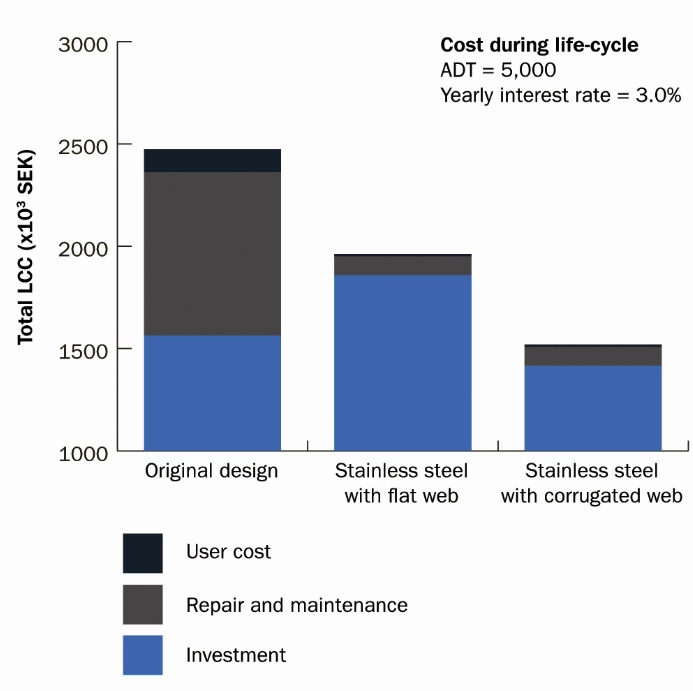
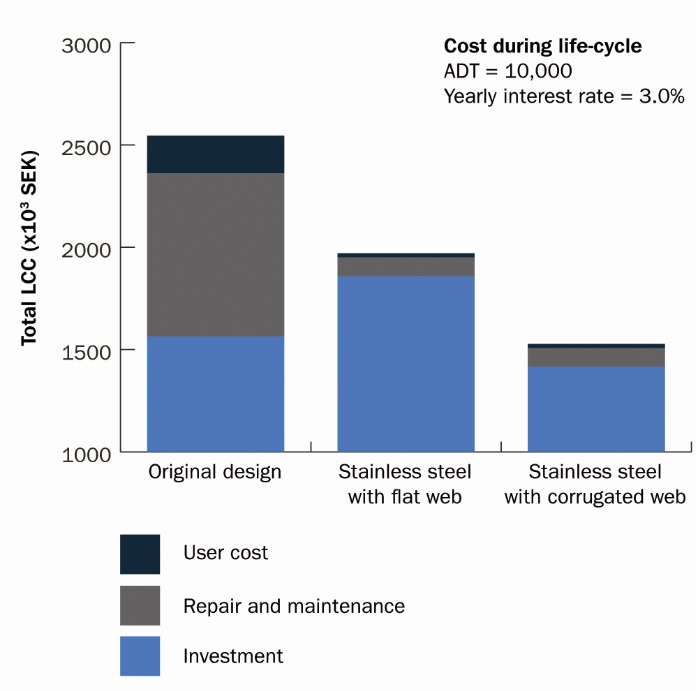
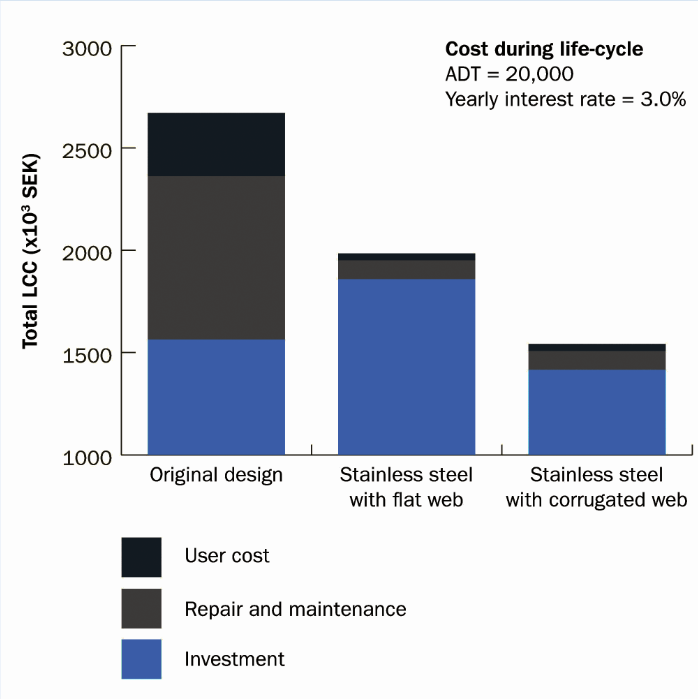 Lifecycle cost analysis for three road bridge variants, with average daily traffic varying from 5,000 to 20,000 vehicles (SIFRA WP1)
The stainless steel manufacturer is involved in SIFRA because it believes there is further potential in the use of stainless steel in bridge construction. “We have high strength, we have low maintenance needs, but also have a price that is higher than carbon steel. Nevertheless, through design there is the possibility to produce a bridge that is weight efficient and therefore cost efficient,” says Janiak.
The day that corrugated stainless steel girders enter mainstream usage is still some way away, acknowledge Janiak and Backhouse. The lack of guides in the Eurocodes for this design means that further research needs to be carried out, especially on its fatigue properties. However, Janiak is confident that this will be overcome because theoretical studies on fatigue for these types of corrugated structures have already been carried out, albeit on carbon steel only. “We have done similar projects on fatigue in the past and shown that stainless steel is almost always the same or better than the carbon steel variant. But we need still to do some verification for this design to make sure we don’t have any surprises.
“We have a project in the pipeline to look into fatigue aspects of these corrugated web designs as well as other fatigue enhancement methods such as post weld treatments, for example HFMI [high frequency mechanical impact] on stainless steel. There are ongoing projects to define fatigue categories for corrugated web details in carbon steels and we want to contribute with our data on stainless steels.” Janiak adds that work is also under way on the creation of an optimisation algorithm that will design stainless steel corrugated web girders based on inputs such as span length and loads with the aim of minimising LCC and LCA.
Until the properties of stainless steel elements are fully tested and understood, it is likely that the material will continue to be used in bridges as it always has been, which in many cases could be described as ‘wastefully’. “The traditional way of doing things is to take the same design and just switch to stainless steel. Then you will have a very expensive bridge because you simply don’t utilise the material fully,” says Backhouse, pointing out that ten years ago Outokumpu commissioned Arup to investigate the implications of changing the steel type of a steel-concrete composite highway bridge in the UK. One of the designs, using duplex stainless designs, was optimised in beam geometry and construction methodology, leading to a total decrease of the weight by 39% and a total construction cost 6% higher than the reference carbon steel design.
Backhouse wants to see more bridge projects that use the full potential of stainless steel’s strength and stiffness through slender elements, because the opposite scenario – stainless steel bridges that are too heavy and expensive – will not attract the interest of bridge engineers. “What we are trying to achieve with SIFRA is to show that you can build an everyday bridge in stainless steel and still be cost efficient. Anyone can pay huge money for a landmark somewhere, but for a utilitarian road bridge over a highway in the countryside, upfront costs are vital.”
Sustainable Infrastructure Through Increased Use of Stainless Steel (SIFRA)
Founders: Vinnova, Swedish Energy Agency, FORMAS
Additional partners: Outokumpu, voestalpine Böhler Welding Nordic, Esab, COWI, WSP, Sandvik
Materials Technology: Swerim, Chalmers University of Technology, Trafikverke