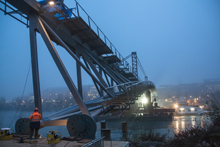
Since graduating with an MSc in Civil Engineering from École Polytechnique Fédérale de Lausanne in Switzerland in 2009, Lee Franck’s career has been coloured by a swathe of experiences. Her structural engineering work has seen her involved with a variety of bridges and buildings in the UK, Rwanda, and the US, and in reading her employment history, one is not only struck by the volume of achievements, but also her position in the vanguard of new developments and ideas in the field.
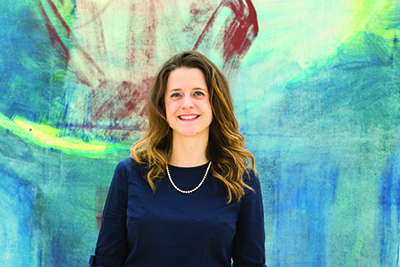
Lee Franck
One of these saw her work as part of a two-person team to launch the inaugural IABSE Future of Design conference in London in 2012 and the New York version of the conference in 2017. Both events have been held every year since and continue to be platforms for exchange between engineers, architects, contractors, artists and more. A passion for connecting industry stakeholders continues to pervade Franck’s professional efforts as she works to build her own company, Realtyimpact. The start-up aims to make it quicker and easier to connect clients with architects, engineers and other built-environment professionals and was established in May after a 14-week pre-seed accelerator programme at the Luxembourg branch of the Founder Institute.
Some of the seeds of inspiration that helped put Franck on this trajectory were planted in her childhood. On a family trip to the US, for example, she recalls the indelible mark the Golden Gate Bridge in San Francisco left on her childhood memories. “It’s partly why I became an engineer in the first place. It was always about bridges, the beauty of bridges and this fascination I developed as a child.” This youthful curiosity, combined with a childhood passion for making things and natural strengths in maths and physics, might lead one to assume that Franck’s choice of engineering as a course of study was made with complete confidence from the get-go.
However, she points out, it was less straightforward than this. “I went towards engineering as I was trying to combine my interest in architecture, my skills in maths and fascination with creating something you can see and touch, and that other people can react to as well. But, I was not always certain that was the right path, and even in my first year of university it took me a while to be sure it was the right choice,” she explains. “I remember there was one class we had about intuitively understanding how structures work: the flow of forces, what a cable does, what a tower does. I thought it was fascinating: you can look at something and really understand how it works.”
A presentation by Swiss bridge builder Toni Rüttimann helped further vindicate her course selection. “He didn’t even finish his engineering studies, but he went off to South America to build bridges,” she explains. “I listened to him and thought, this is amazing: this person uses his passion for engineering to help communities live better. I thought, well, if that’s what civil engineering will allow me to do, then maybe I’m not in the wrong place. That motivated me to go on from there.”
Franck credits her studies with having provided her with a strong technical platform from which to build as a graduate, but highlights a few shortfalls in the course. “It didn’t do two things: it didn’t encourage enough collaborative working that I experienced in my first years with Arup in London, and it didn’t teach us to start designing at a conceptual level. I think that those two things are very important and that universities should create more of a base for that. Maybe they’ve changed since; maybe more work is done on projects with architects and engineers at university.”
This base for thinking collaboratively and having an openness and curiosity for other disciplines is something she believes should be established as early as possible, and she has strived to encourage that in her role as a visiting critic and lecturer at six different universities, including the Department of Civil and Environmental Engineering at Princeton University; the Faculty of the Built Environment at the Bartlett School of Architecture, UCL; and to Master of Architecture students at the Royal College of Art.
The prevalence of architectural departments and schools in the list highlights that she has not just identified the lack of multi-disciplinary insights available in her modules at university, but has since proactively sought to engender a collaborative mindset in the next generation of engineers and architects. A knock-on benefit, she says, has been the ability to play around with innovative design ideas and to create relationships with architecture lecturers, leading to design opportunities and collaborations later on, and she encourages whoever gets a similar chance to get involved and grasp the opportunity with both hands.
Her own professional journey started in 2009 at Arup’s London offices, where she worked as both a building and bridge engineer, after which she joined Guy Nordenson and Associates, a structural engineering firm employing engineers and architects in New York City. The importance of understanding context was highlighted during her first stint as a site engineer with a secondment to Kier Construction in 2012. “I got to hear first-hand things from workers on site like, ‘Why did these engineers design it that way? It would have been much easy to do it this way.’”
An acute awareness of the practical implications of design choices came further into focus when Franck moved into bridge engineering and worked as part of a team at Arup that collaborated on a design and learning tool for the NGO Bridges to Prosperity (B2P). The work involved creating a parametric spreadsheet allowing designers to enter variables such as the span and material and soil properties to produce a safe design based on first principles. Following this, Franck had the chance to help lead the construction of one of the NGO’s bridges in Rwanda: a 50m-long suspension footbridge which still serves a community of 10,000 people.
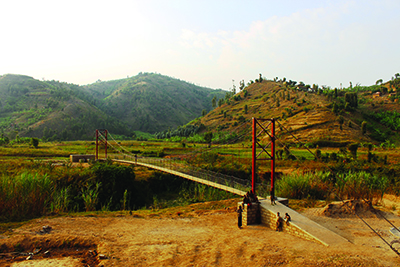
Franck helped lead the construction of a 50m-long suspension footbridge in Rwanda
“When I was building this bridge, that’s when I realised that doing the analysis and calculating how much material you needed to use was actually such a small part of what I was trying to do. I started to understand the context. That was a turning point for me,” she reflects. “From that moment on I tried to zoom out during a project, not just go racing in and start doing numbers, but to think broadly and first understand what the structure is going to do in the context, what is needed, and how we can solve the problem in a bigger way.”
Gaining an intimate contextual understanding was not really possible on the next bridge project that Franck worked on: the Southern Section of the Tuen Mun-Chek Lap Kok Link in Hong Kong. Comprising a 2km marine section, including a 200m-span navigation channel and nine approach viaducts, it is the largest bridge that Franck has been involved with. Alongside the 4.2km Northern Section Tunnel, the Southern Section will provide a link between the New Territories and Hong Kong International Airport when it opens in 2020. The viaducts have been built using prestressed concrete girders and a precast segmental method, and as one of roughly another 50 engineers involved, Franck credits the project with deepening her technical skills: “I was involved with creating the automation tools. If you have such a big structure, that often leads to a lot of changes in the geometry, so you have to come up with ways of designing it quickly and simplifying these repetitive tasks.”
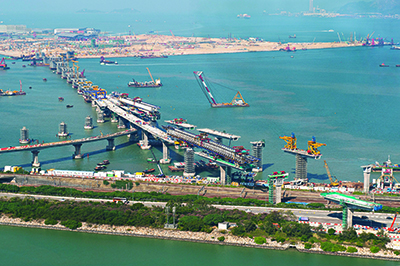
The Tuen Mun Chek Lap Kok Link in Hong Kong is the largest bridge project Franck has been involved with (Arup)
Working on the link was also a key learning experience for Franck, as she realised she was not the right fit for that kind of work: “I missed the collaboration with other disciplines. The work was a lot of design at your desk, on your own, doing numbers. I’m sure that there are many engineers who are happy with this, but it was making me miserable. When I got the chance to step out into a more multidisciplinary environment with greater involvement at a conceptual level, I took it.”
That opportunity came with Franck’s involvement in a winning footbridge design from Arup and Tonkin Liu Architects. Their proposal for the Salford Meadows Bridge in Salford, north-west England won a RIBA Design Competition back in January 2014, but unfortunately never saw the light of day. Nonetheless, their design for a crossing between one of the city’s main roads and the Salford Meadows area was an interesting solution comprising a steel arch bridge designed with a twist, literally, along the arch, which supports a horizontally curved deck.
The main structural components would have been sheet metal with perforations cut into both the arch and deck. These were designed not only to provide enhanced views of the surrounding environs and allow light to filter through, but also to bring the concept of biomimicry to structural engineering by emulating the way natural materials sacrifice strength at less critical points in their structure for enhanced robustness in others.
The unorthodox approach of cutting holes in the arch and deck meant that the team were pushing things structurally. This required several visits to the site and close collaboration between the engineers and architects, an environment in which Franck clearly flourishes. “We would meet once a week in person, discuss ideas, set principles, do our studies, and come back and discuss our results. We also used a number of tools to communicate progress, and one of those was 3D printing,” she says.
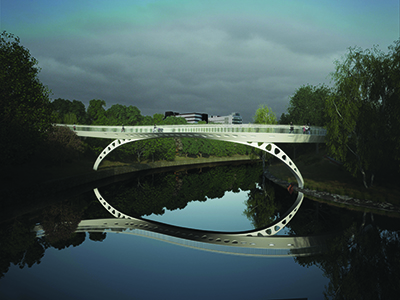
Winning proposal for the Salford Meadows Bridge (Tonkin Liu)
Footbridges, in general, are structures that Franck has always been drawn to because they are where she feels her passion for architecture and bridges come together, and where she can put her extensive experience of working with architects to use. This is something she says is less common with work on bigger bridges. “I wonder if it’s because traditionally, engineers design big bridges, and a lot of engineers might be reluctant to bring in architects while clients might see that as unnecessary,” she says. “If you are an engineer and you design a bridge and only work with other engineers, it can feel easier than if you get all these other people involved who bring their own views and skills, because it forces you to break out of how you see things. That can be painful, but I think the end result is much better, and it’s our responsibility as engineers to be open to that.”
Another aspect of footbridge design she takes joy from is the freedom to move away from what is most structurally efficient, a privilege afforded by the smaller loads involved. However, as she highlights, minimal and sustainable designs are important considerations as we move towards a climate crisis, and while not a dilemma per se, finding a balance between what is aesthetically pleasing and sustainably designed is something bridge engineers and the entire construction industry must achieve.
Another bridge design competition Franck was involved with took even more inspiration from nature than the biomimicry of the Salford Meadows Bridge in that the main structural component proposed was stone. A joint effort between Arup and Knight Architects, the footbridge was proposed as a river crossing close to Lake Geneva and the Swiss mountains. Given the fact that stone, like concrete, has good compressive strength but is poor under tension, the team were curious to see if they could apply prestressing techniques to the stone, something they found out had been achieved on short-span granite bridges by Kusser Graniteworks in Germany. “I still think it’s a fascinating idea, and what is nice is that you get to walk, touch and be with that raw material. It’s not cladding; it is the structure.” The challenge was that to have sourced the amount of stone required for the 200m long bridge would have exceeded the quarrying capacity of Kusser Graniteworks. “Maybe if we had won the competition, we would have found a way to make that happen,” she adds.
Her passion for natural materials is also evident when she describes the structure from her portfolio that is closest to her heart, the Timber Wave. This was a latticework spiral made from American red oak designed to sit at the entrance of the Victoria & Albert Museum for the London Design Festival in 2011. “It’s maybe not something others might have chosen as their most remarkable project, but it brought together the things I’m most excited about as a structural engineer. We only had a limited amount of materials, nine months to design and build it, and a very limited budget, but the team managed to work together so closely over those months that we got over those constraints,” she explains as she almost re-experiences the energy required to make the project a success. “As the architects developed the overall geometry, we picked up any changes straight away in our analysis and liaised with the fabricator to tell them how much material would be needed, and they then let us know straight away if it could be fabricated within the time, budget and material we had available. It was really a trade-off because we wanted to make it as curvy as possible, but this also meant more fabrication time and cost, and it was only through reiterating so often and so quickly that we were able to find a point where it all just about worked.”
Helping to create efficient and effective teams is part of the raison d’être of Franck’s start-up Realtyimpact. Her motivation for creating her own company stemmed from her ongoing desire to build something bigger than one design idea: “After 10 years in the industry, one of the things I was passionate about was entrepreneurship – building something up and making it work – and I guess that’s what I was trying to do with Future of Design. I started to have a real desire to create something, and I decided to go in the start-up direction because it seemed a good way to address some of the challenges I observed in the industry.”
One of these is the way clients find designers, which Franck says can be quite inefficient and unreliable, relying on word of mouth for small-scale projects and design competitions for larger ones. The latter can be both time and resource consuming, with teams often creating designs with little exchange with the client and a basic understanding of the context. “There are a lot of models out there which I don’t think are great, and I’ve set myself the challenge of trying to improve that.” This will be done by creating an online network and marketplace where clients can find talented and trusted architects, engineers and construction firms. The goal is to give companies an online platform to create a profile explaining their capabilities, their skillsets and the types of projects they’re interested in, and on the client side a chance to describe their project and the skills they need.
Another aspect of the procurement process Franck is looking to improve through Realtyimpact relates to the subject of sustainability, an area she is particularly concerned about. “You don’t often get asked as a designer, ‘How do you position yourself with regards to sustainability?’ Hence, I want to embed sustainable design criteria into the process so that the companies that are doing something can stand out, and the clients can find them more easily.”
To facilitate this, the platform will collect data on companies’ sustainable practices, asking questions such as, “On what percentage of your projects have you considered the circular economy design principle?” Data collection will not be limited to sustainable practices but other facets, too, such as the diversity of a company’s workforce and leadership and their use of technology.
She hopes that by providing a tool like this, she will be able to contribute to reducing the construction industry’s CO2 emissions, highlighting that it counts for 40% the total worldwide, with the bulk of the sector’s footprint already embedded in structures. “Most structural engineers have not yet realised what a big impact they are having on the climate crisis through their professional lives. We have an incredible opportunity to change our industry and reduce the impact of our designs, but we need to wake up and change the way we do things if we are to stand a chance.”
Franck is clearly driven by a strong desire to improve design and collaboration and hopes structural engineers will take more of a leading role, especially given the challenges facing the profession: “We must move more towards a leadership role in projects: we do our numbers and design, but we don’t always want to take a bigger role. We can’t just hide behind clients or architects and say, ‘They made the decision’. We must get in there and focus on collaboration and shape projects from the start.”