Designing a reliable, durable, economically feasible, user-friendly and aesthetically pleasing bridge that carries 12 lanes of traffic is a huge design challenge. This is elevated further when significant technical construction and manufacturing considerations related to limited structural height are introduced, as well as large clearance requirements for navigation, a deep and soft subsoil layer, and a high incidence of typhoons. Through the implementation of technological innovation, the construction of the Oujiang Beikou multi-pylon suspension bridge (also known as Oujiang North Estuary Bridge) in Zhejiang Province is progressing well, in spite of all these challenges.
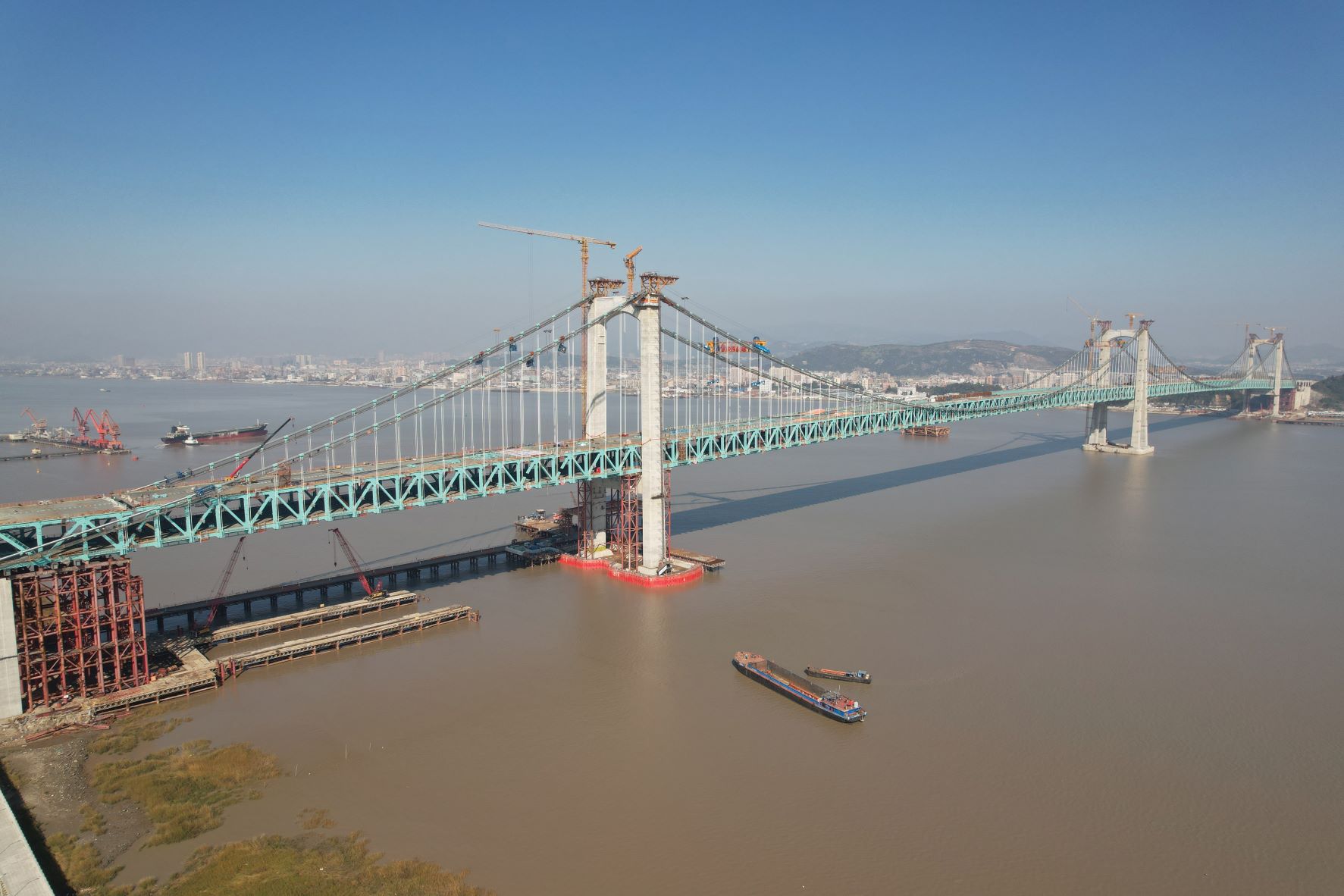 A 12.5m-high Warren truss was chosen, based on wind resistance, structural stiffness and practical experience
On the southern flank of China’s Yangtze River Delta, the Oujiang River runs from west to east directly into the East China Sea via a 9km wide estuary that is divided into northern and southern branches. The Oujiang River is a tidal river fed by mountainous creeks, with a maximum flood tide and ebb velocity of 2m/s and 2.8m/s respectively, and a water depth of some 10 to 15m. At the north bank of the river is Longshe Mountain while at the south bank is a vast estuarine plain with 40-50m thick silty marine soil in the upper part, a deep pebble layer in the middle, and bedrock below, at a depth of over 130m.
As an important traffic corridor, it is planned that the area be served by Freeway G15W3 and National Highway G228. With the bridge at the southern branch of the river already completed in 2018 and carrying G15W3 traffic, the construction of the Oujiang Beikou Bridge is imperative.
The site of Oujiang Beikou Bridge is 8.5km away from Wenzhou Longwan Airport and is in the aviation height restriction zone, which required the top of the pylon to be no higher than 154m (Yellow Sea Elevation). As the Oujiang River is located in a typhoon influenced area, a basic wind speed of 43.2m/s was proposed for the design.
After an extensive research phase, the bridge designer finally opted for a three-pylon suspension bridge with two main spans accommodating the two navigable channels.
The north branch of Oujiang River is divided into north and south navigation channels. The south channel provides the main navigable span and is traversed in both directions by up to 30,000t container ships. The north channel provides a secondary navigable span, which handles traffic in one direction, including up to 3,000t general cargo ships and 30,000t maintenance ships. The south and north navigable spans are 474m by 53.5m and 274m by 53.5m, respectively.
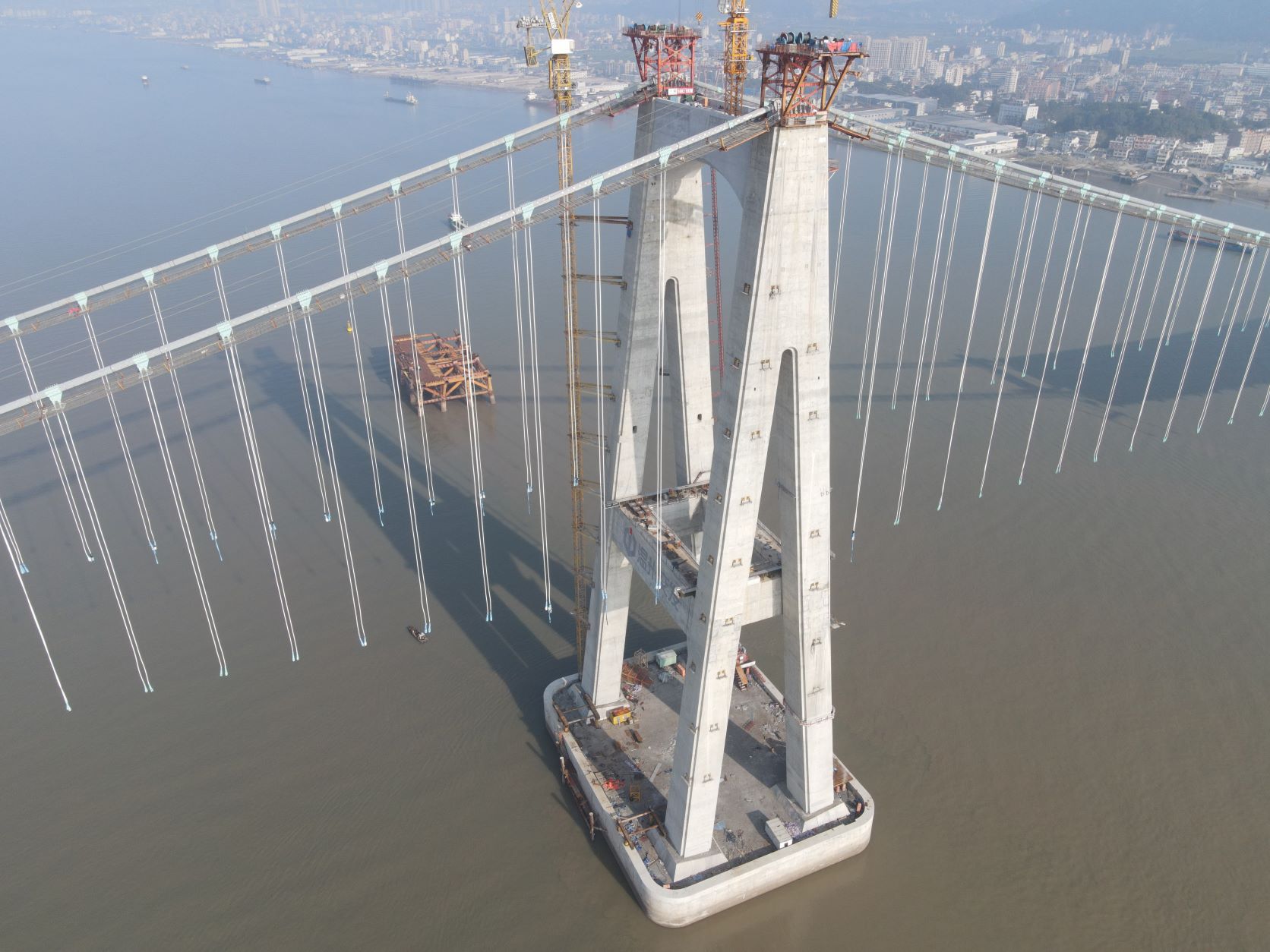 The inverted V-shaped central pylon
The north pylon foundation is located onshore and the south pylon behind the front line of a planned wharf. This not only meets the height limit demand, but meets hydraulic and environment-protection requirements. Furthermore, it reduces the difficulty of foundation construction and the risk of ship collision.
A gravity anchor was selected for the north anchor because in that area the bedrock is exposed. At the central pylon’s location, the water depth is about 15m, with a geological upper layer of around 45m of silt, and a layer of pebbles below. Accordingly, the design for the foundation compared two possible schemes, one with an open caisson and another consisting of a group of piles. From the perspective of engineering cost and mitigating ship impact, the open caisson foundation was selected.
In the area of the south anchorage there is a weak 63m-deep layer and a pebble layer beneath with good bearing capacity. Due to the presence of this thick soft layer, and the fact that the pebble layer has high water permeability, an open caisson foundation was adopted. An H-shaped concrete pylon design with grouped piles was chosen for both north and south pylons based on engineering cost and experience.
The 12 lanes of the Oujiang Beikou Bridge were specified due to the high traffic demand of the freeway and the national highway. A steel truss scheme and a flat three-part steel box girder scheme were considered, but in the end a 12.5m-high Warren truss was chosen, based on wind resistance, structural stiffness and practical experience. Lifting points are located at the exterior side of the transverse beam at the lower chord of the stiffening girder to increase the rise-to-span ratio of main cable, which is 1:10. The bridge span arrangement is 230+800+800+348m, with a four-span continuous structure.
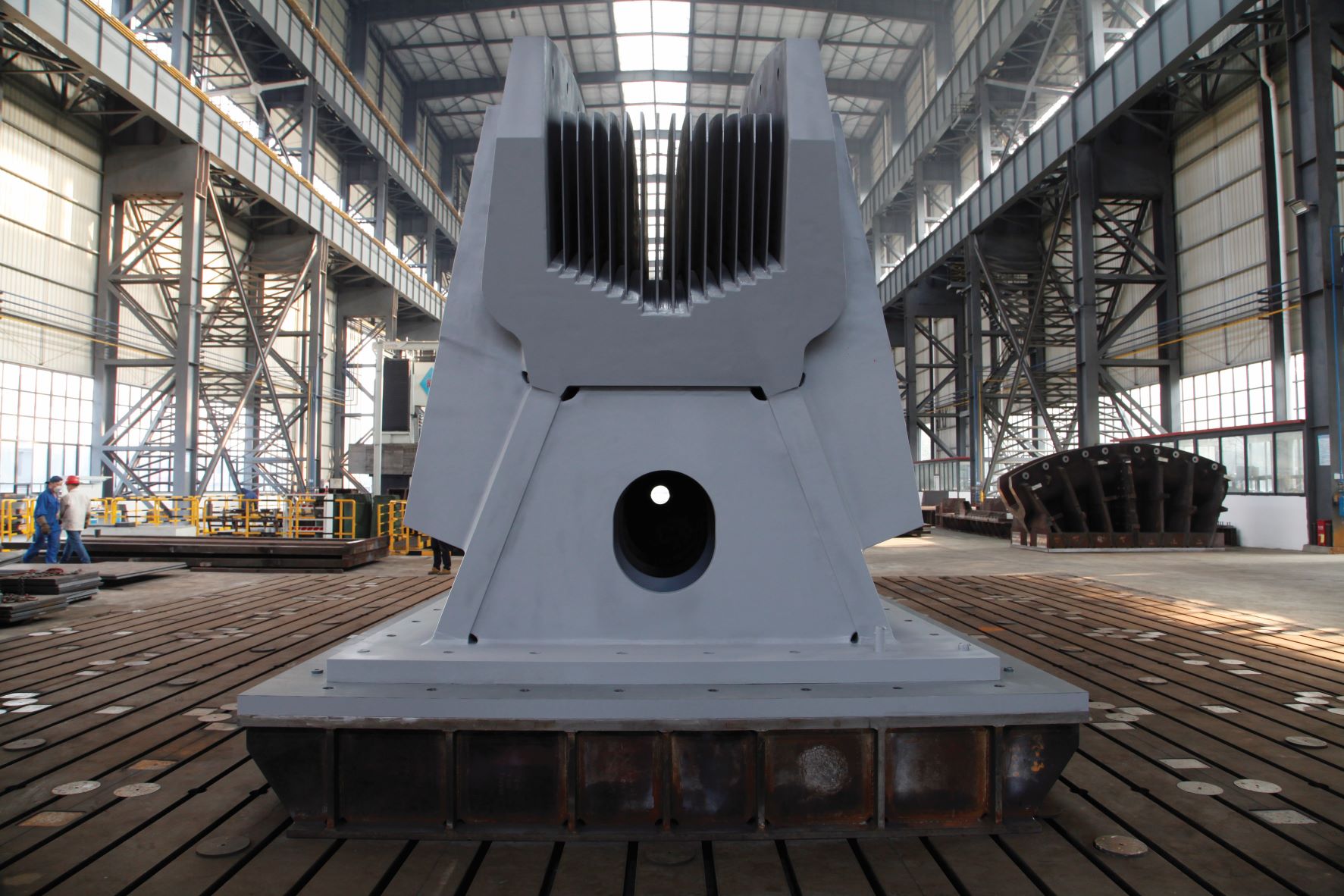 A vertical friction plate saddle replaced the traditional cable saddle design
In China, other three-pylon suspension bridges have mainly used either steel pylons or combined steel-concrete pylons in order to achieve a reduction in the stiffness of the central pylon, which reduces the unbalanced horizontal forces of the main cables on both sides of it. Due to this bridge’s location in an estuary affected by tides and typhoons, and the need for high corrosion and wind resistance, a central concrete pylon was considered a better solution.
The concrete pylon offers good corrosion resistance, less maintenance, and has wind flutter stability that is 30% higher than that of a steel pylon, as well as costing US$20.5 million less. Through preliminary research, an inverted V-shaped pylon with moderate stiffness was selected.
The central concrete pylon increases the overall stiffness of the structure, making non-slippage of the main cable and saddle at the pylon a huge technical challenge. As a consequence, a large number of experimental studies were jointly carried out in 2014 by Zhejiang Institute of Communications and Southwest Jiaotong University, resulting in the implementation of a vertical friction plate saddle instead of a traditional solution.
With this design, vertical friction plates replace the spacers of the typical saddle, and their lower sections are welded to the saddle with a penetration weld that is 12-16cm thick. This improves the overall anti-slip capacity of the cable saddle, as verified by testing. At the same time, we have proposed a method for calculating the nominal friction coefficient of the cable saddle, which for this bridge reaches 0.39 and corresponds to an anti-slip safety factor above 2.63. Through the development of a high-friction cable saddle and the central inverted V concrete pylon, the three-pylon suspension bridge achieves an overall stiffness of 1/605, and flutter stability in wind speeds of 114m/s.
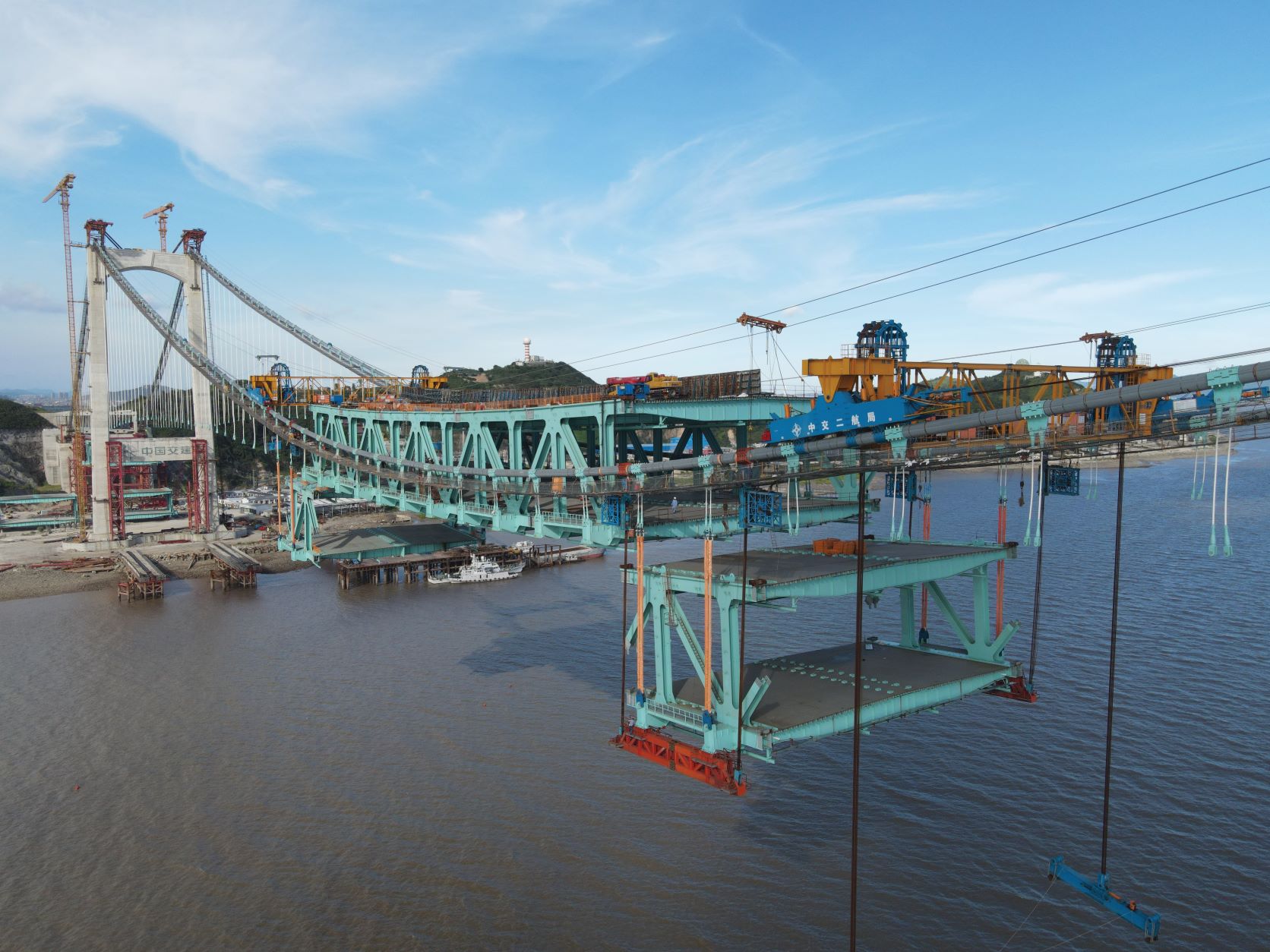 A section of the stiffening girder is lifted into place at the middle span
Construction of the bridge began on 4 January 2017 and is progressing with the installation phase of the stiffening girders, which are expected to arrive on site this year.
Of note are the open caisson foundations of the bridge’s central pylon and southern anchorage, which are the first mega open caisson foundations to be implemented in deep soft soil geological conditions.
After the first open steel caisson of the central pylon had been assembled in the factory, it was transported to the central pylon for placement. Concrete was then poured into the shaft wall; soil excavated for sinking; the next section of open steel caisson connected; and the construction cycle completed when the open caisson had been sunk to the specified level.
For the onshore open caisson of the south anchorage foundation, after pile treatment of the upper soil layer, the first steel shell open caisson was assembled on site and then the concrete poured on top to the required height. After connecting the next section of the open steel caisson, the soil was excavated for sinking, with the construction cycle completed when the open caisson had been lowered to the specified level. A variety of machinery was used for this sinking stage and, after encountering different soil layers including silt and muddy clay, it can be said that the difficulties related to caisson-sinking under complicated geological conditions were overcome. The caisson foundation for the central pylon was completed on 5 November 2019 and on 24 March 2020 for the south.
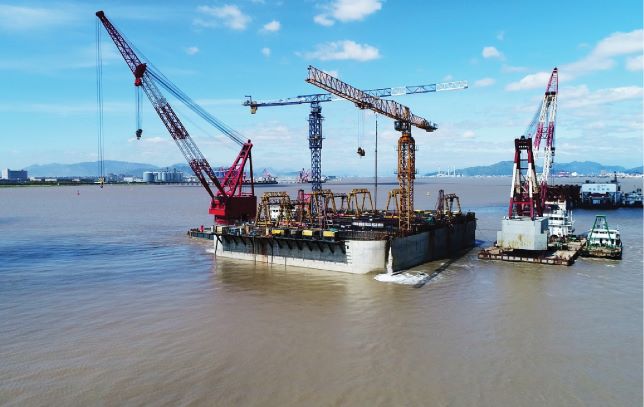 The open caisson for the central pylon’s foundations was laid on deep soft soil
In order to achieve high quality welds between the friction plate and the saddle body in the narrow and deep space at the bottom of the cable groove, a narrow-gap welding robot was created. The welding quality was verified as first-class through ultrasonic phased array inspection.
The prefabricated parallel cable strand erection method was used for the main cable and to ensure its correct installation in the narrow and deep cable groove of the high friction cable saddle of the central pylon, a special robot was developed to guide the strand.
The robot greatly improved the erection efficiency and quality of the main cable unit. It took only 41 days to complete the erection of 169 full-length cable strands and six back cable strands (single cable), setting a new record. The main cable was erected using a scale strand positioning method that had been developed by the research team of Southwest Jiaotong University. It enabled the precise positioning of the main cable strands even during drastic daytime temperature changes, improving the efficiency of their erection.
The lifting point of this bridge is set in the lower cross-beam, which causes a great challenge for the installation of the stiffening girders. Floating crane and cable crane installation options were studied and the latter was chosen in accordance with navigational safety and economic considerations. The middle girder section at the intersection of the main girder and the main cable was lifted by split-type cable cranes and large integral-type cable cranes. The lifting capacity of the split cable crane is 350t with a raising speed of 7.5m/s. The lifting capacity of the integral cable crane is 1,000t with a speed of 15m/s.
The detailed steps were as follows: First, the integral cable cranes were used to lift the stiffening girder from the barge. Second, the stiffening girder was connected to the permanent hanger with a temporary extension sling. Next, the integral cable crane moved forward and the split crane was installed to lift the stiffening girder to the design position. The temporary extension sling was removed and the stiffening girder connected with the permanent hanger.
After the efforts of many parties, the first stiffening girder was safely installed on 13 July 2021. The other sections were installed using integral cable cranes and the installation of the stiffening girders was completed on 16 December 2021.
BIM technology was used throughout the design and construction of the project. During the construction phase, BIM was used to manage all construction elements, such as personnel, machinery, materials, management and environmental protection, thus realising the project in terms of quality, safety and schedule management. Upon completion, the BIM platform will be converted for use during bridge operation and maintenance.
Technological innovation in the design and construction of Oujiang Beikou Bridge has enabled advancements in knowledge as regards the structural stiffness of central pylons in multi-pylon suspension bridges, and new approaches to cost reduction for these bridges.
The construction phase overcame the difficulties of open-caisson construction on deep soft ground and the impact of several typhoons, not to mention the hindrance caused by the Covid-19 pandemic. Builders are currently working to complete the bridge in time for it to open to traffic as planned in 2022.
Changjiang Wang is senior engineer and Gang Xiao is engineer at Zhejiang Institute of Communications. Ji Pan is engineer at Wenzhou Oujiang Estuary Bridge Co