
The works carried out over the last few months have seen cable stays and respective anchorages removed completely for a thorough evaluation of their condition. A total of three cable stays have been replaced by Freyssinet, the suppliers of the original cable system, for concessionaire Chamber of Commerce and Industry (CCI) of Le Havre.
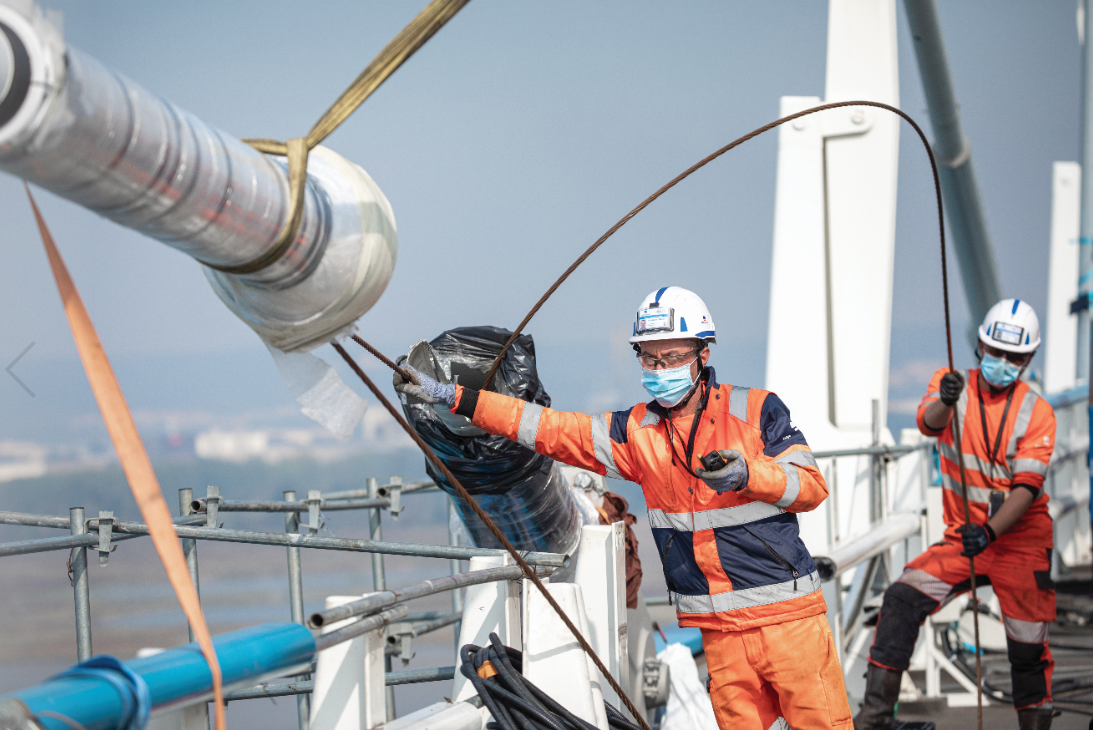 Conventional strand de-tensioning was not possible (Alexis Toureau)
The 2.1km-long Pont de Normandie has a 856m-long main cable-stayed span supported by 214m-high pylons. The 184 stay cables range in length between 95m and 460m and contain 31, 44 or 53 strands. The concession for Pont de Normandie – which was added to an existing 75-year concession for Pont de Tancarville – ends in 2027, when it will be either extended or retendered. Around 7 million vehicles cross the toll bridge each year, a three-fold increase from the amount that crossed when the bridge opened in 1995. At that time, one of the innovations of the crossing was the redundancy that had been designed within the cable-stayed system, enabling individual cables to be removed in order to facilitate maintenance and to minimise closures – a feature that had been fully made use of by the end of December 2020.
The project’s overall aim was to qualify the health of the bridge, which had been constructed with an expected 100-year service life. The already heavily instrumented bridge received an upgraded structural health monitoring system in 2018. Around 200 sensors are currently in place, including GPS, weather stations and acoustic monitoring on the cable stays. Millions of signals are received per second and analysed by the sophisticated cloud-based Bridgewatch system supplied and managed by James Fisher Testing Services.
As stay cables and anchorages are the elements deemed to be the ones most susceptible to local environmental conditions at the Seine Estuary, these were the focus of the project. The area is not only extremely humid and windy but is also exposed to high levels of sulphur from a refinery and chemical complex in the Port of Le Havre, 10km away.
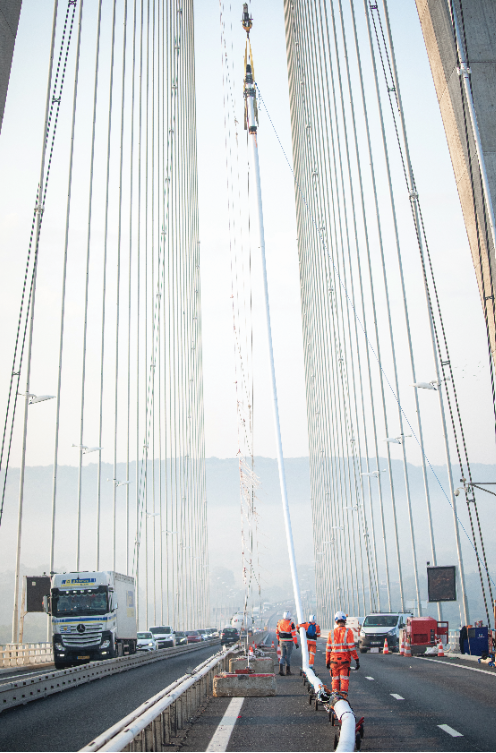
Work on site began in May 2020 (Alexis Toureau)
The scope of the planned tests went beyond typical industry practice of assessing a number of individual strands from a stay cable. For the Pont de Normandie, the aim was to entirely remove three cable stays and their anchorages. The anchorages on the deck, explains Matthieu Guesdon, head of Freyssinet’s stay cable technical division, are the element where the highest stresses are experienced, “It is where all the factors are combined, geometrical deviation, fatigue, everything. The anchorage is the most critical point of the stay cable.” The existing anchorages were not designed to be visually inspected internally, adds Clément Fasquel, CCI deputy director of concessions, “The idea was to get a better understanding of the condition of the anchorages, where it is not possible to see inside, and to get a good correlation between ultrasonic measurements and other inspection methods that are performed from the outside, which would then lead to statistically comparable results.”
Work on site began in May 2020 following a three-month delay caused by the pandemic. The removal operation of the first stay cable revealed some technical issues that needed to be resolved prior to proceeding to the second and third stays. Cable de-tensioning presented an immediate issue, because the stays had not been installed with over-lengths, says Guesdon: “On both cable ends, the strand tail behind the anchorage block was cut quite short, a few centimetres. It was not possible to perform strand de-tensioning with conventional methods involving jacks and stools, as the strand length outside the anchorage was insufficient for the equipment to grip the strand anywhere.”
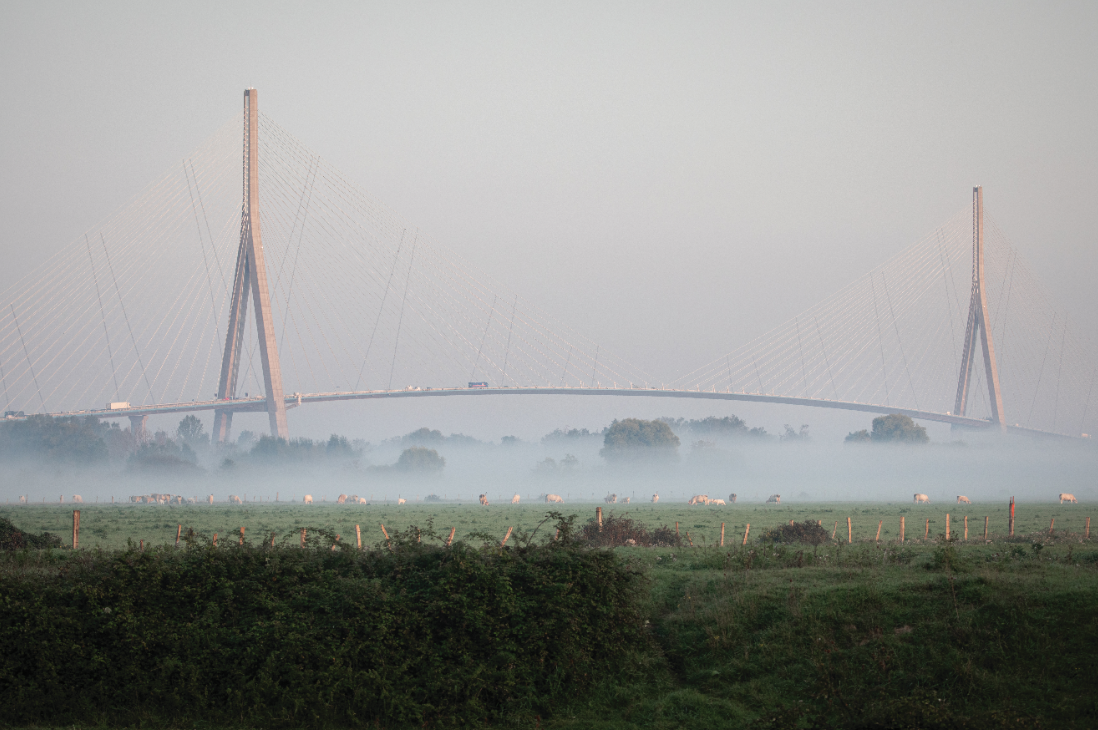 The Pont de Normandie was designed with redundancy within the cable-stayed system – an innovation at the time (Alexis Toureau)
An initial de-tensioning method was discarded due to the effect that the resulting release of energy had on the existing condition of the anchorage and the strands to be tested, disrupting the strand’s setting in the anchor jaws. “This possibility was monitored with the first method, and as we saw too much displacement at the jaws we decided to proceed with the second method,” says Fasquel. A progressive release method was then introduced that used a clamp system in the cable free length, in combination with a system of chain blocks connected to the bottom anchorage. “This allowed the tension in the strand to be cut to be bypassed, and the strand tension to be released slowly,” says Guesdon, adding “It was a better control solution that eliminated any cutting-derived effects on the gripping condition at the wedge, so as to ensure subsequent testing was relevant.”
While stay cable de-tensioning provided plenty of engineering challenge, in practice the most difficult part of operations was dealing with the interconnected system of cross ties that prevent wind-induced vibration on the cable stays. There are four stabilising cables per cable fan, says Guesdon, and they too have a tensile implication on the cable set-up. “The cross ties cables impose a defined geometry for the cable, and especially at crossing locations where cross-tie collars provide a connection in between the cables, therefore making a full cable network. While this network brings significant dynamic benefits, it also complicated the replacement operations a lot.”
This meant that during cable replacement the rope workers were needed at each connection between the cross-tie systems. New methods and equipment had to be developed to deal with the connections between the cross ties and stay cables; for erection of the stay ducting in several sections; and for enabling transversal shifts into the cable network. The geometry of the cable network required the cable adjustments to be made with a high accuracy, all at heights of up to 200m above deck. “We had to rely on the rope walkers to do these jobs for us, they were our hands, heads and eyes,” says Guesdon.
By December 2020, the three stays had been replaced and finishing works were being carried out on site, such as wax injection at the anchorages and removal of temporary equipment. As is common in refurbishment projects, the replacement cables and anchorages were upgraded. The most important improvement related to enhanced water-protection for the new anchorages, which is via a new continuous ducting system that prevents any water run-off penetrating the anchorage from the stay cable, and includes condensation drainage.
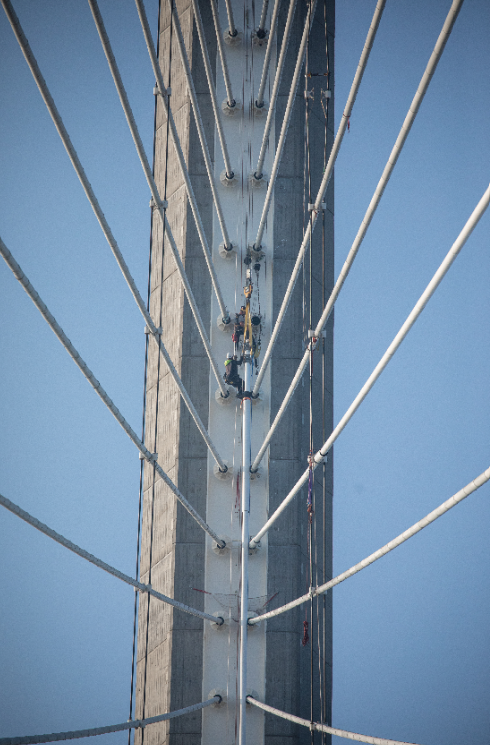
Accurate adjustments were needed at heights of up to 200m (Alexis Toureau)
By the time the three new cable stays had been installed, a number of strands and strand sheaths had been examined; high-definition images and corrosion measurements taken; and tensile strength and fatigue tests carried out. “We have qualified the level of corrosion in the anchorage. We have tried to understand its distribution, and the impact on the resistance of the strands,” says Fasquel. “We are nearly at the end of the project, we just need to compile all the information for conclusion at the end of March,” says Fasquel. Results are encouraging, he says. “So far we have found good correlation between the inspection methods and the analysis. It is good confirmation that ultrasonic measurements are effective when carried out in the right manner.”
However unusual and in-depth the assessment on Pont de Normandie may be, it is not the only such project Freyssinet is undertaking. “As a cable specialist, we can feel directly the impact of the recent bridge collapses. There have been strong messages from the authorities to bridge owners and operators that we have felt too. We have many ongoing investigations as a result of the realisation that cable-stayed bridges are assets that need looking after.” A number of such projects are located in France but also abroad, in India, where some of the techniques and methods learned during the latest project will come in useful. “Now everybody is working towards better knowledge of the condition of their bridges.” As well as providing an excellent assessment of the condition of the Pont de Normandie, the project has delivered methods, expertise and experience for carrying out stay-cable replacements both on this bridge – if needed again in the future – and other similar structures.
The bridge returned to normal operations in January, over a month ahead of schedule.