Installation of dampers at bridge deck level on stay cables is the most common countermeasure for increasing the structural damping of cables and reducing vibration. Until recently the most common solution was to install hydraulic or viscous dampers between the stay cable and the deck, near the anchorage.
This solution can be as simple as on the Brotonne or Elorn bridges in France, or the Erasmus Bridge in the Netherlands, or it can be more complex such as the solution devised for the Normandy Bridge. These solutions have the advantage of being easily accessibile for maintenance operations, but in some cases their aesthetic qualities could be open to critcism. Other systems on the market are designed to be installed without being connected to the deck, as a ring around the cable.
The damper is installed in the steel anchorage guide pipe which is embedded in the concrete deck or within a steel support pipe that extends the anchorage guide pipe. Viscous dampers consist of freely-moving plates or rings in a viscous, silicon-like material which ensures the dissipation of energy. But they have a disadvantage in that the damper characteristics depend on temperature and the frequency of cable vibration.
All these types of dampers may be subject to small, non-critical vibrations on an almost permanent basis, and they will very quickly have to support a high level of cycles. Consequently they may experience rapid deterioration and require frequent maintenance operations. To answer these major problems of fatigue and maintenance, VSL has introduced the friction damper. Friction vibration absorbers have been designed in 1973 and installed on some structures like chimneys and buildings.
Professor I Kovacs developed this concept for cables and a first generation of friction damper was installed in 1996 on the stay cables of Badajoz Bridge. VSL has now worked with him to develop a second generation of these friction dampers for use on suspended structures. These dampers have a number of advantages (see box). The friction damper connects a specified point of the cable with the bridge structure and it consists of two parts. The first is a steel collar that is rigidly fixed to the cable and moves as the cable moves. The main elements of this collar are the two wings that project transversely to the cable plane, and four hard friction 'partner' components that are attached to the top and bottom sides of the wings.
The second part consists of two spring blade half-ring pairs that are rigidly fixed to the bridge structure, both of them circling the cable. Four soft friction 'partner' components which are pressed against the hard friction partners are held by the spring blade rings through an inwardly-projecting plate . When the cable vibrates, friction forces and damping reactions are produced between the soft and the hard friction partners, to counteract the cable movement.
The flexibility of the spring blade rings allows the soft friction partners to follow the longitudinal movement of the cable and remain in permanent contact with the hard friction partners, and the friction force of the damper is constant. All the component parts of the friction damper are fixed. For aesthetic resasons, the damper is generally placed near the anchorage. The vibration amplitude at the damper point of the cable is then not more than 1 or 2mm. Any play or flexibility in the unit would lead to loss of the efficiency. Some damper designs are not compatible with these small cable amplitudes and have to be placed at a greater distance from the anchorage. The new damper works in any direction of cable motion. At small amplitudes the friction parts are designed to stick and hence prevent the damper from coming into play. Dampers are adjusted so that they begin sliding as soon as a predefined amplitude of cable deformation is reached. The analysis of the friction damper is based on the classic 'galloping' theory.
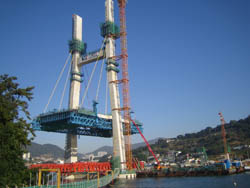
As an example, the cable stability on one of the stay cables equipped with a friction damper on the Gdansk Bridge in Poland has been measured. When the vibration amplitude of the cable reaches 50mm the friction damper starts to work and increases the damping of the cable from 0.006 to 0.048. The characteristics of the damper were defined to have a safety factor of two applied to the excitation, and the friction force was adjusted to 3.6 kN.
The efficiency of the damper was calculated by considering the flexibility of the damper support. If the support is too flexible, it can reduce the efficiency of the damper quite dramatically. For higher modes of vibration, the efficiency is the same as for the first mode but with a different starting amplitude. Characteristics have been checked by considering some variation in the friction force. The damping force can be adjusted on the cable during the periodic maintenance operations on the bridge.
Long-term performance of these new dampers has been assessed to some degree on the Uddevalla Bridge in Sweden. A total of 120 friction dampers were installed on the stay cables of the Uddevalla Bridge in 2000. After two years of service, 25% of the dampers were investigated to check their condition. During the two-year period since the opening of the bridge to car traffic, the structure has been subjected to varying speed winds, from low to high, and no cable vibration has been observed.
Each of the 30 controlled friction dampers was partially dismantled and re-assembled after examination of its components. All the necessary operations of control and adjustment of the damper characteristics were achieved in situ. The friction damper is covered, at the deck, by an anti-vandalism pipe. Access to the damper is easy but it was necessary to use a small mobile crane to dismantle the anti-vandalism pipe.
After this pipe was dismantled, the dampers were found to be in good condition and it was not deemed necessary to replace any of the friction pads. The visual examination of the sliding plates allowed the movement of the friction pads to be assessed and demonstrated that the cables had been subjected to small movements.
Dismantling and reassembly of the friction partners was achieved easily and allowed a detailed examination of all the components. Once the damper had been reassembled on the cable, the friction force was able to be easily adjusted to the recommended value for each damper. This maintenance operation confirmed the ease with which each element of the unit could be examined and replaced, if necessary. The performance that was measured for the friction dampers after the first two years has led to a predicted design life for the friction partners of more than 15 years.
Absorbing application
The main advantages of this new type of friction damper are the following:
* The damper is not activated for small and non-critical vibration amplitudes, which means that wear is reduced and maintenance costs are kept low.
* The friction damper is designed to be easily installed on existing bridges where cables are subject to unexpected vibrations.
* All components of the damper are accessible and can be easily inspected and replaced, if necessary, during maintenance operations.
* Characteristics of the damper can be easily adjusted during maintenance operations.
* The friction forces are practically constant and independent of the speed of the point to be dampened.
* The damping characteristics are insensitive to the frequency of the vibrations and to the temperature.
* Dampers can be placed at a closer to the anchorage in order to improve the aesthetics.