
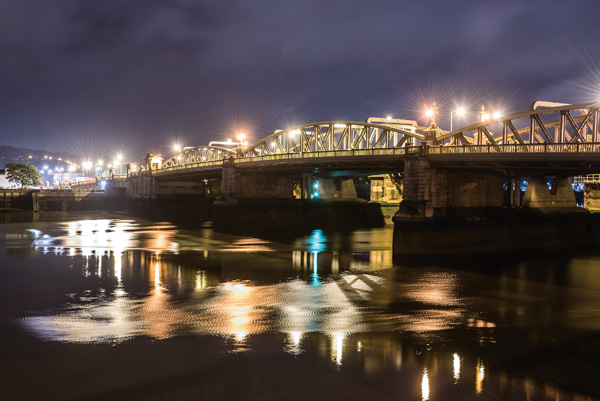
Rochester Old Bridge at night, by Rob Gilbert
Renovation works on three bridges in Rochester – a town 50km south-east of London, England – are approaching the half-way mark, with numerous steps taken to minimise disruption to traffic. For nearly two millennia there has been a crossing over the tidal River Medway in Rochester. The first was built by the Romans soon after the invasion of 43AD and lasted until 1381, when it collapsed and was replaced by a stone arch bridge. Today, there are four bridges between Rochester and Strood: three owned by the Rochester Bridge Trust and one, a railway bridge, by Network Rail.
The New Bridge and Service Bridge were completed in 1970 on Victorian foundations. The New Bridge is a two-lane crossing carrying highway traffic eastwards from Strood and consists of a reinforced concrete deck resting on twin welded steel box girders. The Old Bridge was originally built in 1856 as a cast-iron structure, but was then reconfigured into its current steel bowstring truss form in 1914. Between the two is the Service Bridge, a concrete and steel structure that carries pipes and cables across the river.
The three 200m-long estuary bridges are currently undergoing repair and refurbishment with the objective of putting them in the best possible condition for the next 20-30 years while minimising non-routine intervention. The Rochester Bridge Refurbishment Project started in April 2019 and is scheduled for completion by the end of this year. The works are being carried out by FM Conway under a single contract to minimise disruption to the community and avoid the undertaking of multiple projects over many years.
As part of the contract, the original 1970s parapets of the New Bridge and its expansion joints, which have reached the end of their serviceable life, are being replaced. Original street lighting, drainage system and kerbs are also being updated, while the deck will be resurfaced and the box girders recoated. The Service Bridge is to receive a new roof and coat of paint, in addition to steel and concrete repairs. On the Old Bridge, the traditional 100-year-old ornate lighting is to be sympathetically replaced and enhancement lights added to the bowstring trusses. New expansion joints will be fitted and the deck resurfaced. Repairs will also be carried out to masonry and brickwork under the deck.
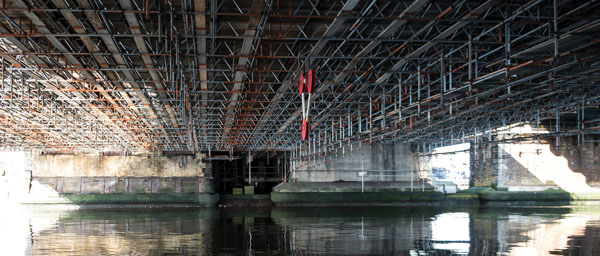
Underdeck works take place under all three structures in parallel
While the refurbishment plan has many aspects in common with similar projects, what is unusual about the current works is that they have all been designed to put bridge users first, ahead of contractor convenience or cost minimisation.
This approach is due to the Rochester Bridges Trust’s unique funding position, which allows it to take a very long-term view (see box, opposite). Cost is considered in terms of the whole-life of structures rather than as an immediate cash outlay, which has a direct influence on procurement decisions.
Consequently, finding creative ways to maximise lane availability while carrying out work safely and to the highest quality is the top priority. On a practical level, this means that only one bridge at a time can have carriageway restrictions, an approach that has been applied rigorously during the project. For instance, the New Bridge’s two lanes are maintained in each direction throughout the day while parapets are replaced.
The complex refurbishment schedule is loosely split into New Bridge and Service Bridge; Old Bridge; and Esplanades, the latter comprising sections running from the Old Bridge along the river bank on either side.
In-situ works thus began in April 2019 on the upstream side of the New Bridge, with replacement of the parapet followed by refurbishment of the adjacent Service Bridge, taking advantage of traffic management. The road layout was then rearranged in November to enable work on the downstream side. In parallel, works are currently under way on the underdeck of all three bridges, and on the footway of Rochester Esplanade.
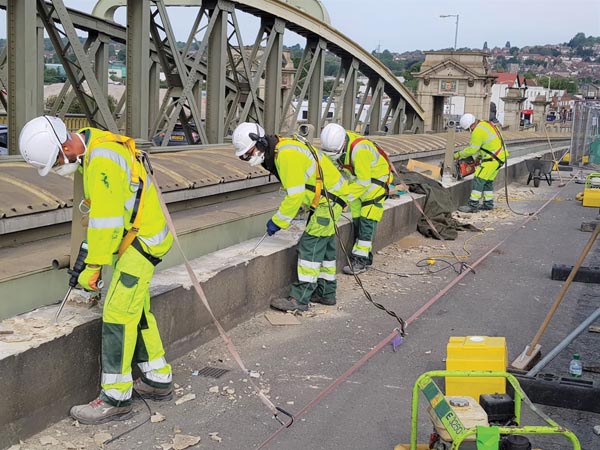
New Bridge parapet removal works, by Awnesh Sothiratnam
The replacement of the New Bridge’s parapets also presented the opportunity to separate the integral lamp columns, improve the style of lighting and meet the safety and environmental standards for a crossing over a major tidal river. The new equipment will also be easier to maintain, which will reduce any disruption for repairs in the future. Approximately 80% of the New Bridge has now been switched over to LED, with just each end of the bridge remaining.
Another focal point of the project is the installation of new lighting for the Old Bridge and Esplanades, which is being manufactured by heritage-project specialist Metcraft Lighting to designs by Arcadis and DW Windsor. This part of the work entailed the removal of examples of existing lanterns, brackets, and a pedestal in the Autumn of 2018, to form the basis for prototypes. These prototypes were essential both for technical approval and to reach compliance with the Listed Building Consent – required due to the historical status of the structure. Approximately 70 lanterns and 30 other decorative fixtures have been manufactured ready for installation later in the year. The lanterns have an IP65 dust and water ingress protection rating, which should ensure the longevity of the lanterns and reduce maintenance.
Another heritage-sector specialist, PAYE Stonework and Restoration, is currently carrying out a mixture of engineering works that range from new elements on the New Bridge, to conservation and repair on the Old Bridge, which includes new granite balustrades at each end of the bridges.
The entire project is being undertaken under the Considerate Constructors Scheme (CCS), whose objectives align with the Trust’s. Both FM Conway and the Trust are registered participants in the scheme, which helps to drive continuous effort to improve and deliver best practice in managing a site and ensures that work reflects what is important to our local community, and not just what a contractor might do elsewhere. The CCS carries out regular visits that are attended by contractor and client, offering opportunities to review progress and indentify even more opportunities to improve.
This approach is reflected by a site that is clearly delineated and maintained. Multi-logo hoarding and encapsulation are used as required and daily boundary checks and litter sweeps are carried out. The positive appearance of the workforce is also a priority, with logo-branded PPE in good order, and a clear hard-hat colour scheme to aid identification. The fact this is the joint commitment of client and contractor is significant because it helps to reinforce the importance of these actions.
The workforce is encouraged to report near-misses and positive safety interventions, with the total periodically added up and a donation presented to the Lighthouse construction charity by the contractor, match-funded by the Trust. An occupational health service regularly visits the site, with anyone involved with the project able to make an appointment.
Furthermore, the client’s project manager and supervisor are both co-located on the site, which gives rise to open communication channels. This is a good opportunity to resolve issues and share ideas – often in the large canteen and welfare facility, which include shower and laundry facilities.
Meanwhile, the works contract has been integrated into the Trust’s own programme of engagement with schools and young people. Tours and events are organised for groups from nursery age upwards, alongside careers talks and activity sessions, and the contract requires the contractor to work with the Trust to deliver these initiatives, with financial incentives available to maintain focus.
Liaison with the community forms an important part of the project, as shown by the efforts of the public liaison officer at FM Conway, whose role is to establish and maintain relationships with bridge users through regular newsletters, emails and face-to-face visits. In parallel, a dedicated area of the Trust’s website informs and updates the public, including a regular Bridge Engineer’s Blog written by the Trust’s team which provides more details of current activities. The blog is shared on social media, along with photo ‘journeys’ through the site, to appeal to a wide range of people with varying levels of experience. The blog generates much general interest as well as interesting questions, all of which assist the Trust in selecting what additional information to share. It is particularly gratifying when members of the public show an interest in areas of the project that had only been thought to appeal to civil engineers.
Other initiatives include a 100% recycling target for construction waste. Environmental information is, therefore, being collected to share with the public once the project is at a more advanced stage.
This refurbishment aims to demonstrate that good engineering is about so much more than just completing the task at hand. It takes a whole project approach, taking note of the past, consideration of the present and preparing for the future, all while embracing best practice across the board.
Sue Threader is chief executive, Rochester Bridge Trust
The 500-year maintenance plan of the Rochester Bridge Trust
The Rochester Bridge Trust is a medieval charity that was founded in 1399 to maintain the crossing at no cost to the public in perpetuity. The foundation formalised arrangements for maintenance which date back to at least the eighth century, and probably from the fall of the Roman Empire.
The Trust does not charge tolls or receive any funds from local or central government. When the Trust was founded, endowments of land and money were made by 14th and 15th-century benefactors. These have been carefully managed and extended, and it continues to own a significant portfolio of investment property across England which generates its income.
Financial planning is carried out on a 500-year basis, ensuring there will be funds available to maintain the bridges to a high standard and to eventually replace them at no public cost. The Trust sets out what maintenance is needed and at what intervals, ie annual, 10-year, 20-year, 50-year, replacement, and then the projects ahead in the coming centuries together with the other costs of running the Trust. Income, capital growth returns and the impact of inflation are then estimated based on past performance and industry statistics, with projections made for the next 500 years.
Standard economic discounting is used to identify costs and income at current values. This gives an idea of the impact of spending now on the ability to meet long-term (effectively perpetual) liability for the bridges. It identifies how much the Trust needs to raise from investments to ensure it never runs out of funds. In practice this actuarial variation also enables the Trust to identify any surplus above what is needed for the bridges, quantifying how much can be safely invested in grants and other projects without compromising them.
This approach to financial modelling means the Trust can support an extensive range of engineering education projects for children, grants for heritage structures and other charitable projects.
The Trust is widely recognised for its leading work with primary schools and the support of civil engineering education.